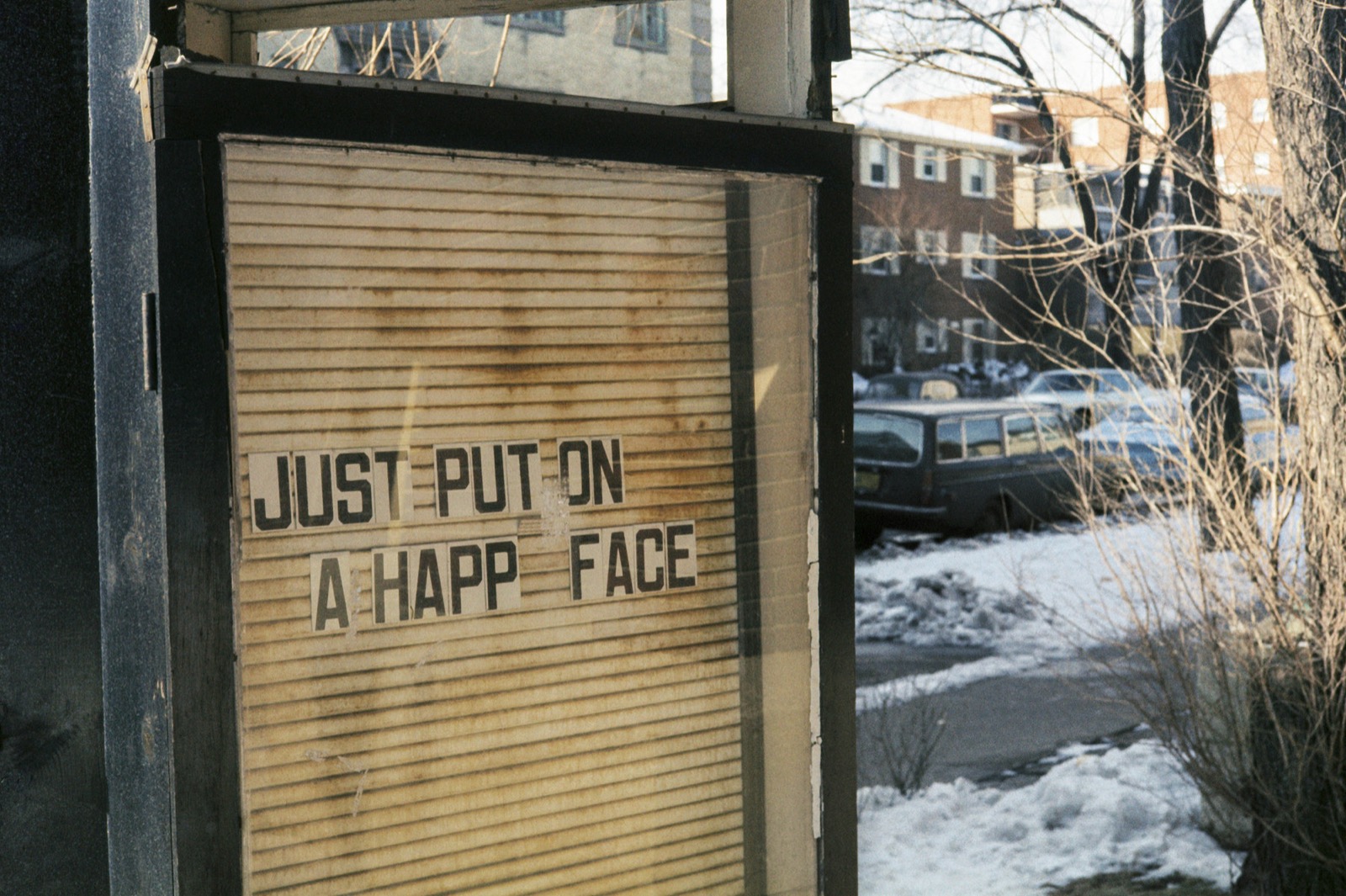
To photograph a sign is to photograph a wish. The letterboard here issues its order in pressed plastic — JUST PUT ON / A HAPP FACE — and the order has already failed: the Y is gone, the smile arrives with a tooth missing. Vivian Maier did not correct the spelling and did not soften the irony. She set the lettering tight against ribbed wooden panelling and let the low February sun rake the grain, so that every water stain and dent reads as wear on a surface meant to look cheerful. The instruction to perform contentment is itself worn out.
A photograph of an injunction is never neutral; it records both the demand and our distance from it. Past the sign, Chicago declines to play along — a wood-panelled station wagon nosed to the curb, leafless trees, brick walk-ups, a gritted ridge of melting snow. Kodachrome warms the ochre and rust against the blue of winter shade, a warm surface over a cold day, and the public exhortation must share the frame with an indifferent street. The image does not editorialize. It merely shows the gap between what we are told to feel and what the weather permits.
This was Maier's discipline: to find the sign that accidentally tells the truth, and to photograph it from behind her own withheld face. Two decades of Chicago, well over a hundred thousand negatives, none of it shown in her lifetime — an archive amassed by someone who refused to be looked at while she looked. Drawn from her color work and editioned to fifteen by the estate, this chromogenic print belongs with Arbus and Winogrand in its suspicion of the cheerful, and it leaves the command unanswered. Someone meant the happy face. No one here is wearing it.
To photograph a sign is to photograph a wish. The letterboard here issues its order in pressed plastic — JUST PUT ON / A HAPP FACE — and the order has already failed: the Y is gone, the smile arrives with a tooth missing. Vivian Maier did not correct the spelling and did not soften the irony. She set the lettering tight against ribbed wooden panelling and let the low February sun rake the grain, so that every water stain and dent reads as wear on a surface meant to look cheerful. The instruction to perform contentment is itself worn out.
A photograph of an injunction is never neutral; it records both the demand and our distance from it. Past the sign, Chicago declines to play along — a wood-panelled station wagon nosed to the curb, leafless trees, brick walk-ups, a gritted ridge of melting snow. Kodachrome warms the ochre and rust against the blue of winter shade, a warm surface over a cold day, and the public exhortation must share the frame with an indifferent street. The image does not editorialize. It merely shows the gap between what we are told to feel and what the weather permits.
This was Maier's discipline: to find the sign that accidentally tells the truth, and to photograph it from behind her own withheld face. Two decades of Chicago, well over a hundred thousand negatives, none of it shown in her lifetime — an archive amassed by someone who refused to be looked at while she looked. Drawn from her color work and editioned to fifteen by the estate, this chromogenic print belongs with Arbus and Winogrand in its suspicion of the cheerful, and it leaves the command unanswered. Someone meant the happy face. No one here is wearing it.