Sarah Moon turned fashion photography into something closer to séance. A model herself before she moved behind the camera in the late 1960s, she abandoned the crisp certainties of commercial work for grain, blur and a soft, failing light, reviving the spirit of Pictorialism and the nineteenth-century photograph for a contemporary stage. Her images do not record garments so much as summon apparitions; they belong as much to memory and dream as to the season's collections.
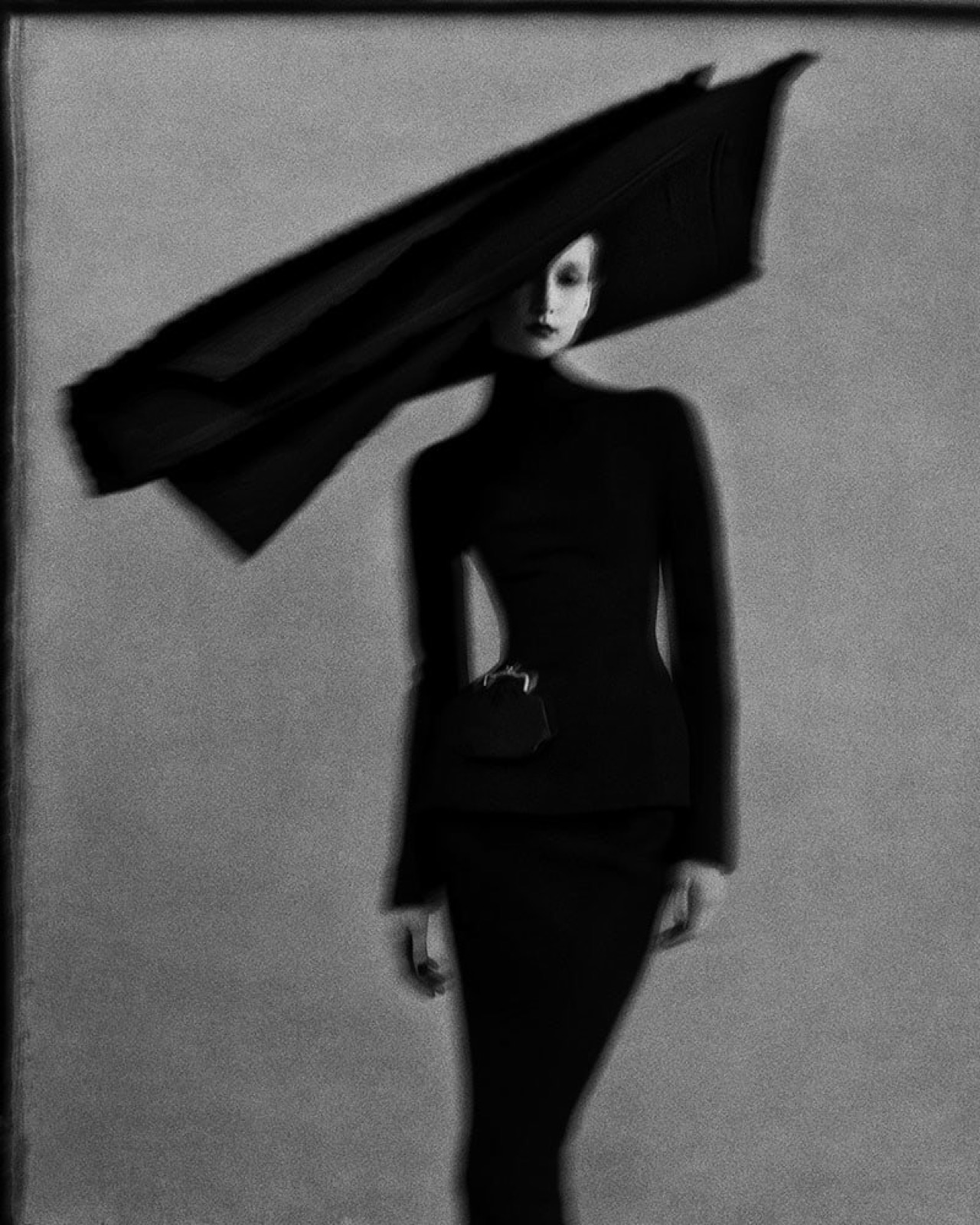
This 1999 photograph for John Galliano's Christian Dior is pure, hushed theatre. A severe black silhouette stands against a soft grey ground, the waist drawn impossibly tight, the figure crowned by a great hat tilted like a dark wing — or a blade — above a face that hovers, pale and spectral, at the threshold of vanishing. Nothing is fully described; everything is suggested. The drama lives in shadow, in the velvet weight of the blacks and the trembling indistinctness of the surface.
It is the perfect meeting of two romantic imaginations: Galliano's couture, with its historical theatre and melancholy grandeur, and Moon's painterly refusal of the literal. Where most fashion photography insists on desire as clarity, Moon offers desire as mystery — the allure of what cannot quite be seen. The result feels less like a document of 1999 than a fragment recovered from some older, dreamed century, and it carries the quiet authority of an artist who made atmosphere itself her medium, and longing her enduring subject. Long since embraced by the fine-art world — the Fondation Cartier, the Pirelli calendar, the museum wall — Moon dissolved the border between commerce and art until the two could no longer be told apart.
Sarah Moon turned fashion photography into something closer to séance. A model herself before she moved behind the camera in the late 1960s, she abandoned the crisp certainties of commercial work for grain, blur and a soft, failing light, reviving the spirit of Pictorialism and the nineteenth-century photograph for a contemporary stage. Her images do not record garments so much as summon apparitions; they belong as much to memory and dream as to the season's collections.
This 1999 photograph for John Galliano's Christian Dior is pure, hushed theatre. A severe black silhouette stands against a soft grey ground, the waist drawn impossibly tight, the figure crowned by a great hat tilted like a dark wing — or a blade — above a face that hovers, pale and spectral, at the threshold of vanishing. Nothing is fully described; everything is suggested. The drama lives in shadow, in the velvet weight of the blacks and the trembling indistinctness of the surface.
It is the perfect meeting of two romantic imaginations: Galliano's couture, with its historical theatre and melancholy grandeur, and Moon's painterly refusal of the literal. Where most fashion photography insists on desire as clarity, Moon offers desire as mystery — the allure of what cannot quite be seen. The result feels less like a document of 1999 than a fragment recovered from some older, dreamed century, and it carries the quiet authority of an artist who made atmosphere itself her medium, and longing her enduring subject. Long since embraced by the fine-art world — the Fondation Cartier, the Pirelli calendar, the museum wall — Moon dissolved the border between commerce and art until the two could no longer be told apart.