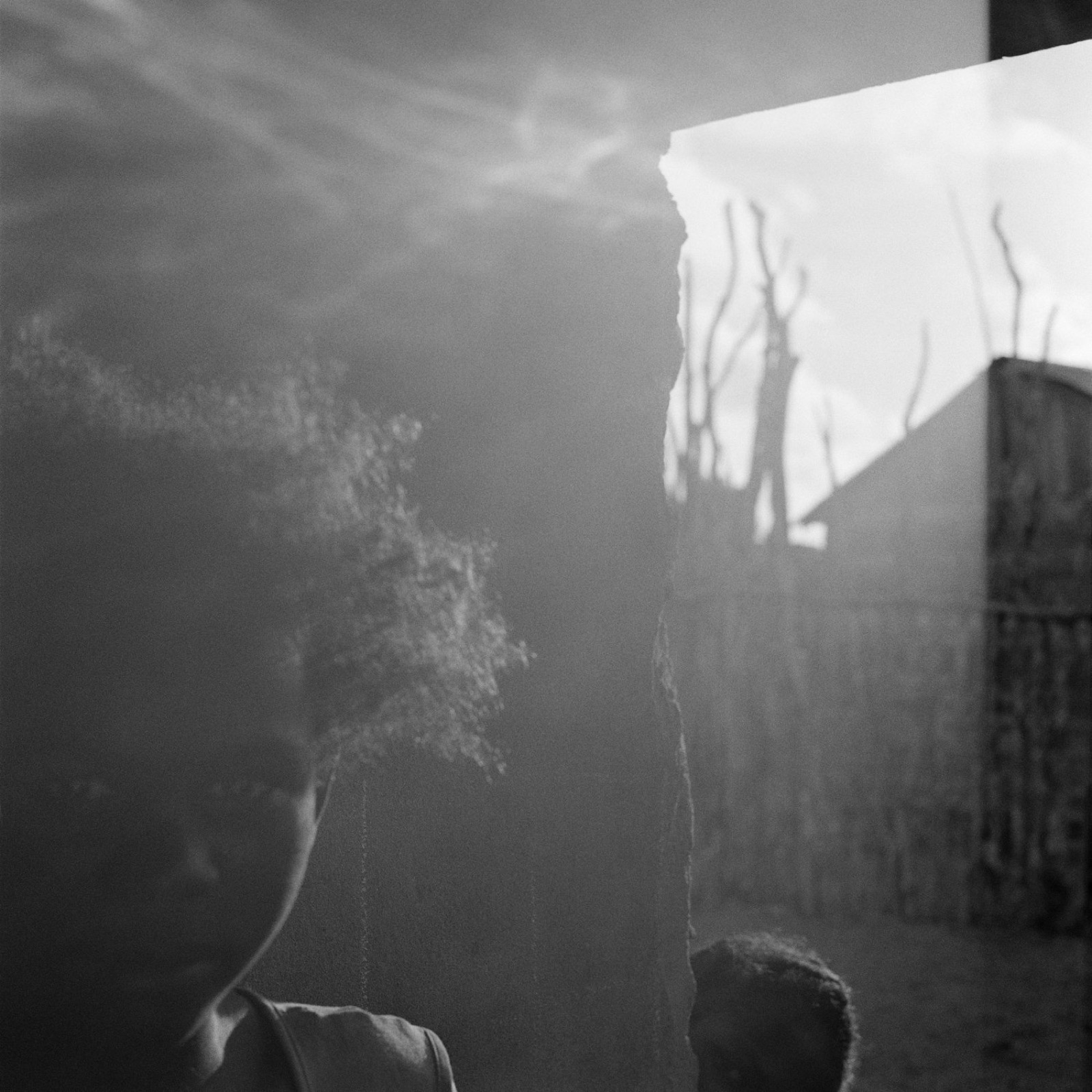
A torn edge runs down the middle of the frame, the deckled rip of paper or of light, and it divides the picture the way a wall divides a yard: on one side a child's face surfacing from shadow, on the other a brighter world where a small standing figure stands among bare branches that reach up like fingers into a pale sky. The two halves belong to one another and refuse to meet. This is what Pancho Saula has called Family, and the title is both a promise and a question.
Look at the child on the left. The light catches only the rim of the cheek and a corona of hair, so that the face seems to be deciding whether to be seen. A second small head rises into the lower edge, near, almost touching, yet kept from us. To photograph children in another country is to risk turning them into a lesson, and Saula declines the lesson. He gives us instead the ordinary mystery of two people who are related to each other and to a place we are only passing through. Madagascar, where he made these frames in five quick days with a Rolleiflex, is not offered as spectacle. It is a quality of afternoon light, a fence, a far roof, a tree.
The doubling is not an accident of the eye but of the negative: the bright panel reads like a window cut into the dark, a memory laid over the present. Printed in gelatin silver and toned with selenium, the blacks hold their depth and the highlights take on a faint metallic breath. What stays with me is the reaching of those branches, and how the standing child seems to have wandered into them, already half a story. Family, the picture suggests, is the thing we are inside of and cannot quite picture whole.
A torn edge runs down the middle of the frame, the deckled rip of paper or of light, and it divides the picture the way a wall divides a yard: on one side a child's face surfacing from shadow, on the other a brighter world where a small standing figure stands among bare branches that reach up like fingers into a pale sky. The two halves belong to one another and refuse to meet. This is what Pancho Saula has called Family, and the title is both a promise and a question.
Look at the child on the left. The light catches only the rim of the cheek and a corona of hair, so that the face seems to be deciding whether to be seen. A second small head rises into the lower edge, near, almost touching, yet kept from us. To photograph children in another country is to risk turning them into a lesson, and Saula declines the lesson. He gives us instead the ordinary mystery of two people who are related to each other and to a place we are only passing through. Madagascar, where he made these frames in five quick days with a Rolleiflex, is not offered as spectacle. It is a quality of afternoon light, a fence, a far roof, a tree.
The doubling is not an accident of the eye but of the negative: the bright panel reads like a window cut into the dark, a memory laid over the present. Printed in gelatin silver and toned with selenium, the blacks hold their depth and the highlights take on a faint metallic breath. What stays with me is the reaching of those branches, and how the standing child seems to have wandered into them, already half a story. Family, the picture suggests, is the thing we are inside of and cannot quite picture whole.