Series: St. Louis
Archival pigment print. Printed later.
Edition of 20
20 x 24 in / 50 × 60 cm
Edition of 10
30 x 40 in / 76 × 101 cm
Edition of 5
48 x 60 in / 121 × 152 cm
Edition of 3
60 x 75 in / 152.4 x 190.5 cm
20 x 24 in / 50 × 60 cm
Edition of 10
30 x 40 in / 76 × 101 cm
Edition of 5
48 x 60 in / 121 × 152 cm
Edition of 3
60 x 75 in / 152.4 x 190.5 cm
Hand-signed by artist, mounted, titled, editioned and print date in ink label affixed to mount verso
© The Artist

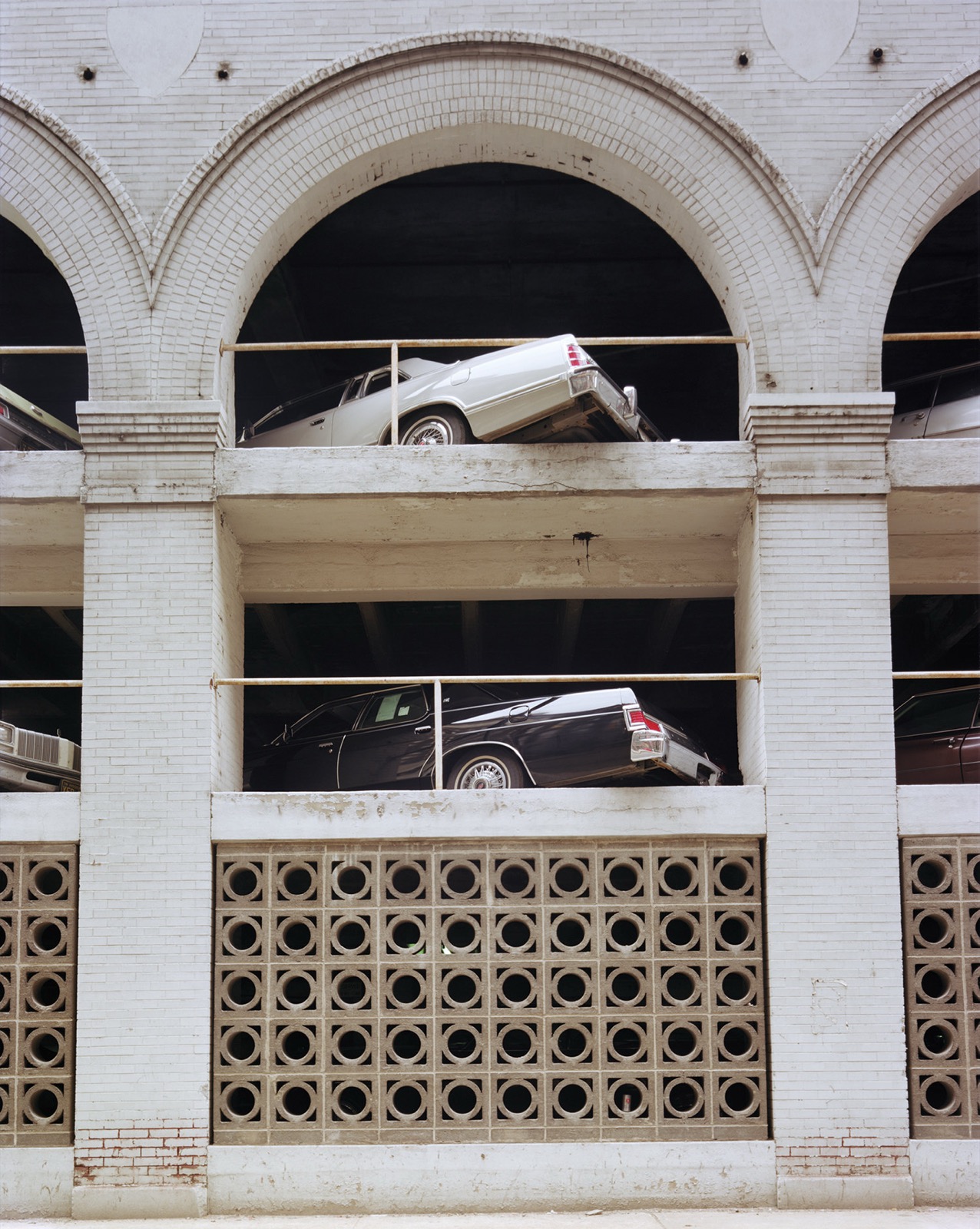
Two cars, caught mid-climb, noses tipped up at exactly the angle of a swimmer about to dive or a dog begging for a biscuit. That's the thing that gets me here: parked cars are the most inert objects on earth, and yet Meyerowitz has found a parking garage where the cars look like they're going somewhere, straining up the ramps behind those white-brick arches as if the building itself were daydreaming about flight. The lower one, dark and finned, has just crested its slope; the pale one above is still on the way up. Nothing is moving. Everything is about to.
You could file this under his St. Louis pictures — the city he'd remember for its strange spaciousness, the way you could look between the buildings and see "block after block of missing pieces." Here the spaciousness has gone inward, into the open mouths of a garage, the arches framing the gloom like a cloister that took a wrong turn into the twentieth century. And down at the bottom, that band of decorative breeze-block, hundreds of little concrete portholes, the cheapest possible gesture toward grace on a structure whose only job is to store metal. I love that he gave it equal billing with the cars.
This is 1978, the moment color photography was being argued into the museum, and Meyerowitz was one of the people doing the arguing — not with manifestos but with prints like this, where the dirty whites and bruised shadows do work black-and-white simply couldn't. The picture's funny and then, a beat later, it isn't: those tilted cars start to feel like something stranded, hopeful, a little absurd, which is roughly how it feels to be a person.