Series: Photojournalism
Gelatin Silver Print.
Printed in 2025.
Image: 20 x 30 cm / 7 7/8 x 11 3/4 in / Paper: 30 x 40 cm / 11 3/4 x 15 3/4 in
Frank Horvat Estate dry stamp, signed and authenticated by Fiammeta Horvat with title and edition number in pencil on verso
© The Artist
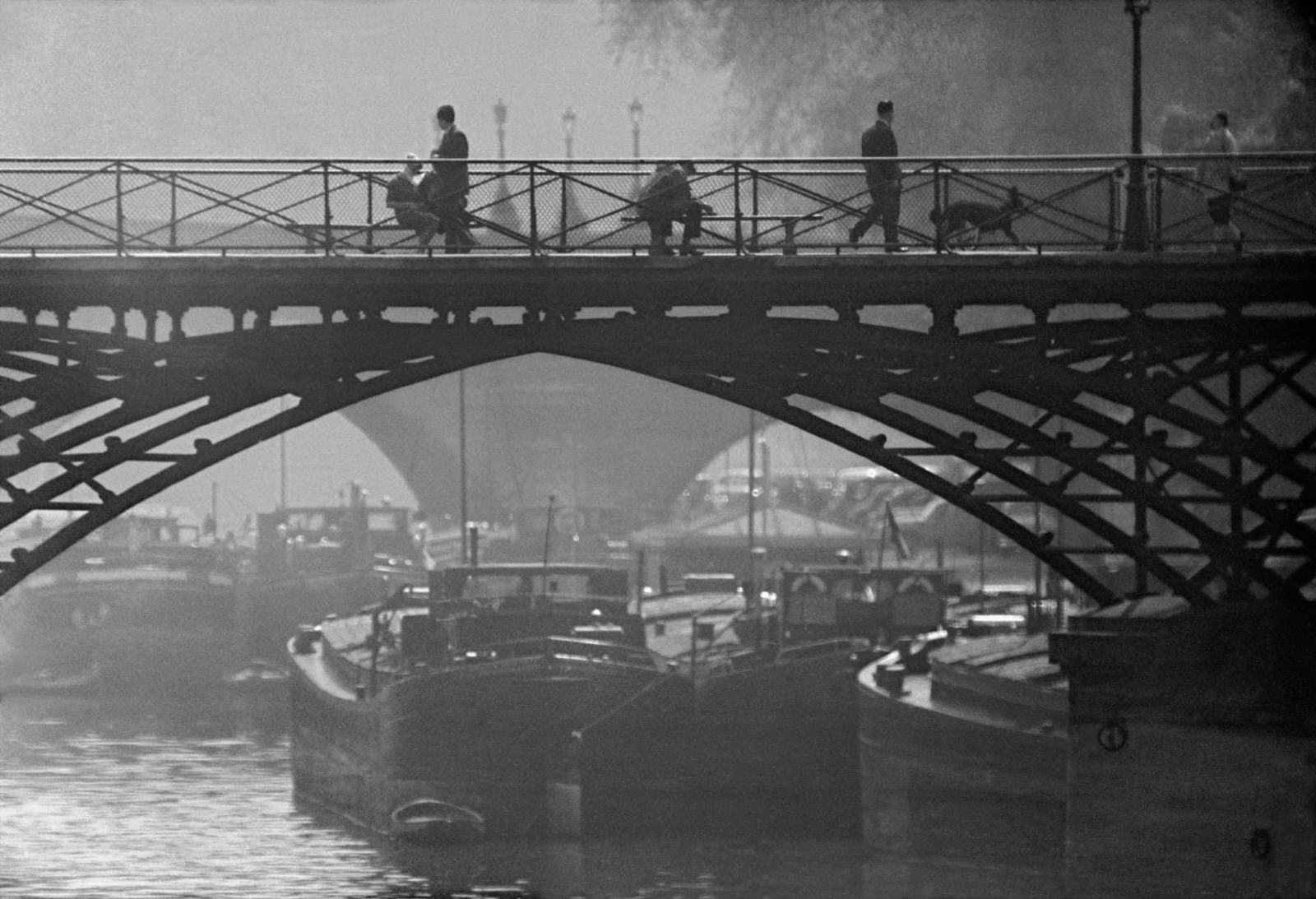
A long lens does the decisive work here, and it is worth dwelling on what it accomplishes. Horvat trains his telephoto down the Seine until the Pont des Arts no longer reads as a span we might cross but as a thin horizontal ledge, a frieze on which figures are arrayed in profile: a man bent over his reading on the bench, a second crouched at the rail, a walker keeping pace with a small dog that trots ahead toward the right edge. Behind and below them the great steel arch of the next bridge swings up out of the haze, and the moored barges, dark and patient, are pressed almost level with the strolling pedestrians. The lens has flattened the river's depth into a single stacked plane.
Horvat made the picture in 1956, a year after settling in Paris, and it belongs to the body of personal street work he pursued alongside the fashion assignments that would soon make his name. One sees in it the lesson absorbed from Cartier-Bresson—the patience to wait at a distance until the geometry resolves—turned to a cooler, more graphic end. The morning mist bleaches the lampposts and the far trees to pale silver, so that the wrought-iron lattice of the footbridge and the riveted ribs beneath it stand out as pure drawing against the gray.
It is a quietly historical image as well: the working barges record a Seine still given over to commerce, a postwar Paris caught in the last years before the river emptied of its freight. Horvat holds the documentary fact and the formal music in the same frame, which is precisely why these 1956 Paris photographs endure.