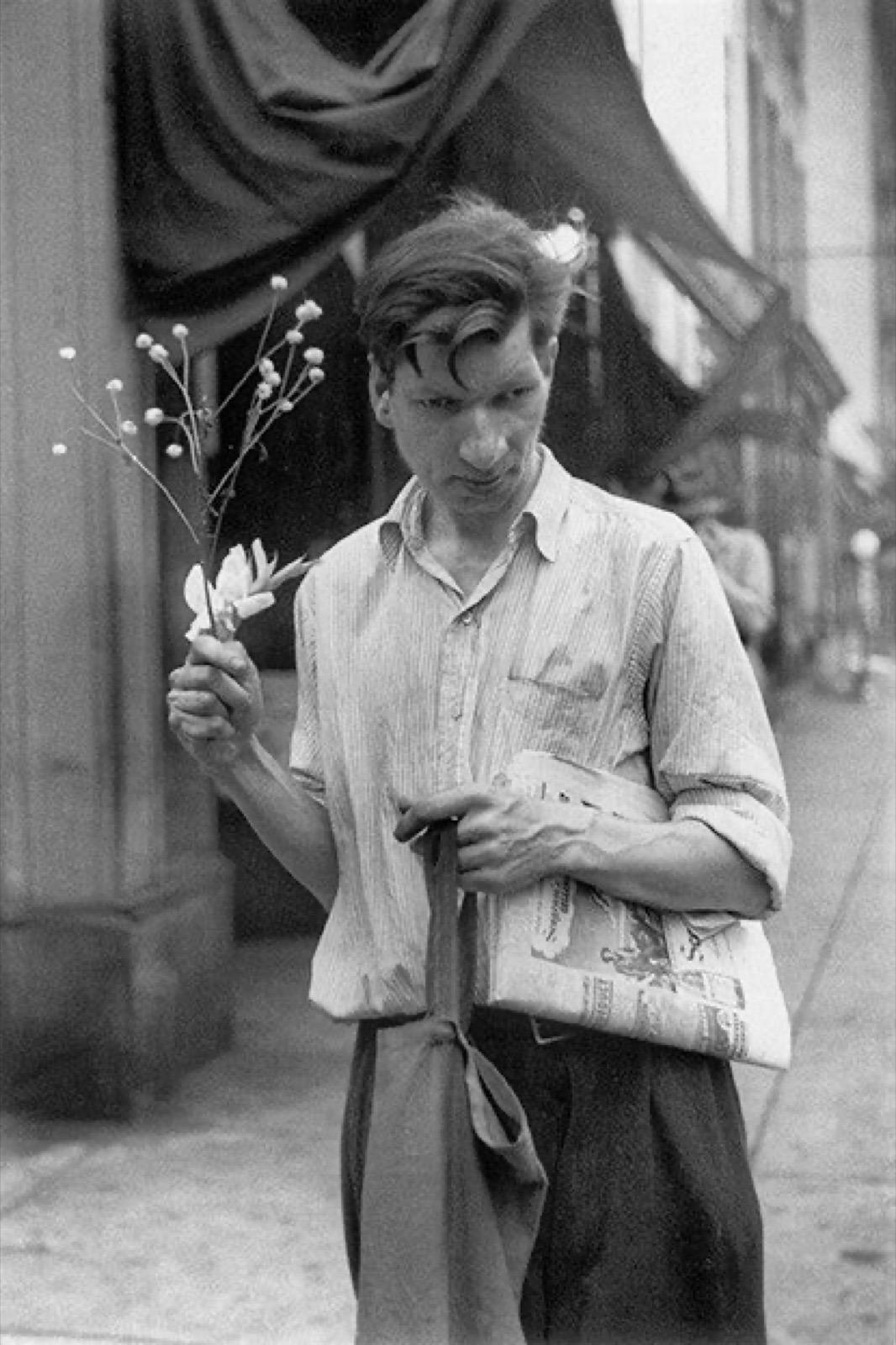
A man can hold tenderness and ruin in the same two hands. Eddie stands on a New York sidewalk in 1948, thin in a striped open-collared shirt, and in his raised right hand he grips a slender flowering branch — pale blossoms on bare twigs, lifted almost to eye level — while his left hand clutches a rolled newspaper against his belly. He looks down and slightly away, mouth set, the daylight catching the gauntness of his cheek and the loose fall of his hair.
Louis Faurer found his subjects among the unhoused and the marginal of midtown, and Eddie belongs to that company: a figure most people on the block would have walked past, or past whom they were already walking. Behind him a swag of dark fabric drapes a storefront, and an awning recedes down the street. The frame gives him nothing soft to lean on, only the hard verticals of the city, against which the flowers read as something he has decided to carry rather than something he has been given.
The photograph refuses to settle into pity. The branch in his fist is not a prop of sentiment but evidence of a private grammar, a man composing himself with whatever beauty the street allows. Faurer photographs him at full standing height, dignified, neither cropped into a case study nor flattered into a saint. The blossoms will not last the afternoon. The newspaper carries yesterday's news. Eddie holds both, and for the length of one exposure refuses to let either of them go.
A man can hold tenderness and ruin in the same two hands. Eddie stands on a New York sidewalk in 1948, thin in a striped open-collared shirt, and in his raised right hand he grips a slender flowering branch — pale blossoms on bare twigs, lifted almost to eye level — while his left hand clutches a rolled newspaper against his belly. He looks down and slightly away, mouth set, the daylight catching the gauntness of his cheek and the loose fall of his hair.
Louis Faurer found his subjects among the unhoused and the marginal of midtown, and Eddie belongs to that company: a figure most people on the block would have walked past, or past whom they were already walking. Behind him a swag of dark fabric drapes a storefront, and an awning recedes down the street. The frame gives him nothing soft to lean on, only the hard verticals of the city, against which the flowers read as something he has decided to carry rather than something he has been given.
The photograph refuses to settle into pity. The branch in his fist is not a prop of sentiment but evidence of a private grammar, a man composing himself with whatever beauty the street allows. Faurer photographs him at full standing height, dignified, neither cropped into a case study nor flattered into a saint. The blossoms will not last the afternoon. The newspaper carries yesterday's news. Eddie holds both, and for the length of one exposure refuses to let either of them go.