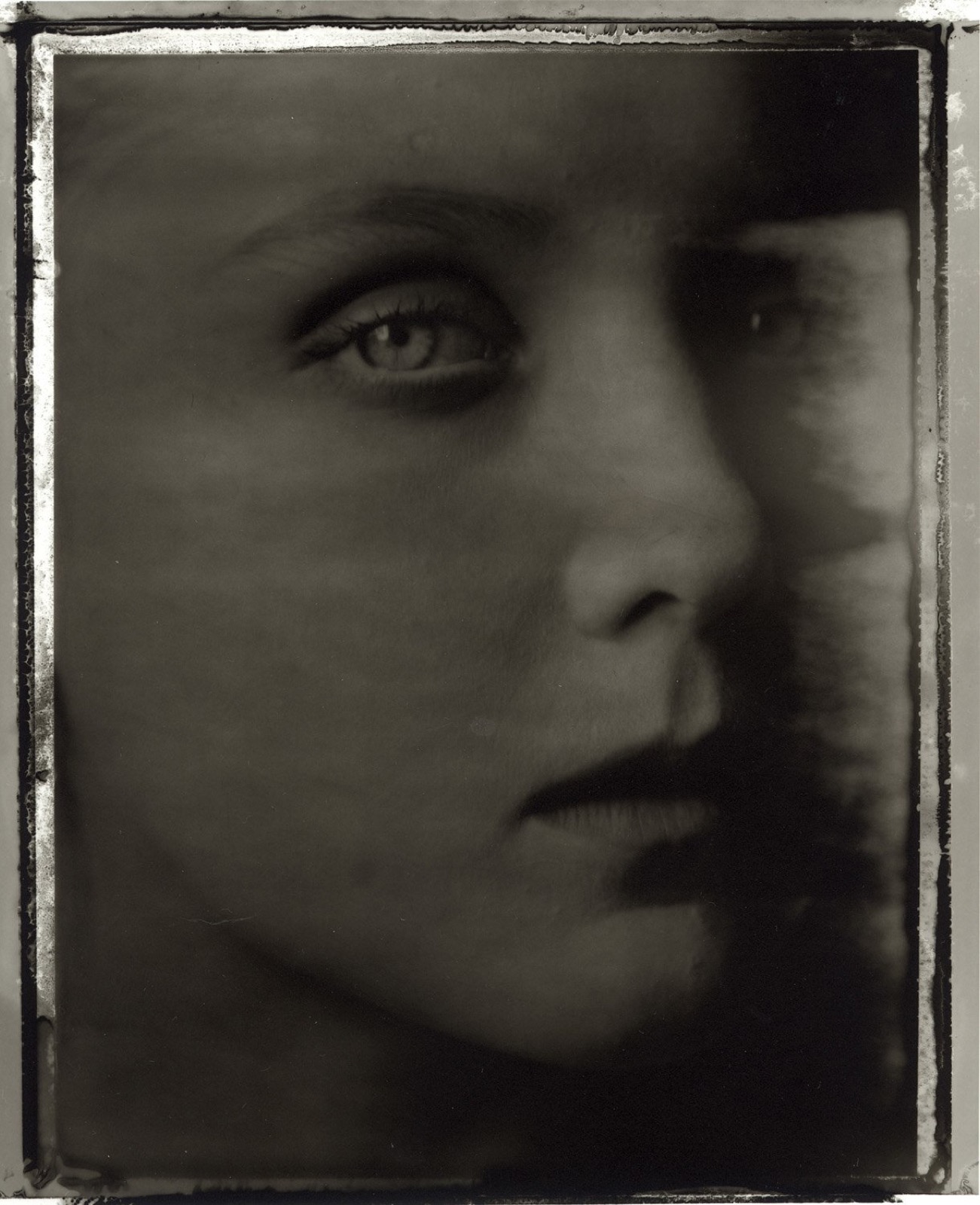
The eye. I begin there because I cannot do otherwise — it has already chosen me. The studium is plain enough: a woman's face, Julia Stouvenel, drawn too close in 1989, the silvery grain Sarah Moon prefers to the lacquer of fashion, the black corroded borders that confess a print made and barely rescued by hand. All this I can name, classify, admire. It interests me. It does not catch and hold me.
What catches and holds me is the wet, pale, startled iris in the upper left, lashes still sharp while the whole lower face drowns. This is the punctum: not that she looks, but that one eye stays awake inside a face already dissolving. The mouth has gone into shadow; the right cheek streaks downward as if the emulsion were sliding off the plate, abandoning her even as she arrives. She surfaces and withdraws in the same grey breath, and the detail that snags me is precisely this — that I cannot tell whether I am watching her appear or watching her leave.
Moon stood before the camera herself in the 1960s before she stepped behind it, and something of that earlier exposure lingers: the image does not pose, it remembers. Her prints from these years rest in the Maison Européenne de la Photographie, rarely surfacing at this hushed, intimate scale. To keep one is to keep a face that refuses to settle — a small wound that does not close.
The eye. I begin there because I cannot do otherwise — it has already chosen me. The studium is plain enough: a woman's face, Julia Stouvenel, drawn too close in 1989, the silvery grain Sarah Moon prefers to the lacquer of fashion, the black corroded borders that confess a print made and barely rescued by hand. All this I can name, classify, admire. It interests me. It does not catch and hold me.
What catches and holds me is the wet, pale, startled iris in the upper left, lashes still sharp while the whole lower face drowns. This is the punctum: not that she looks, but that one eye stays awake inside a face already dissolving. The mouth has gone into shadow; the right cheek streaks downward as if the emulsion were sliding off the plate, abandoning her even as she arrives. She surfaces and withdraws in the same grey breath, and the detail that snags me is precisely this — that I cannot tell whether I am watching her appear or watching her leave.
Moon stood before the camera herself in the 1960s before she stepped behind it, and something of that earlier exposure lingers: the image does not pose, it remembers. Her prints from these years rest in the Maison Européenne de la Photographie, rarely surfacing at this hushed, intimate scale. To keep one is to keep a face that refuses to settle — a small wound that does not close.