Ramón Masats Spanish, 1931–2024

Terrassa, 1953.
Series: Where it all began
Gelatin Silver Print. Printed later.
Image: 30 x 30 cm / 11 3/4 x 11 3/4 in / Paper: 50 x 40 cm / 19 3/4 x 15 3/4 in
Masats Estate dry stamp, signed and authenticated by Sonia Masats with title and edition number in pencil on label affixed to print verso
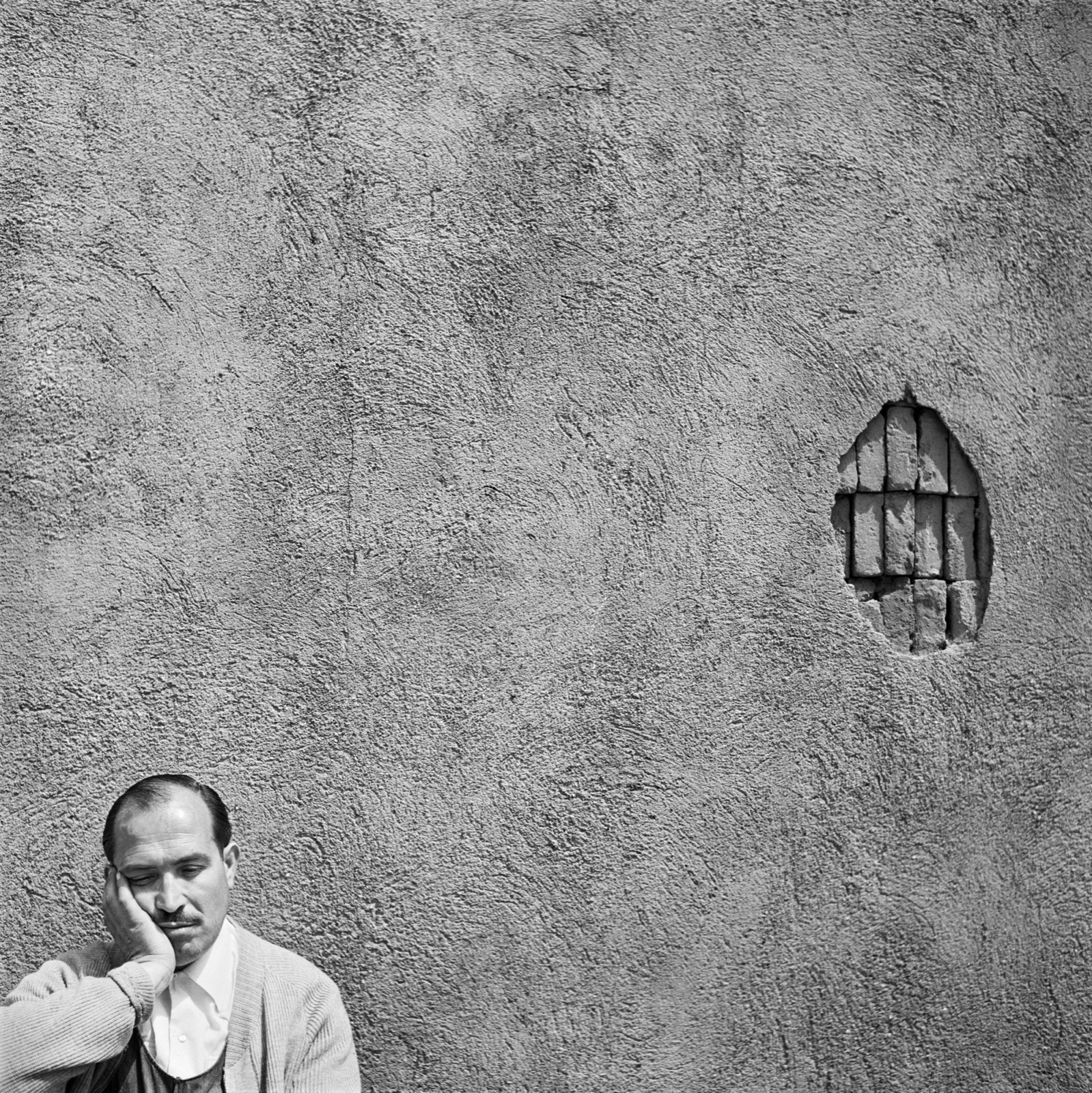
Most of this picture is wall. A great expanse of stucco, raked by light into a topography of nicks and trowel marks, fills nearly the whole square, and a photographer with ordinary instincts would have walked past it. Masats instead made it the subject. He gave the man—seated at the bottom left, cheek folded into his open hand, cardigan loose at the shoulders—a single corner, and let the rest of the frame go to plaster. The risk is plain: empty a picture this far and it can simply fall apart. This one does not. It holds because two small things answer each other across all that grey.

One is the man's tilted, half-closed face. The other, up at the right, is a ragged window-shaped hole where the rendering has broken away to show the brick beneath, its bars of shadow oddly echoing the bones of a face. The eye travels the diagonal between them, and in that crossing the wall stops being background and becomes the picture's weather. The square format, which refuses to favor either figure, keeps the two poised. Neither dominates; both are held in suspension by the surface between.

What the camera describes here is exact and unsentimental: the grain of cheap render, the particular slump of a man with time on his hands, the way a flaw in a wall can carry as much presence as a face. Masats had taken up photography only that year, during military service, and would soon become a central figure of Spain's postwar documentary generation. Already he trusts the thing seen over the thing arranged. The achievement is a matter of placement and patience—of knowing how little a photograph needs, and exactly where to put it.