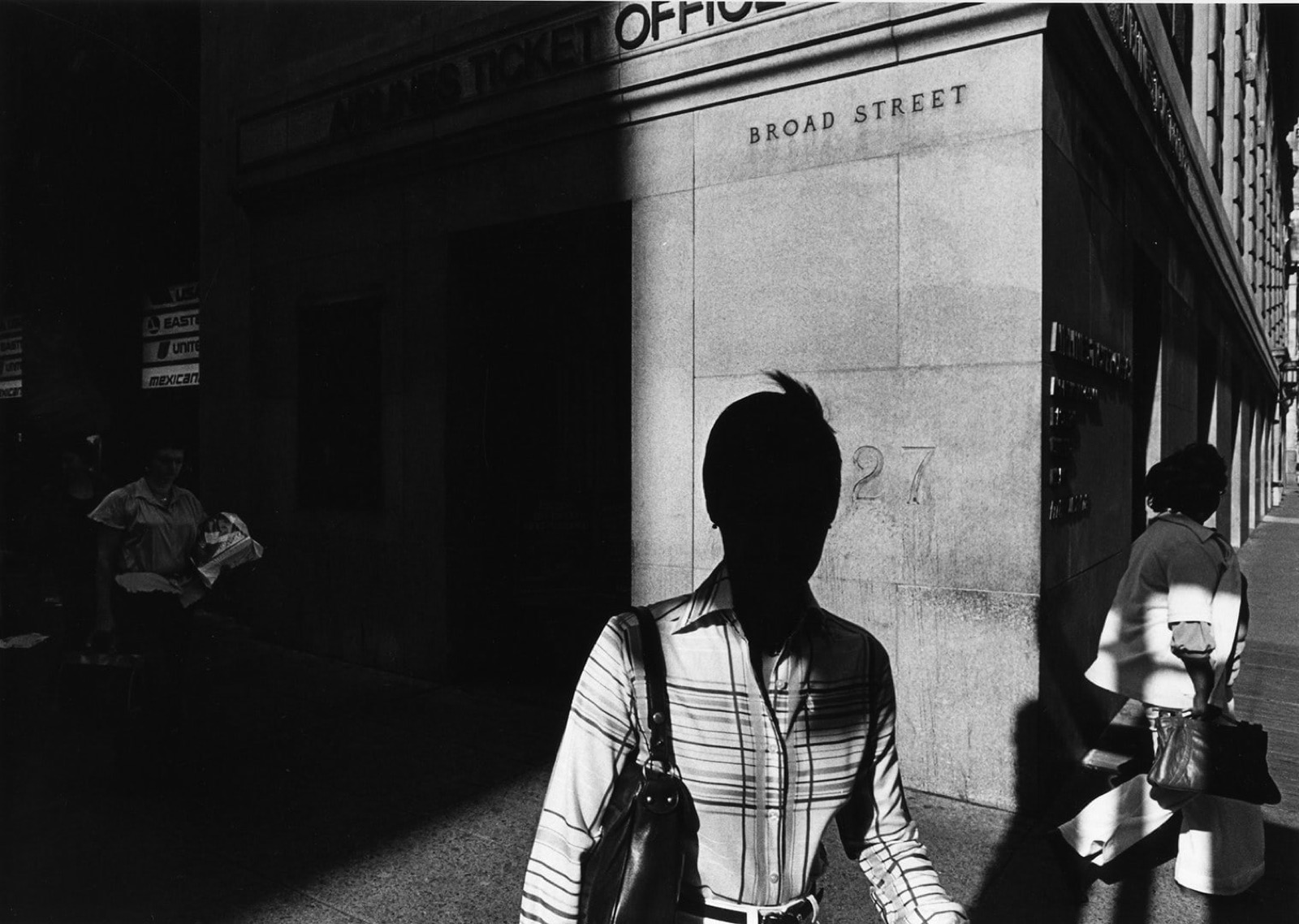
Begin with the title that isn't one — BROAD STREET, cut crisp into the granite cornerstone, and beneath it the ghost of a numeral, a soft 27 worn into the stone. That's the joke and the tenderness of it: the building names itself, shouts AIRLINES TICKET OFFICE up top, lists EASTERN, UNITED, Mexicana on its signboard, yet the one human who matters has no name, no face. She stands dead center, blouse a riot of plaid and stripe catching the hard Philadelphia sun, and where her head should be there is only a perfect black cut-out, a hooded absence with a single flick of hair off the crown. The sun gave her everything but her face, and kept that for the dark.
The light rakes in from the right and lays the corner pier bare — every chamfered edge of stone, the woman in pale at the far right with her handbag, her shadow flung long across the pavement like a second person. Then it just quits. To the left the world drops into velvet nothing, a doorway of pure pitch, and out of that murk a second woman surfaces, blouse glowing, arms full of papers. Three figures, none aware of the others, each sealed in her own pocket of brightness or black — a city overheard rather than seen, whispers, the series is rightly called.
By 1980 the man making this had been at the street thirty years, and the whole century of the medium presses behind it, darkened down to something private and mournful. A vintage print like this, struck by his own hand near the moment, holds that black the way no later one can: dense, breathing, exact. The same image hangs in MoMA, the Met, Chicago, and the Philadelphia Museum a few blocks from where she crossed — which tells you what this quiet corner is worth, though the picture would never stoop to saying so.
Begin with the title that isn't one — BROAD STREET, cut crisp into the granite cornerstone, and beneath it the ghost of a numeral, a soft 27 worn into the stone. That's the joke and the tenderness of it: the building names itself, shouts AIRLINES TICKET OFFICE up top, lists EASTERN, UNITED, Mexicana on its signboard, yet the one human who matters has no name, no face. She stands dead center, blouse a riot of plaid and stripe catching the hard Philadelphia sun, and where her head should be there is only a perfect black cut-out, a hooded absence with a single flick of hair off the crown. The sun gave her everything but her face, and kept that for the dark.
The light rakes in from the right and lays the corner pier bare — every chamfered edge of stone, the woman in pale at the far right with her handbag, her shadow flung long across the pavement like a second person. Then it just quits. To the left the world drops into velvet nothing, a doorway of pure pitch, and out of that murk a second woman surfaces, blouse glowing, arms full of papers. Three figures, none aware of the others, each sealed in her own pocket of brightness or black — a city overheard rather than seen, whispers, the series is rightly called.
By 1980 the man making this had been at the street thirty years, and the whole century of the medium presses behind it, darkened down to something private and mournful. A vintage print like this, struck by his own hand near the moment, holds that black the way no later one can: dense, breathing, exact. The same image hangs in MoMA, the Met, Chicago, and the Philadelphia Museum a few blocks from where she crossed — which tells you what this quiet corner is worth, though the picture would never stoop to saying so.