Series: Photojournalism
Gelatin Silver Print.
Printed in 2025.
Image: 20 x 30 cm / 7 7/8 x 11 3/4 in / Paper: 30 x 40 cm / 11 3/4 x 15 3/4 in
Frank Horvat Estate dry stamp, signed and authenticated by Fiammeta Horvat with title and edition number in pencil on verso
© The Artist
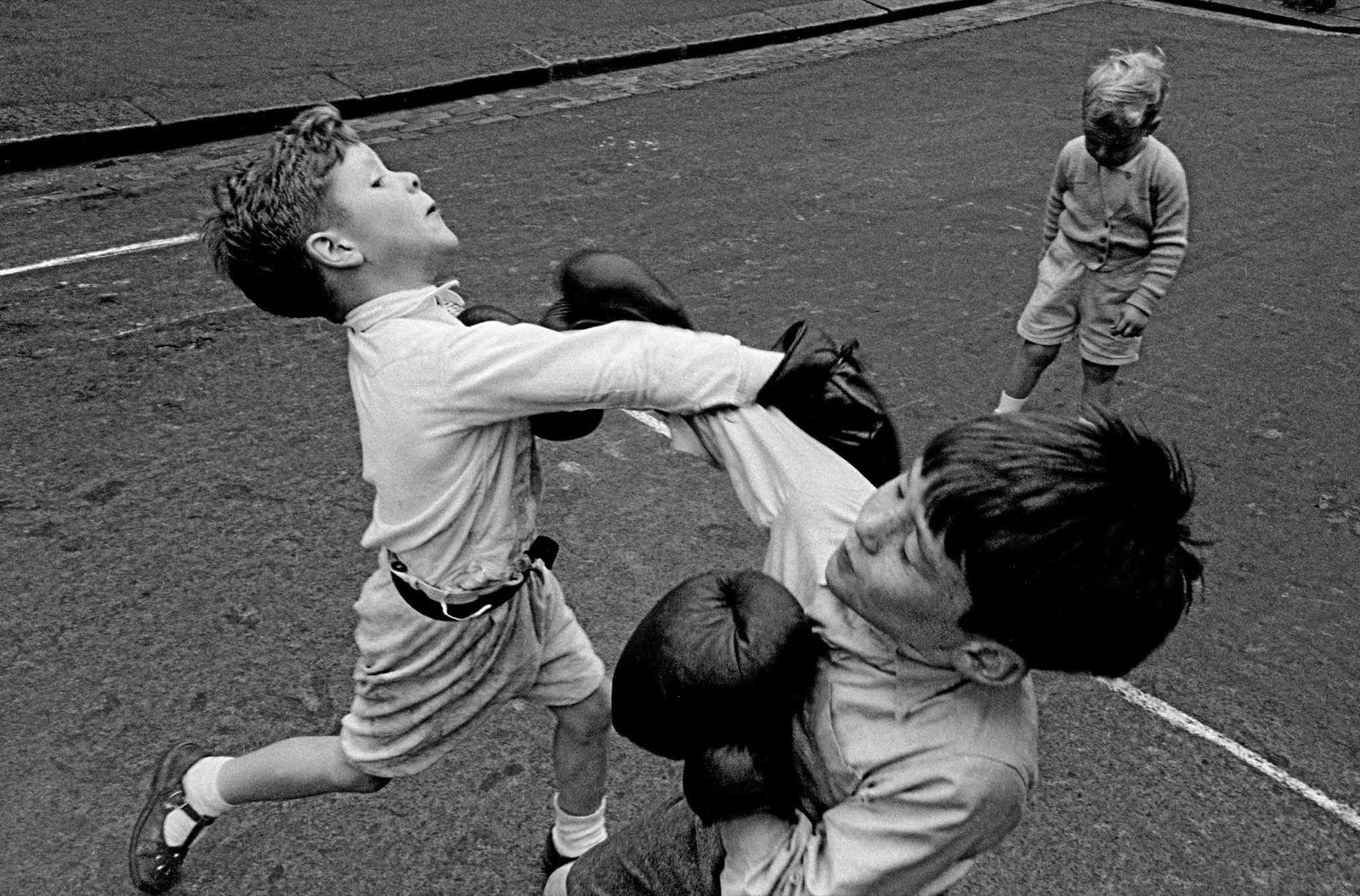
The camera has gotten down low, almost to the level of the asphalt, and from there the fight looks larger than it is. The boy on the left has just been hit. His chin is up, his eyes shut, one boot already off the ground, and the glove that did it is still hanging in the air at the center of the frame — too big for the hand inside it, the way borrowed gloves always are. From this vantage the punch reads as the main event of the picture, which is exactly the point: a higher camera would have made these small fighters small.
What keeps the thing honest is the chalk. The pavement is ruled with white lines that have nothing to do with boxing — a hopscotch grid, the leftover geometry of some other game — and the match is being staged right on top of it. The ring is wherever the boys decide to stand. Off to the right a girl watches with her hands behind her back, unimpressed, supplying the scale and the witness the scene needs. The second boxer's dark head turns into the blow; you read the whole exchange in the angle of two necks.
Horvat (1928–2020) made this in Lambeth in 1955, in the stretch after his Asian reportage and before the fashion work that made his name, when he was still photographing the street for its own sake. He had the reporter's instinct for the half-second the body gives itself away, and the formal sense to shoot it from the ground up. The picture argues nothing about childhood or the postwar city. It simply describes, very precisely, what a punch looks like to someone willing to kneel for it.