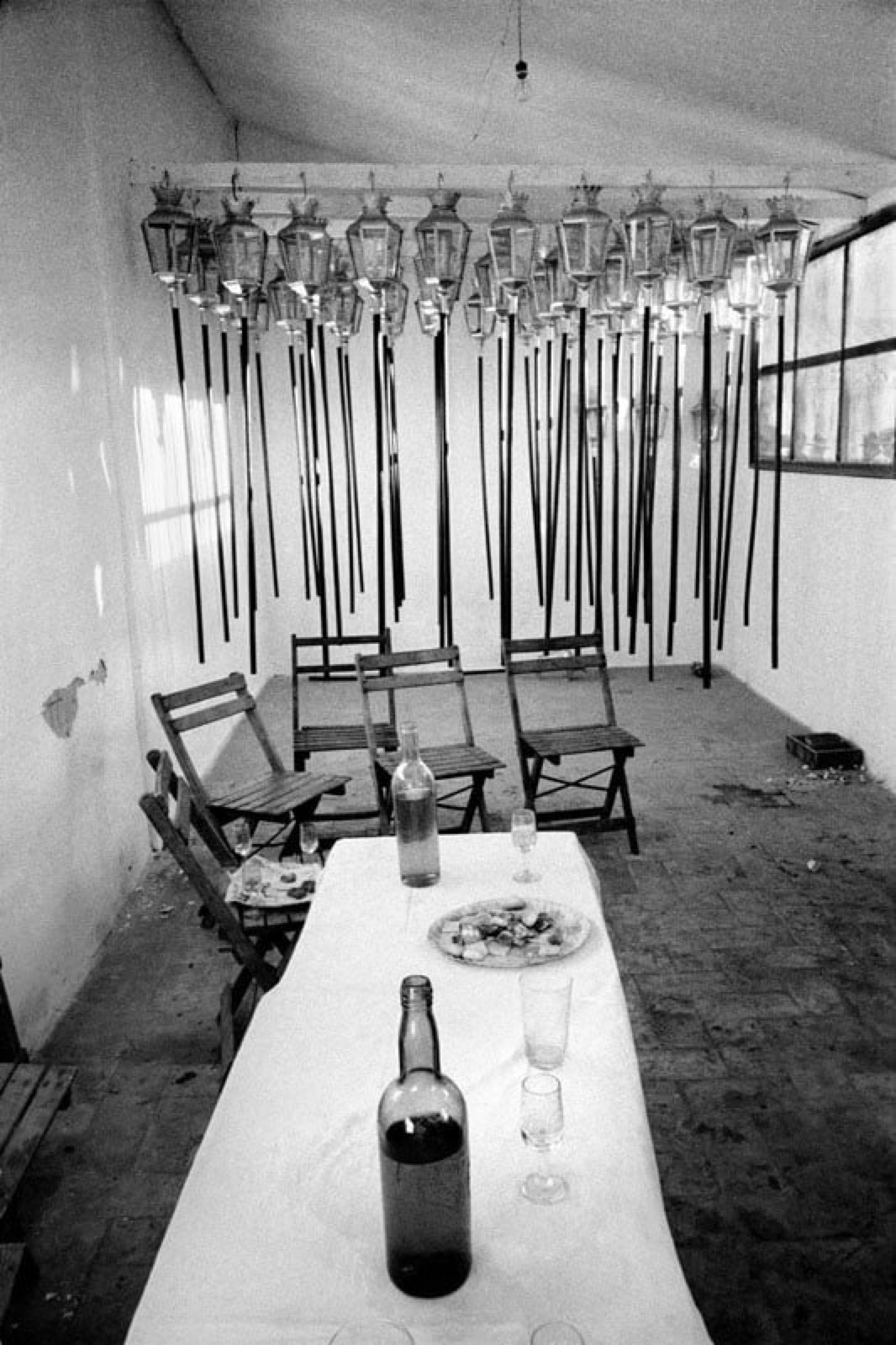
It's the kind of whitewashed room you'd find behind any Andalusian house: a low ceiling, a wall scuffed where shoulders have leaned, daylight coming in flat and patient from the left. The sort of space that exists to store things between uses. And then you tilt your head up and the ceiling has sprouted a forest — dozens of black poles hanging point-down from a rail, lanterns blooming at the wrong end, the whole procession racked indoors like umbrellas in a hall, waiting out the daylight.
That's the joke and the marvel of it. El Rocío, 1959: one of those vast Andalusian pilgrimages that photographers throw themselves at, hoping for dust and faces and ecstasy. Masats walks into the room where the ecstasy is kept overnight and finds, underneath all those dark dangling poles, a table. White cloth, a wine bottle drained to its last inch, a second bottle nearer the camera, a plate someone left, three folding chairs shoved back. People ate here. They got up. The picture is the few minutes after they got up.
What gets me is how the top half and the bottom half refuse to agree. Above, that dense vertical clatter of iron and glass, all rhythm and threat. Below, the flat calm of a tablecloth catching the light. Sacred apparatus up top, warm wine down below, and Masats — one of the great eyes of Spanish postwar photography, the man who could find the whole Romería in an empty room — just lets the two of them sit in the same frame without forcing a sermon out of it. The faith is upstairs, drying out. The meal is what's left.
It's the kind of whitewashed room you'd find behind any Andalusian house: a low ceiling, a wall scuffed where shoulders have leaned, daylight coming in flat and patient from the left. The sort of space that exists to store things between uses. And then you tilt your head up and the ceiling has sprouted a forest — dozens of black poles hanging point-down from a rail, lanterns blooming at the wrong end, the whole procession racked indoors like umbrellas in a hall, waiting out the daylight.
That's the joke and the marvel of it. El Rocío, 1959: one of those vast Andalusian pilgrimages that photographers throw themselves at, hoping for dust and faces and ecstasy. Masats walks into the room where the ecstasy is kept overnight and finds, underneath all those dark dangling poles, a table. White cloth, a wine bottle drained to its last inch, a second bottle nearer the camera, a plate someone left, three folding chairs shoved back. People ate here. They got up. The picture is the few minutes after they got up.
What gets me is how the top half and the bottom half refuse to agree. Above, that dense vertical clatter of iron and glass, all rhythm and threat. Below, the flat calm of a tablecloth catching the light. Sacred apparatus up top, warm wine down below, and Masats — one of the great eyes of Spanish postwar photography, the man who could find the whole Romería in an empty room — just lets the two of them sit in the same frame without forcing a sermon out of it. The faith is upstairs, drying out. The meal is what's left.