Series: Photojournalism
Gelatin Silver Print.
Printed in 2025.
Image: 20 x 30 cm / 7 7/8 x 11 3/4 in / Paper: 30 x 40 cm / 11 3/4 x 15 3/4 in
Frank Horvat Estate dry stamp, signed and authenticated by Fiammeta Horvat with title and edition number in pencil on verso
© The Artist
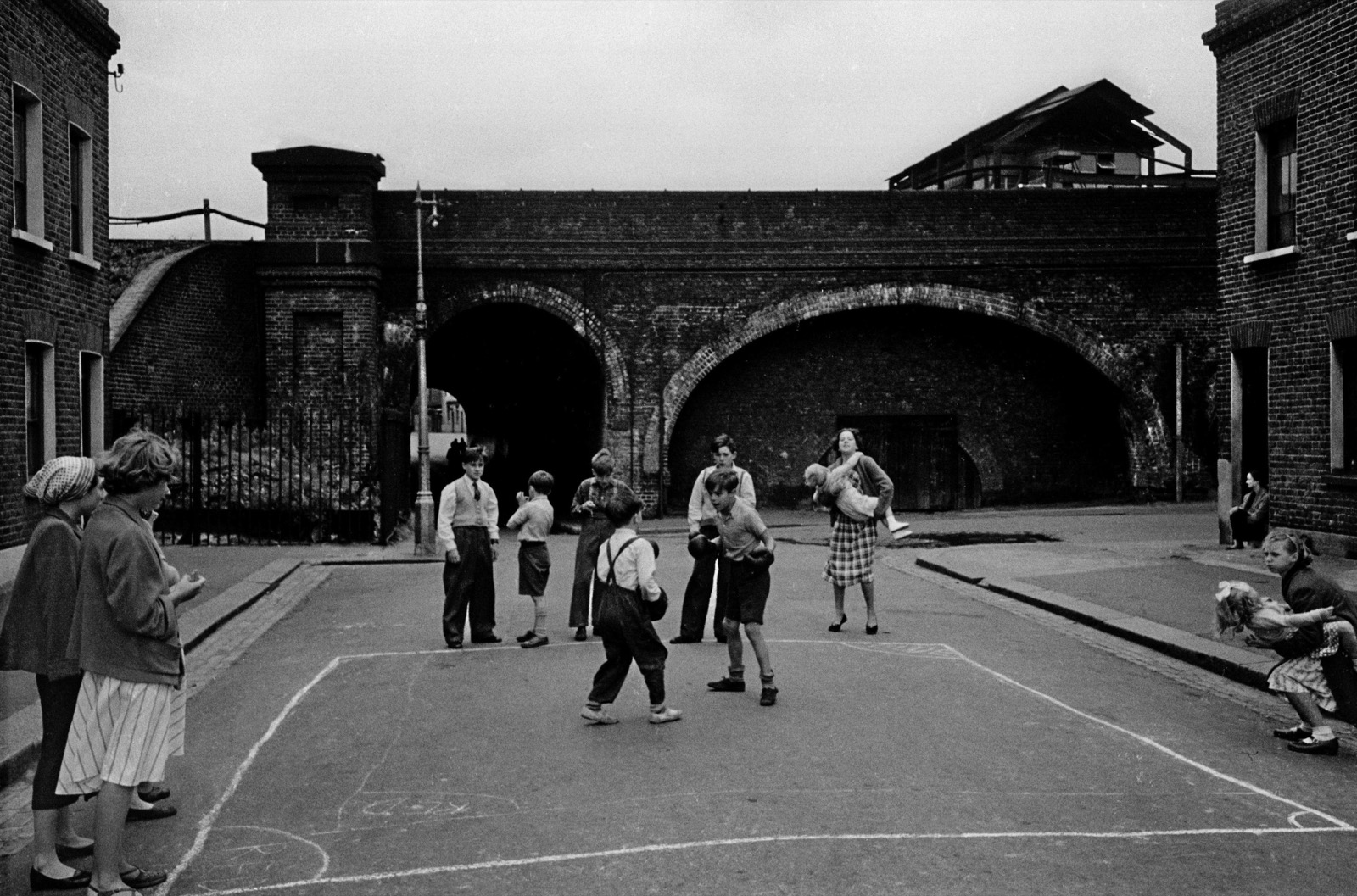
A chalked rectangle has been drawn onto the tarmac, and within its faint white border the whole event takes place: two boys, gloves far too large for their thin arms, square off while a mother with an infant on her hip pauses to watch, and beyond them the great brick arches of a railway viaduct close the yard like the apse of a church. Horvat lets the geometry do the work. The improvised ring on the ground rhymes with the two dark voids of the arches above, so that play and architecture are bound into a single figure, and the children's game acquires, without sentiment, a kind of monumentality.
This is South London in 1955, Lambeth still shaped by Victorian terraces and the soot of the line overhead, and Horvat, Italian-born and lately returned from photographing across Asia, was here working in the humanist current that ran through Picture Post and the European weeklies of the decade. What distinguishes the picture from the period's softer reportage is its refusal of close embrace. He stands back, at the yard's far edge, and describes rather than intrudes—the watching women at left, the girl crouched at right, the boxers held at the exact center where the chalk lines and the arches converge.
The frame's intelligence lies in that distance. By keeping the whole court in view, Horvat shows us not a fight but a social space: the way a borough's children claimed the ground between the houses, the adults' attentive presence at its margins, the camera's own clear account of how a community arranged itself. Printed here in 2025 from the 1955 negative, it remains among the strongest of his early London street pictures, made before fashion drew him elsewhere.