Louis Faurer American, 1916–2001

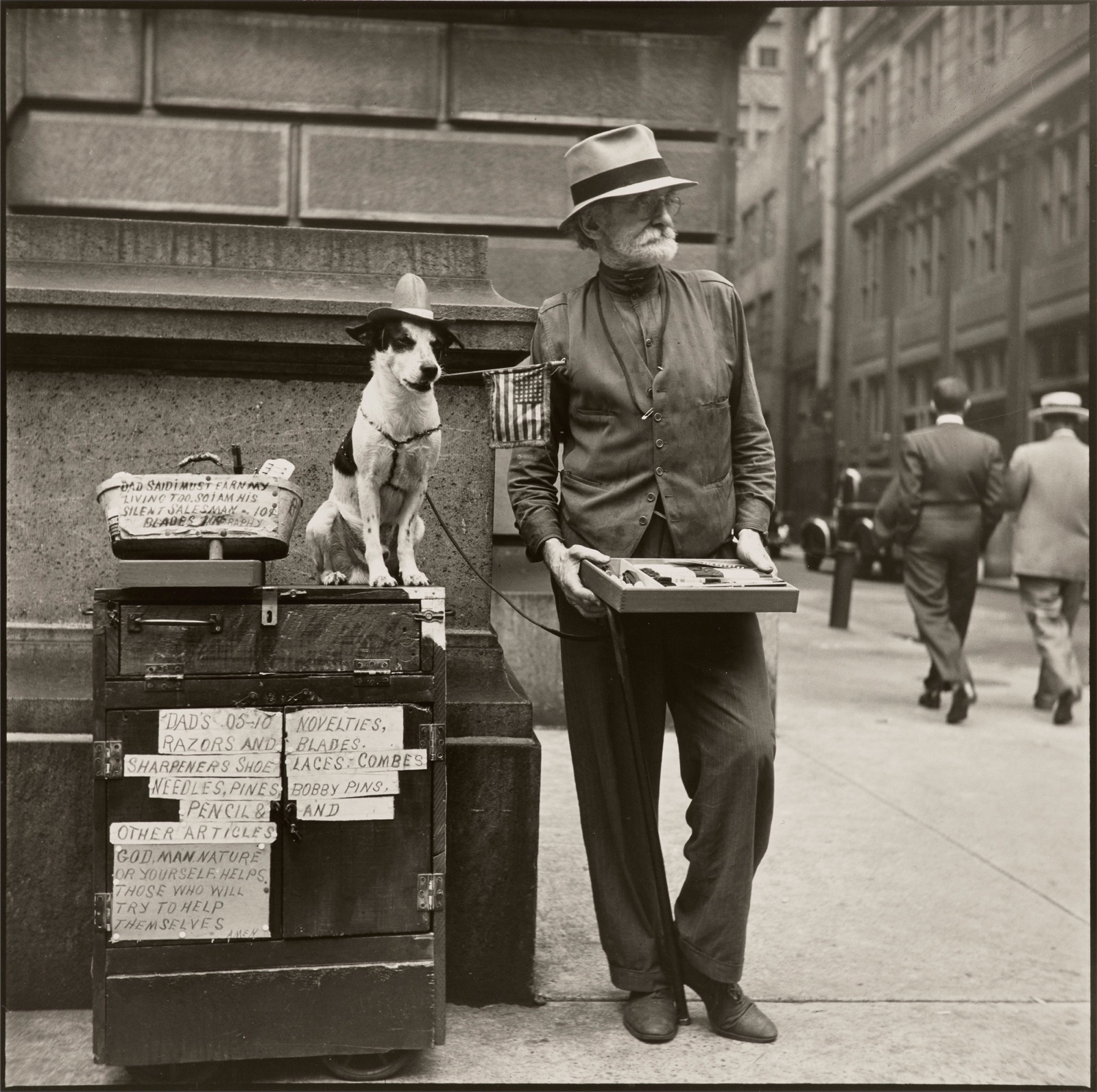
Silent Salesman, Philadelphia, 1937.
Series: The Light Suite
Gelatin Silver Print. Printed by Chuck Kelton, 1980-81.
Image: 24 x 24 cm / 9 1/2 x 9 1/2 in / Paper: 35.6 x 27.8 cm / 14 x 11 in
Signed, titled, and dated in pencil on the reverse

On a Philadelphia sidewalk, against the cut stone of some bank or courthouse, an old man has set up his entire economy: a battered trunk lettered by hand with the goods he sells—razors, blades, needles, pencils, shoelaces, combs—and a small dog wearing a hat, seated on top like a partner in the enterprise. Faurer, in 1937, before he had yet become the photographer of neon and crowds, found here the opposite of the crowd: a single human being who has reduced his life to what a box can hold.

The photograph is, among other things, a document of reading. The signs ask to be read, and so we read them, including the homemade theology—God and man, nature, help yourself, those who help themselves—painted beside the price list. This is the pathos of the self-employed at the bottom: a man who must advertise, who must turn his poverty into copy. The camera does not mock him. It transcribes him with the patience one gives to a monument, which is what the stone behind him pretends to be.

What lingers is the salesman's bearing—erect, mustached, hat squared, trousers pressed despite everything—offering his open tray to two prosperous men already walking away down the bright street. Faurer understood early that dignity and futility can occupy the same body at the same instant. The dog watches; the man waits. Photography here is less an act of capture than of attendance, the willingness to stand on the curb long enough to see what selling actually costs.