Series: 35 mm - Color
Archival pigment print. Printed later.
Edition of 20
20 x 24 in / 50 × 60 cm
Edition of 10
30 x 40 in / 76 × 101 cm
Edition of 5
48 x 60 in / 121 × 152 cm
Edition of 3
60 x 75 in / 152.4 x 190.5 cm
20 x 24 in / 50 × 60 cm
Edition of 10
30 x 40 in / 76 × 101 cm
Edition of 5
48 x 60 in / 121 × 152 cm
Edition of 3
60 x 75 in / 152.4 x 190.5 cm
Hand-signed by artist, mounted, titled, editioned and print date in ink label affixed to mount verso
© The Artist

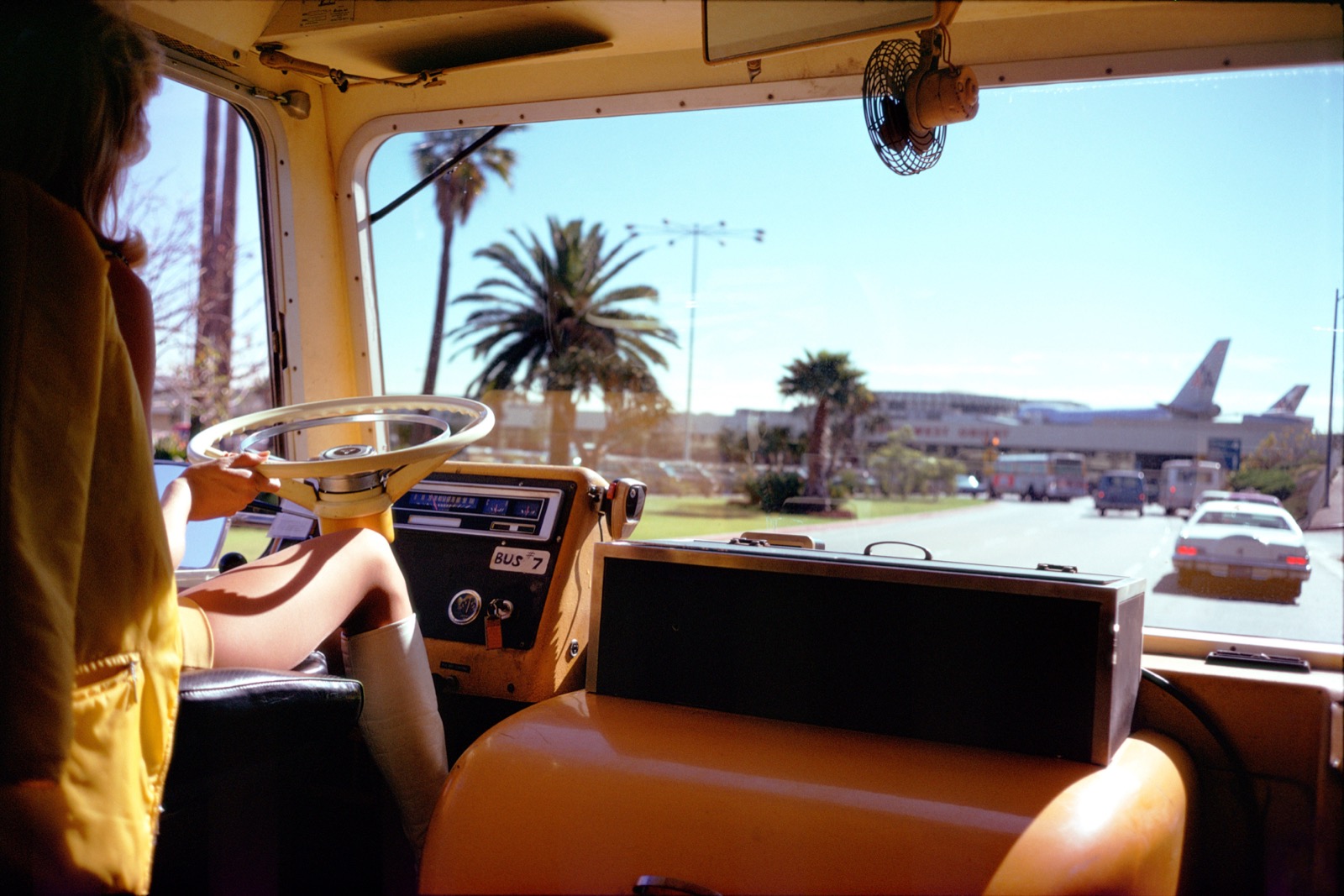
When Joel Meyerowitz boarded shuttle bus number seven at the Los Angeles airport in 1976, he was a decade into a project that would help redraw the boundaries of serious photography. He had begun on the New York street in the early 1960s, often beside Garry Winogrand, and by the middle of the next decade he had staked his work almost entirely on color at a moment when the medium's custodians still treated it as the province of advertising. This frame belongs to that argument. From the driver's seat he lets the cramped, particular interior — the cream wheel held in a young woman's sunlit hand, the hand-lettered "BUS #7" placard, the coin box, the small caged fan bolted overhead — press against the wide California horizon framed by the windshield.
That collision is the picture's intelligence. Beyond the glass a row of palms, a low terminal, and the tail of a parked airliner sit under a flat, depthless blue, while a white sedan and vans thread the access road; within the cab, ochres and chrome crowd close enough to touch. Meyerowitz understood, as few then did, how a color transparency could hold both the incident of a gesture and the atmosphere of a specific light, and here the hard, even glare of Los Angeles becomes a subject in its own right.
The vantage is characteristic of these years — democratic, alert to the structure latent in an ordinary working vehicle, content to let the medium describe what the eye might pass over. Meyerowitz's color work of the 1970s now anchors the collections of the Museum of Modern Art, the Metropolitan Museum, and the Whitney, and prints from this period grow scarcer. Made later from the original transparency, this archival pigment print carries that luminous register intact.