Series: 63 - Cadiz
Gelatin Silver Print.
Printed Later.
Edition of 15
Image: 37.5 x 24.5 cm / 14 3/4 x 9 5/8 in / Paper: 40 x 30 cm / 15 3/4 x 11 3/4 in
Edition of 5
Image: 56.5 x 37.5 cm / 22 1/4 x 14 3/4 in / Paper: 60 x 50 cm / 23 5/8 x 19 3/4 in
Image: 37.5 x 24.5 cm / 14 3/4 x 9 5/8 in / Paper: 40 x 30 cm / 15 3/4 x 11 3/4 in
Edition of 5
Image: 56.5 x 37.5 cm / 22 1/4 x 14 3/4 in / Paper: 60 x 50 cm / 23 5/8 x 19 3/4 in
Ramón Masats Estate dry stamp, signed and authenticated by Sonia Masats with title and edition number in pencil on label affixed to print verso
© The Artist

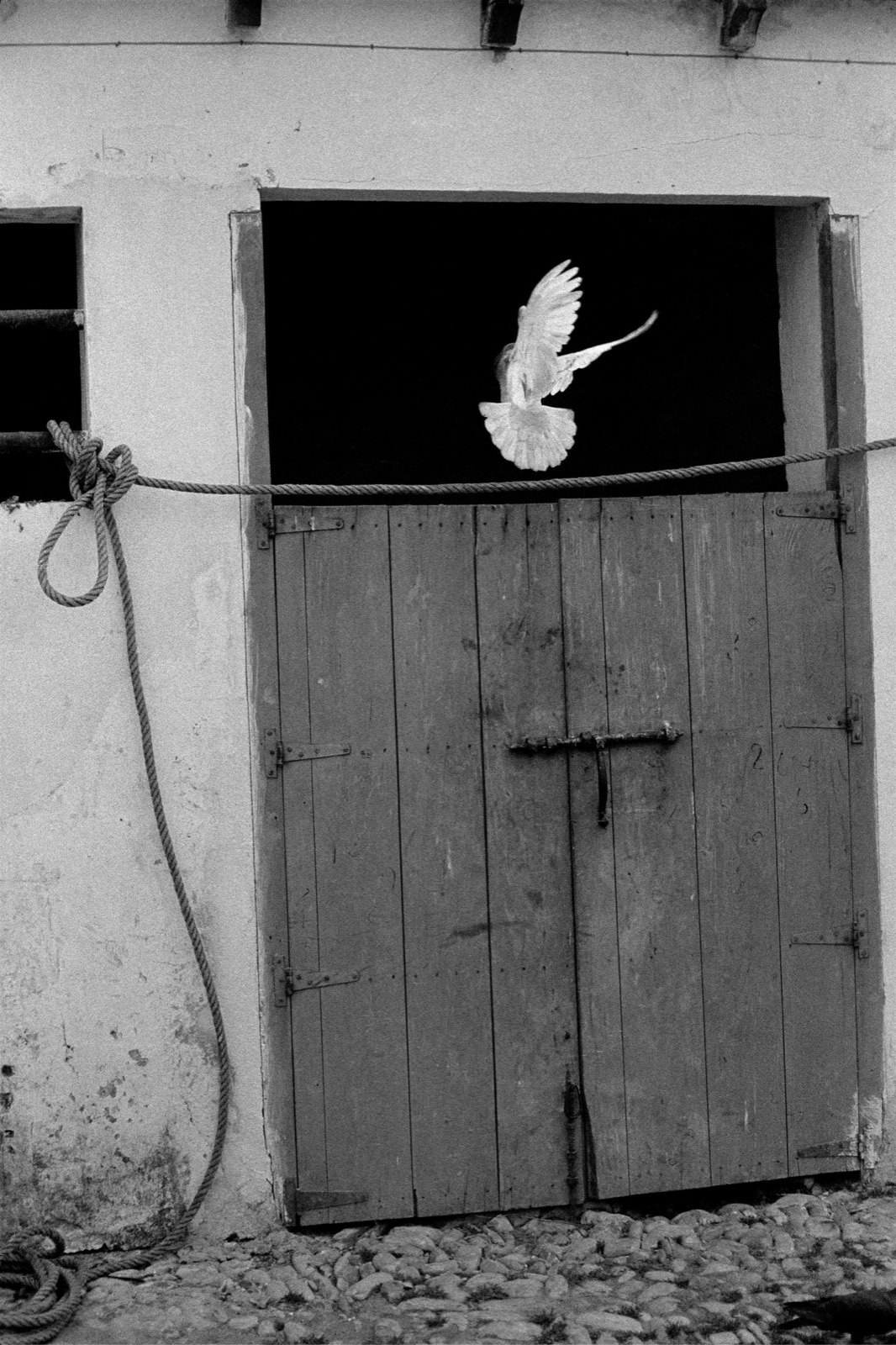
The doors are the whole tonal argument of the picture: weathered planks of a worked grey, dry and chalked over, their vertical seams and iron nailheads catching just enough sidelight to register as touchable wood. Above them the camera opens onto a flat black transom, a rectangle of nothing, and into that nothing a single dove is let loose. The bird is the brightest thing in the frame by a long margin, its splayed tail and lifted wings burning white against the dark while the latch, the bolt, the cobbles, the whitewash all settle into a careful scale of greys. That is the first thing the photograph solves — where the light is, and what gets to keep it.
It is a tidy bit of seeing. A coiled rope hangs at the left like a hank of slack punctuation, looped twice over a peg and trailing down the rough plaster to the stones; it gives the wall its weight and the door its use. The dove arrives at the one place the eye was already going, dead center in the black, and the rest of the picture — the chalky wall, the studded grain of the planks, the uneven cobbles below — holds perfectly still around it. The camera does not chase the bird; it builds a stage of plain country surfaces and waits for the white thing to fall into the hole left for it.
Made in Arcos de la Frontera in 1959, it belongs to the Andalusian work that established Masats among the central figures of Spanish postwar photography, the generation around the AFAL group whose vintage prints are now closely held. What looks like luck is really patience and a good eye for where the contrast lives, and that is the durable pleasure here: an ordinary stable door, and the one instant it is asked to be a frame.