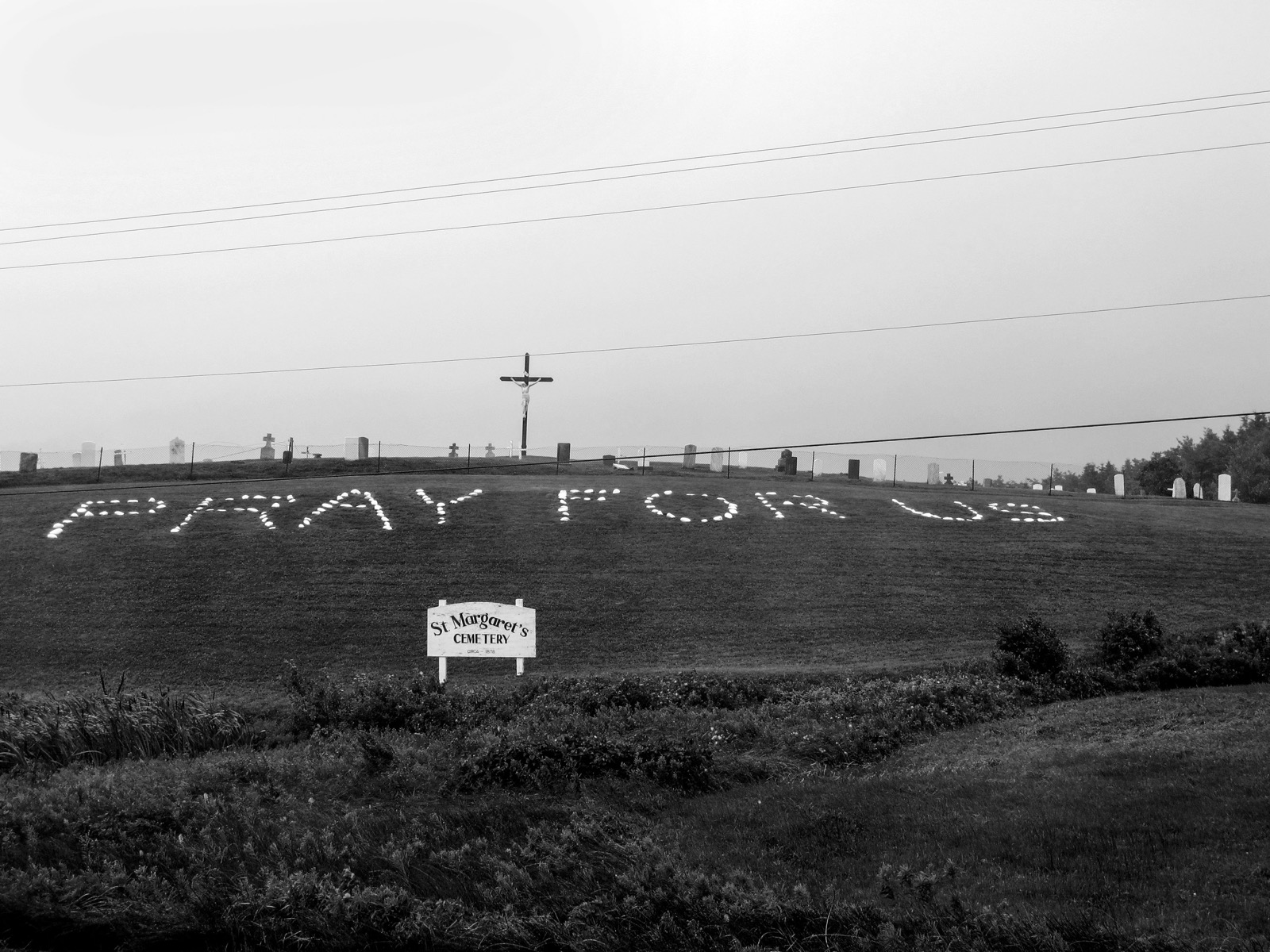
Someone climbed this hill with a sack of white stones and spelled PRAY FOR US across the slope, letter by letter, large enough to be read from the road. Clark Winter found it already made and did the harder thing: he stood far enough back to let the field, the crucifix, the headstones, and the lettering all land in one frame, none of them louder than the rest. The camera reports the words flatly, the way it reports the grass and the sign for St. Margaret's Cemetery propped in the foreground. That evenness is the picture's wit. A plea and a piece of municipal signage get exactly the same gray.
What the print does well is hold the soft, weatherless light of an overcast morning, in which everything sits at the same distance and nothing throws a shadow to argue with. The crucifix at the crest should dominate and doesn't quite; the two power lines crossing the sky cut straight through its arms without apology. The eye keeps sliding off the cross and back to the clumsy, generous capitals on the lawn, which is where the photograph wants it.
Winter, who worked this plainspoken vein of American landscape for decades, understood that a found message is only a picture if the frame turns it into one. Print the words alone and you have a snapshot of a sign. Set them under wires, behind a hand-lettered placard, on a hill of the buried, and the request stops being quaint. The selenium-toned silver print, offered here in the intimate small size and a wall-scaled enlargement, gives the gray field a faint, cool weight. It is a quiet, exact, slightly funny photograph about how plainly a place can ask for help.
Someone climbed this hill with a sack of white stones and spelled PRAY FOR US across the slope, letter by letter, large enough to be read from the road. Clark Winter found it already made and did the harder thing: he stood far enough back to let the field, the crucifix, the headstones, and the lettering all land in one frame, none of them louder than the rest. The camera reports the words flatly, the way it reports the grass and the sign for St. Margaret's Cemetery propped in the foreground. That evenness is the picture's wit. A plea and a piece of municipal signage get exactly the same gray.
What the print does well is hold the soft, weatherless light of an overcast morning, in which everything sits at the same distance and nothing throws a shadow to argue with. The crucifix at the crest should dominate and doesn't quite; the two power lines crossing the sky cut straight through its arms without apology. The eye keeps sliding off the cross and back to the clumsy, generous capitals on the lawn, which is where the photograph wants it.
Winter, who worked this plainspoken vein of American landscape for decades, understood that a found message is only a picture if the frame turns it into one. Print the words alone and you have a snapshot of a sign. Set them under wires, behind a hand-lettered placard, on a hill of the buried, and the request stops being quaint. The selenium-toned silver print, offered here in the intimate small size and a wall-scaled enlargement, gives the gray field a faint, cool weight. It is a quiet, exact, slightly funny photograph about how plainly a place can ask for help.