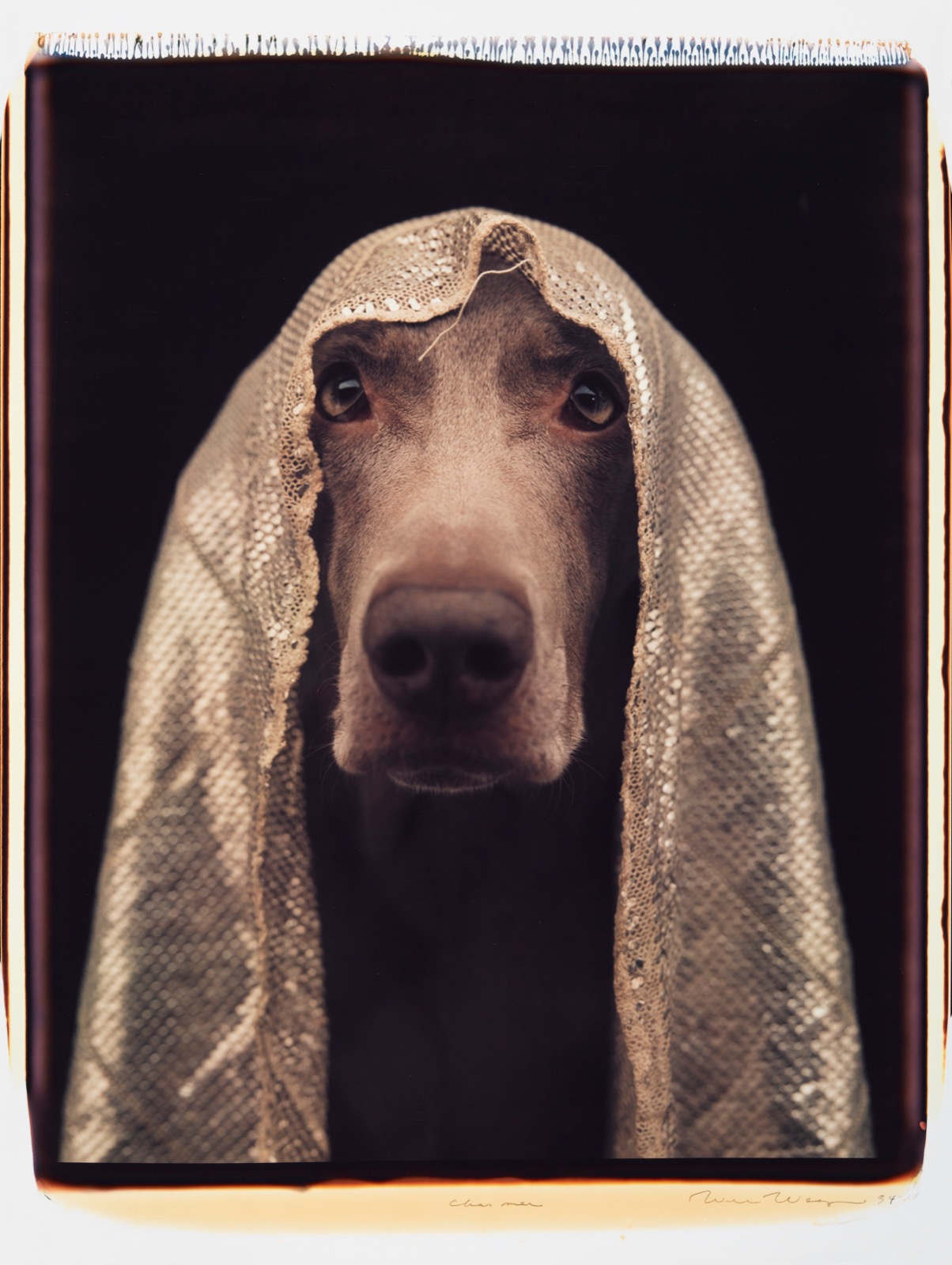
Drape a head in a glittering veil against a field of black and the whole inheritance of devotional portraiture stirs: a Flemish Madonna, a saint emerging from gilded shadow, the haloed face out of the dark. Then the muzzle resolves, the amber eyes hold dead-level to the lens, and the genre collapses into a Weimaraner. What carries the joke is not the costume but the chemistry. This is a print pulled from the room-sized 20x24 Polaroid camera, one of only a handful ever built, where exposure and development happen in a single irreversible minute. There is no negative behind it, no second copy waiting. The ragged white teeth of emulsion across the top, the bleed of amber pooling at the foot, are the signature of that apparatus, the very sheet that sat in the camera's back while the dye couplers migrated up to settle into this image. To own it is to own the only one there is.
Wegman knew exactly what this chemistry rewards: smooth, weighty tonal fields and a saturated bloom of color in the highlights. So he gave the camera a gold sequined veil, and the dye-diffusion process answers by scattering that mesh into hundreds of specular flares against a velvet black the Polaroid renders without grain or seam. The fabric falls over the animal's skull like a mantle; the long muzzle and those level eyes do the rest. Process and pose conspire into something between reliquary portrait and deadpan gag.
The penciled title and signature along the lower margin confirm what the surface already tells you. This is a made thing, dated 1994, unrepeatable by the very technology that produced it, now that the giant camera and its film have passed into history. The print is no window on the dog. It is the dog's encounter with a singular machine, fixed once and held.
Drape a head in a glittering veil against a field of black and the whole inheritance of devotional portraiture stirs: a Flemish Madonna, a saint emerging from gilded shadow, the haloed face out of the dark. Then the muzzle resolves, the amber eyes hold dead-level to the lens, and the genre collapses into a Weimaraner. What carries the joke is not the costume but the chemistry. This is a print pulled from the room-sized 20x24 Polaroid camera, one of only a handful ever built, where exposure and development happen in a single irreversible minute. There is no negative behind it, no second copy waiting. The ragged white teeth of emulsion across the top, the bleed of amber pooling at the foot, are the signature of that apparatus, the very sheet that sat in the camera's back while the dye couplers migrated up to settle into this image. To own it is to own the only one there is.
Wegman knew exactly what this chemistry rewards: smooth, weighty tonal fields and a saturated bloom of color in the highlights. So he gave the camera a gold sequined veil, and the dye-diffusion process answers by scattering that mesh into hundreds of specular flares against a velvet black the Polaroid renders without grain or seam. The fabric falls over the animal's skull like a mantle; the long muzzle and those level eyes do the rest. Process and pose conspire into something between reliquary portrait and deadpan gag.
The penciled title and signature along the lower margin confirm what the surface already tells you. This is a made thing, dated 1994, unrepeatable by the very technology that produced it, now that the giant camera and its film have passed into history. The print is no window on the dog. It is the dog's encounter with a singular machine, fixed once and held.