The lettered signs hold perfectly still—VERSAILLES, AUTEUIL–LES MOULINEAUX, St GERMAIN, the lit promise of SORTIE AMSTERDAM—while everything human beneath them gives way. Horvat held the shutter open long enough that the concourse of the Gare Saint-Lazare turned to a tide of half-figures, hundreds of commuters smeared into a single grey current. The architecture and its commerce stay legible; the crowd becomes weather. What anchors the picture is the deliberate ledger of sharpness against blur: the camera describes the station as fixed and the people as the thing passing through it.
Look toward the lower right and one couple resists the dissolve—a young woman and the man turned to her, nearly resolved, caught in the half-second they stood apart from the flow. At the bottom edge a lone man with a newspaper under his arm reads as solid too, a fixed point the river of bodies parts around. Horvat lets these few held figures carry the whole exposure; they are where time, elsewhere abolished, briefly resumes.
Made in 1959, the frame belongs to the years when Horvat was moving between Paris reportage and the fashion commissions that would make his name, carrying a small camera into the city's transit halls. It descends from the station as the medium's recurring subject—Stieglitz's steam, Frank's American platforms—yet refuses the decisive instant for duration itself, photographing not a moment but the passage of many. The result situates him among the most inventive of the postwar French photographers: a picture that uses the long exposure not as effect but as argument, the station holding firm while the century hurries past.
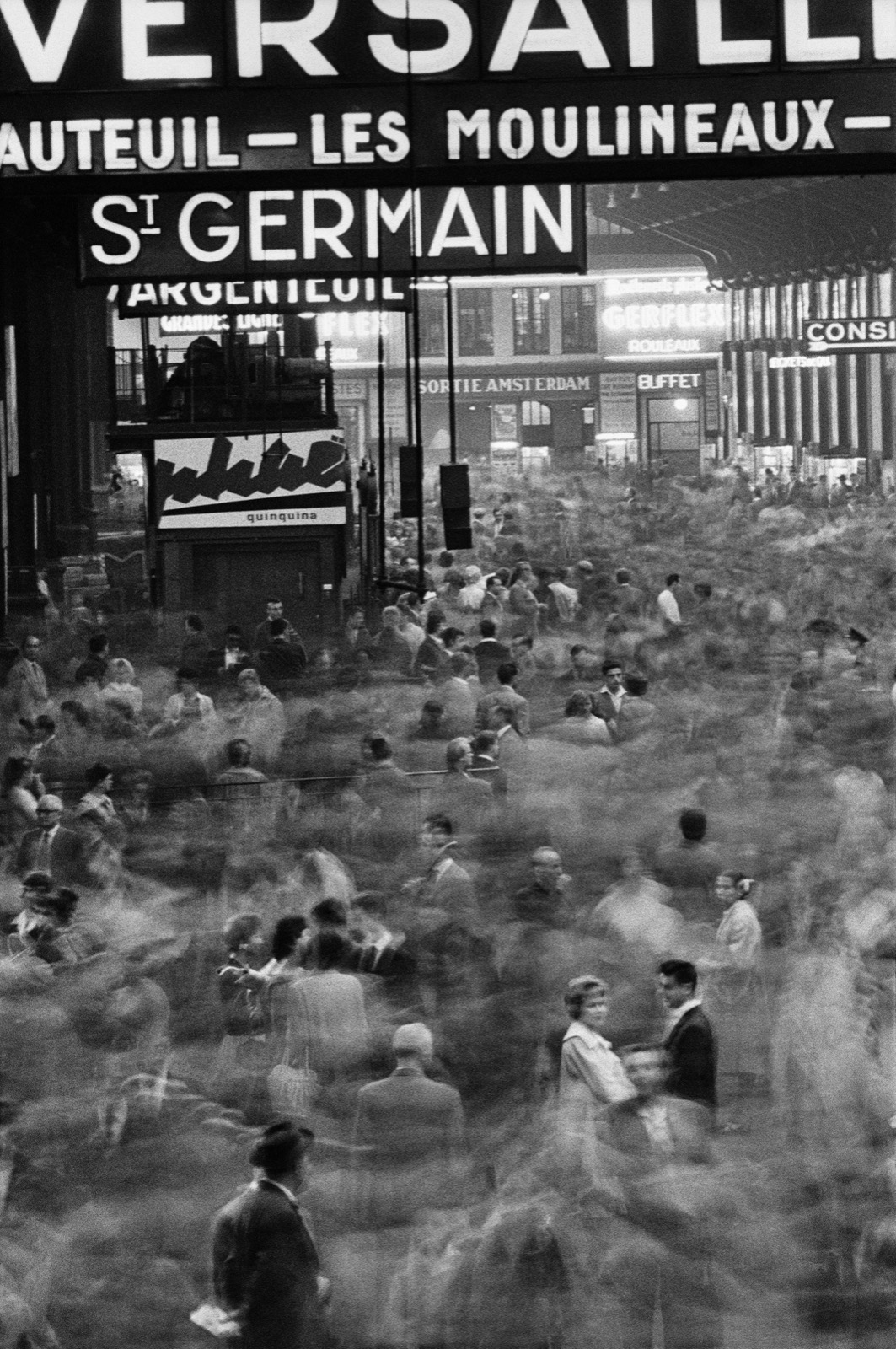
The lettered signs hold perfectly still—VERSAILLES, AUTEUIL–LES MOULINEAUX, St GERMAIN, the lit promise of SORTIE AMSTERDAM—while everything human beneath them gives way. Horvat held the shutter open long enough that the concourse of the Gare Saint-Lazare turned to a tide of half-figures, hundreds of commuters smeared into a single grey current. The architecture and its commerce stay legible; the crowd becomes weather. What anchors the picture is the deliberate ledger of sharpness against blur: the camera describes the station as fixed and the people as the thing passing through it.
Look toward the lower right and one couple resists the dissolve—a young woman and the man turned to her, nearly resolved, caught in the half-second they stood apart from the flow. At the bottom edge a lone man with a newspaper under his arm reads as solid too, a fixed point the river of bodies parts around. Horvat lets these few held figures carry the whole exposure; they are where time, elsewhere abolished, briefly resumes.
Made in 1959, the frame belongs to the years when Horvat was moving between Paris reportage and the fashion commissions that would make his name, carrying a small camera into the city's transit halls. It descends from the station as the medium's recurring subject—Stieglitz's steam, Frank's American platforms—yet refuses the decisive instant for duration itself, photographing not a moment but the passage of many. The result situates him among the most inventive of the postwar French photographers: a picture that uses the long exposure not as effect but as argument, the station holding firm while the century hurries past.