Series: Photojournalism
Gelatin Silver Print.
Printed in 2025.
Image: 30 x 20 cm / 11 3/4 x 7 7/8 in / Paper: 40 x 30 cm / 15 3/4 x 11 3/4 in
Frank Horvat Estate dry stamp, signed and authenticated by Fiammeta Horvat with title and edition number in pencil on verso
© The Artist
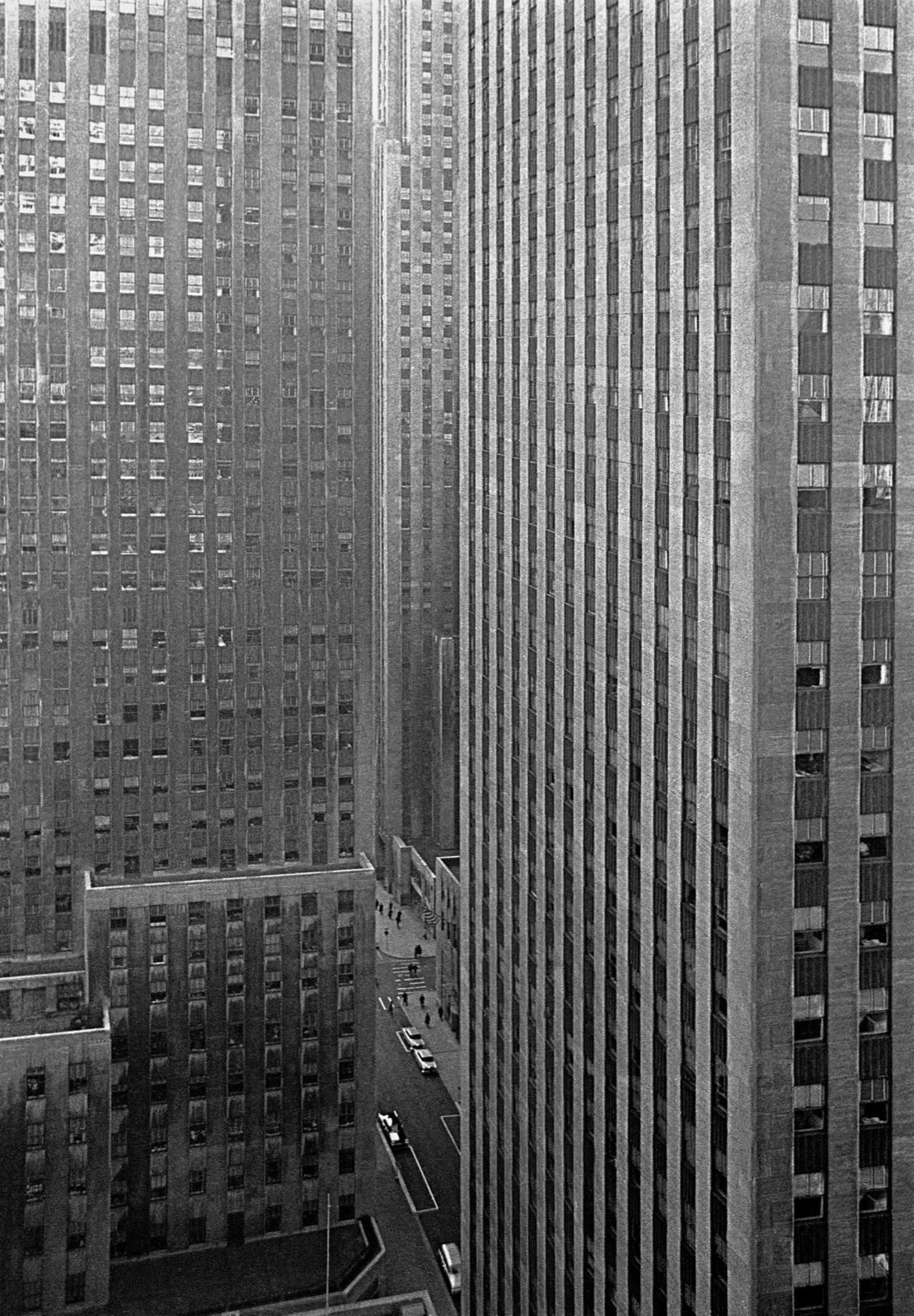
Gray, here, is a material with grain. The limestone slabs of Rockefeller Center come to the camera not as architecture but as fabric — vertical pilasters drawn fine as corduroy, the thousands of windows ruled into the stone like stitches, each pane holding its own slightly different value, so that the whole surface shivers between cloth and rock. Nothing in the frame is black and nothing is white; the picture lives entirely in the close middle tones, and that restraint is the work's intelligence.
The vantage is the photograph's real subject. From a high window the buildings have been allowed to crowd out the sky entirely, two great planes of facade leaning toward each other and leaving, between them, a single deep seam of street. Down in that seam the scale suddenly returns: a pale taxi, a scatter of small cars, the road itself no wider than a pencil mark. The eye that has been reading texture is dropped, without warning, into actual depth — and the abstraction turns out to have a floor.
This is the discipline that runs through the work of a photographer who began among painters and arrived at the street with a draughtsman's patience. Made in 1963, the picture belongs to the New York he photographed with a long lens and a cool head, finding pattern where others found only monument. Printed in 2025 from the negative, the gelatin silver surface gives those graded grays the depth they were always reaching for. The achievement is not that the towers look large. It is that they have been described — fairly, exactly — as a thing the camera could hold.