Louis Faurer American, 1916–2001

Repaving Times Square, New York City, 1949.
Series: The Light Suite
Gelatin Silver Print. Printed by Chuck Kelton, 1980-81.
Image: 21.2 x 31.7 cm / 8 3/8 x 12 1/2 in / Paper: 28 x 35.5 cm / 11 x 14 in
Signed, titled, and dated in pencil on the reverse
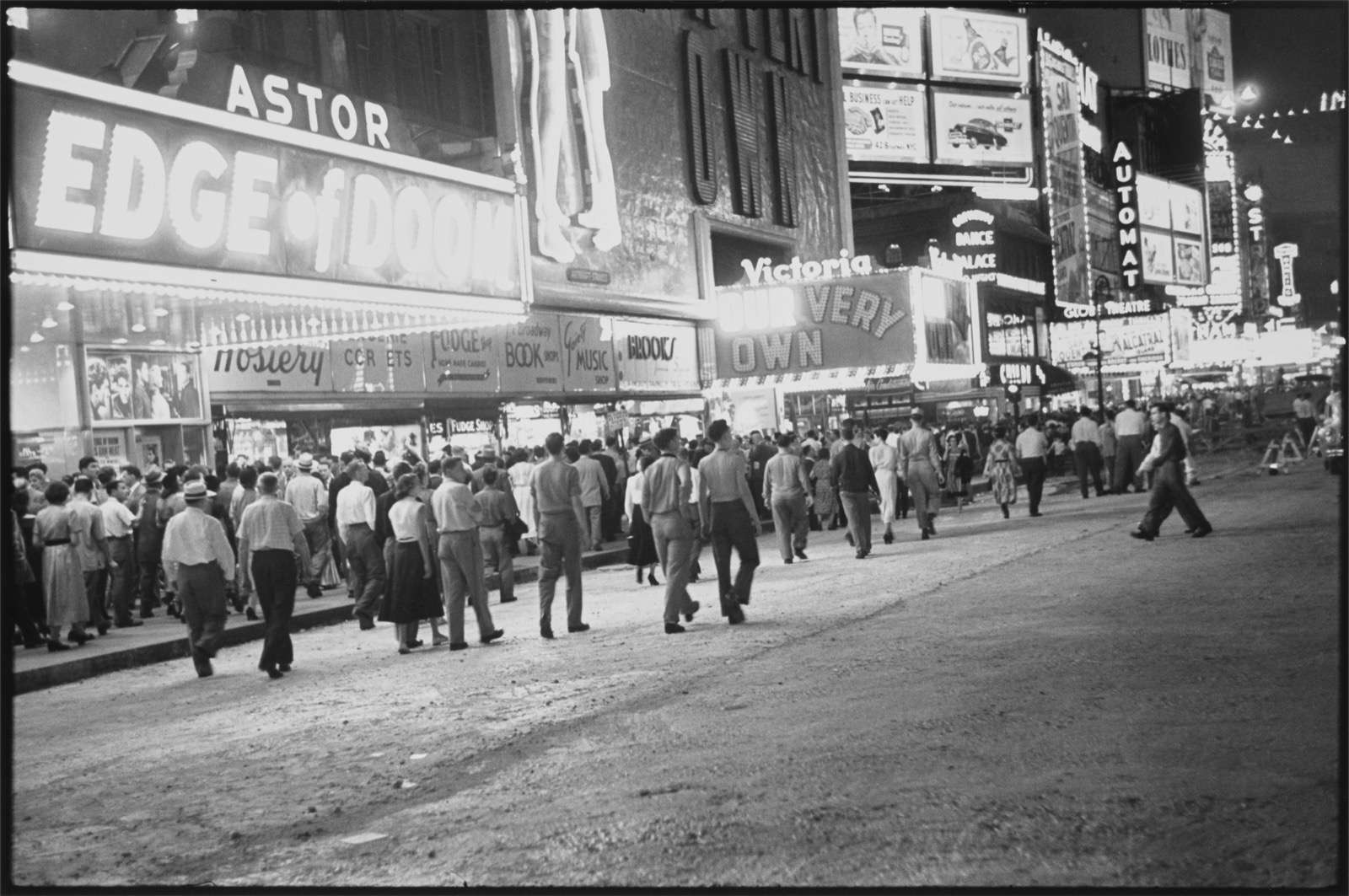
Gravel and broken asphalt fill the entire foreground, a torn dark field of rubble where Times Square is being repaved, and above it the marquees burn white—ASTOR, EDGE OF DOOM, Victoria, the Automat, the Globe—a horizon of electric letters spelling films and promises. Faurer composes the picture as two textures at war: the powdery, churned earth of the street, grainy and lightless, and the hard luminous crust of signage that floats over the crowd. The brightest American place is photographed from its rawest, most provisional ground.

The title of one feature, Edge of Doom, hangs over the throng like a caption the city wrote for itself in 1949. The crowd streams along the lit sidewalk, hundreds of small figures in shirtsleeves and summer dresses, while the roadway beside them lies opened up, unfinished, half-ruined. Faurer had an instinct for the moment when spectacle reveals its underpinnings—the dirt beneath the glamour, the labor beneath the leisure—without ever turning the discovery into a sermon.

Spectacle, the photograph seems to know, is always being repaired. The electric paradise depends on this nightly excavation, on streets perpetually torn and remade so that the crowd may keep arriving. What the long exposure preserves is not only the glow but its cost in dust. To stand here with a camera was to record a civilization at its most dazzling and least finished, doom advertised in lights above a road that has not yet been put back together.