The studium is easy to read, and almost too generous: a drugstore lunch counter, the long ceiling of fluorescent tubes burning evenly overhead, the cheerful litter of American signage — Gillette, ice cream four for 98¢, the half-word of a prescriptions sign dissolving into glare at the right. An older man in a dark suit and a small patterned bow tie tilts his head back and grins, his eyeglasses catching the light, while a glass of water and a salt shaker keep their patient places on the white Formica. We know this room. We have been told what it means.
But something pierces, and it is small. It is the carton he holds up, half toward us, on which a young woman smiles back — a printed face inside the photographed scene, a second, glossier happiness wedged against his living one. That doubled smile is the punctum: her advertised joy and his actual joy meeting at the counter, neither quite able to vouch for the other. I cannot stop looking at the seam between them, the place where the commercial image touches a real mouth.
This is the seeing that made The Americans a rupture in 1958 — the tilted frame, the low angle, the grain that refuses to flatter, a Swiss outsider finding the nation's loneliness inside its abundance. The artist's archive rests at the National Gallery of Art; his prints hang at MoMA and the Met. A vintage print from these years is the thing itself, the trace exposed close to the moment — and here the moment will not settle, which is exactly why it holds.
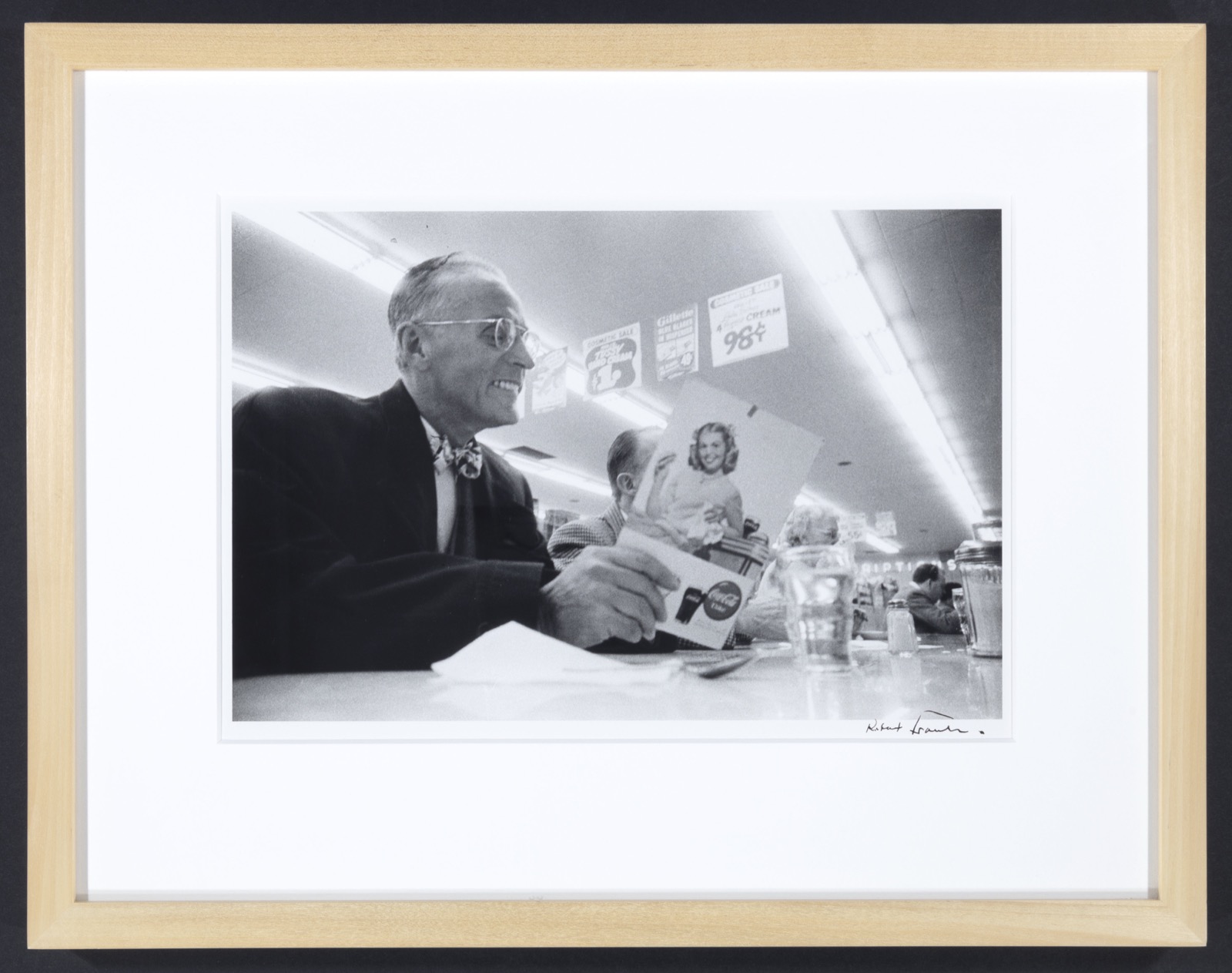
The studium is easy to read, and almost too generous: a drugstore lunch counter, the long ceiling of fluorescent tubes burning evenly overhead, the cheerful litter of American signage — Gillette, ice cream four for 98¢, the half-word of a prescriptions sign dissolving into glare at the right. An older man in a dark suit and a small patterned bow tie tilts his head back and grins, his eyeglasses catching the light, while a glass of water and a salt shaker keep their patient places on the white Formica. We know this room. We have been told what it means.
But something pierces, and it is small. It is the carton he holds up, half toward us, on which a young woman smiles back — a printed face inside the photographed scene, a second, glossier happiness wedged against his living one. That doubled smile is the punctum: her advertised joy and his actual joy meeting at the counter, neither quite able to vouch for the other. I cannot stop looking at the seam between them, the place where the commercial image touches a real mouth.
This is the seeing that made The Americans a rupture in 1958 — the tilted frame, the low angle, the grain that refuses to flatter, a Swiss outsider finding the nation's loneliness inside its abundance. The artist's archive rests at the National Gallery of Art; his prints hang at MoMA and the Met. A vintage print from these years is the thing itself, the trace exposed close to the moment — and here the moment will not settle, which is exactly why it holds.