Gelatin Silver Print.
Image: 25.4 x 34.3 cm / 10 x 13 1/2 in / Paper: 27.6 x 34.9 cm / 10 7/8 x 13 3/4 in / Frame: 33.3 x 41.6 cm / 13 1/8 x 16 3/8 in
Signed, titled and dated "1964" in ink on the recto; Tate Modern exhibition frame with Tate Modern labels affixed to the verso
© The Artist
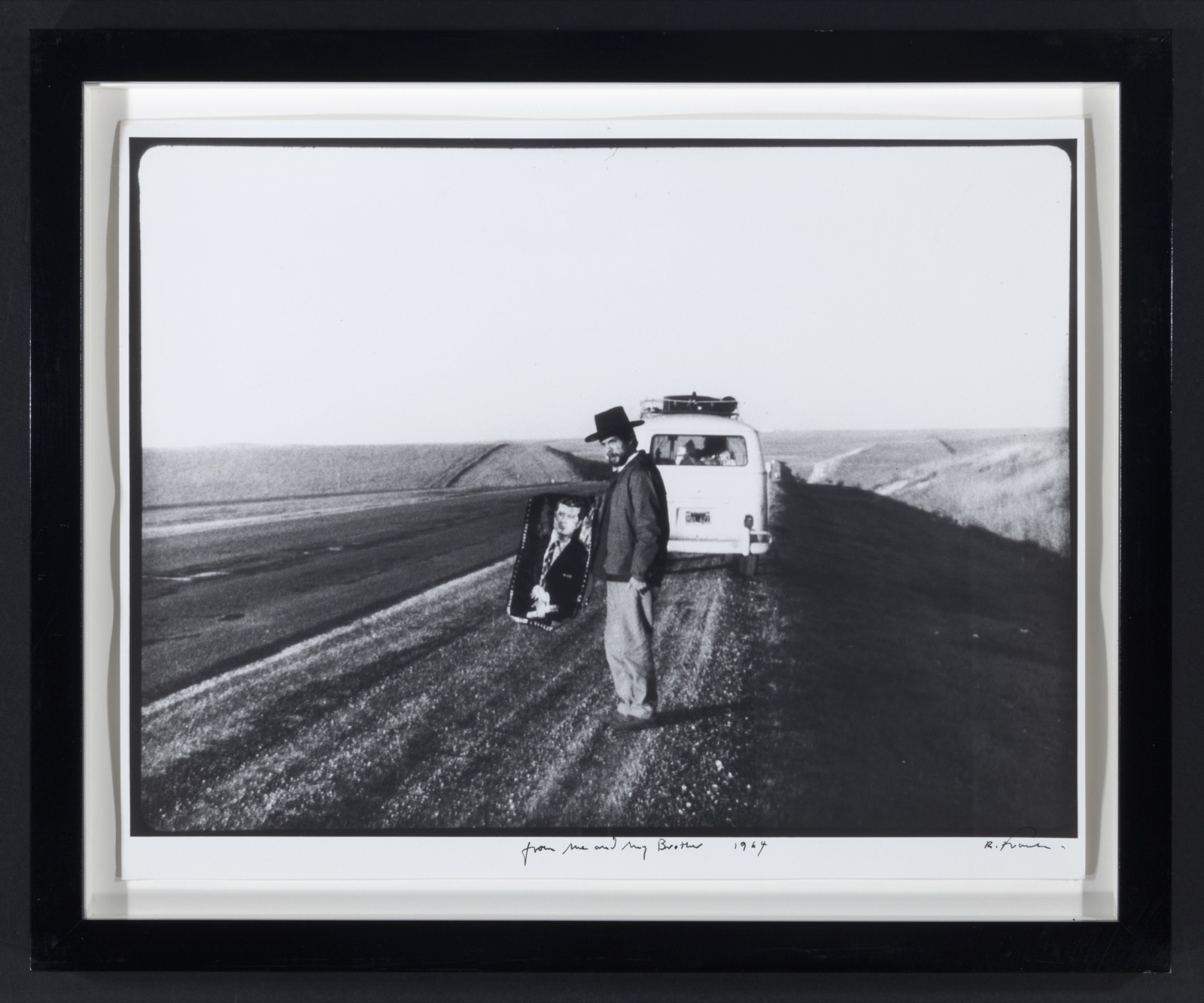
A man stands on the shoulder of an empty two-lane highway, dark suit and broad-brimmed hat against a flat prairie that runs to a featureless pale sky. He has stopped beside a white van loaded with luggage on its roof, its tail toward us, faces dim in the rear window. Under one arm he carries a large framed photograph of another man, turned outward so that the pictured face confronts us as plainly as his own. The road's gravel verge fills the lower frame; the asphalt shines faintly, as if the light were leaving. Nothing here is staged for grace.
The picture belongs to the years when this artist had set aside the road poem of the 1950s for film and for a more wounded, autobiographical register. It is a still from his own work of that decade, and it folds the medium back on itself: a photograph of a man holding a photograph, the carried portrait standing in for an absent brother, presence and image refusing to settle. The blur on the distant figures, the leaning horizon, the abrupt black margins of the print are not failures but the grammar of his late manner, where doubt and feeling override polish.
His vision reset the course of American photography, and the institution that holds his archive has kept his work at the center of the canon. Inscribed and signed by hand in the lower margin, a vintage print of this image carries not only the picture but the trace of his touch—the road, the brother, the camera, all held for a moment before the light goes.