Louis Faurer American, 1916–2001

Longchamps Restaurant, 42nd and Lexington Avenue, New York City, 1946.
Series: The Light Suite
Gelatin Silver Print. Printed by Chuck Kelton, 1980-81.
Image: 23 x 22.7 cm / 9 x 9 in / Paper: 35.5 x 28 cm / 14 x 11 in
Signed, titled, and dated in pencil on the reverse
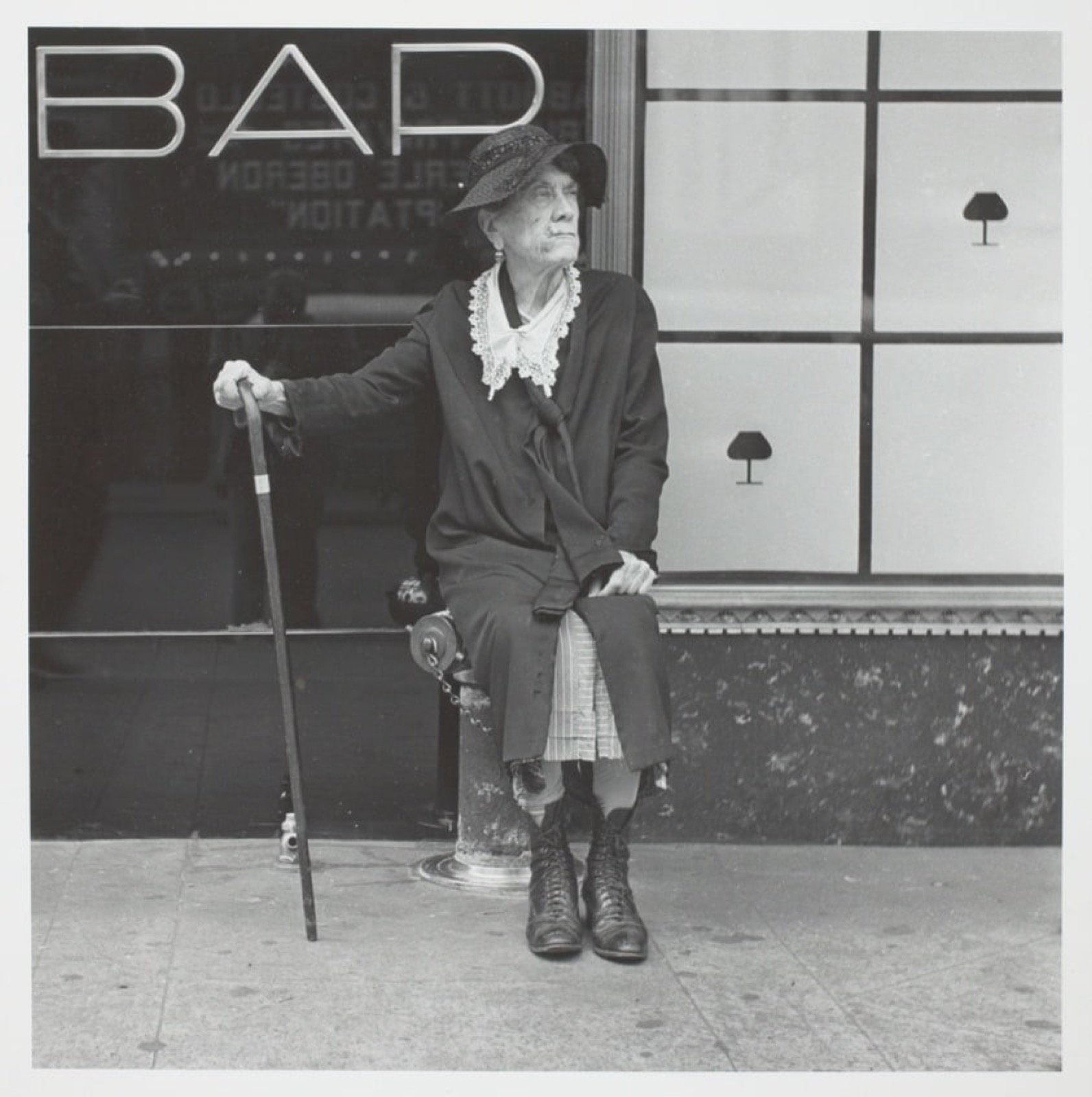
The greys here behave like nothing the eye expects of a city street. Faurer has let the plate glass of the Longchamps window go nearly liquid, so that the seated woman with her cane floats in a register somewhere between bench and reflection. Behind her, a pair of lampshades hovers as flat black silhouettes, and the word BAR runs backwards across the top of the frame, reversed by the glass into a glyph that reads almost as decoration. Tone does the describing: the matte wool of her coat, the chalk of the lace at her collar, the worn nap of the sidewalk paving.

Photography is often praised for its speed, but what holds the picture together is a kind of patience. The woman is at rest, deliberately so, her gloved hand braced on the cane, her face turned toward a light off to the right that does not concern us. The camera meets her at her own pace. Faurer made this in 1946, early in his New York years, and already the instinct is there to find stillness inside the busiest material the city offers, to slow a glass surface until it becomes a screen.

The print, carried later into rich silver by Chuck Kelton, keeps that ambiguity alive in the darkroom. You read the figure as solid and the window as depthless at once, and the longer you look the harder it is to say which plane she belongs to. That uncertainty is not a flaw. It is the picture's quiet argument about how a street, pressed into a single tone-scale, stops being a place and becomes a meditation on surface, age, and the long afternoon of waiting.