Louis Faurer American, 1916–2001

Philadelphia, 1937.
Series: The Light Suite
Gelatin Silver Print. Printed by Chuck Kelton, 1980-81.
Image: 20.6 x 20.7 cm / 8 1/8 x 8 1/8 in / Paper: 35.6 x 27.8 cm / 14 x 11 in
Signed, titled, and dated in pencil on the reverse

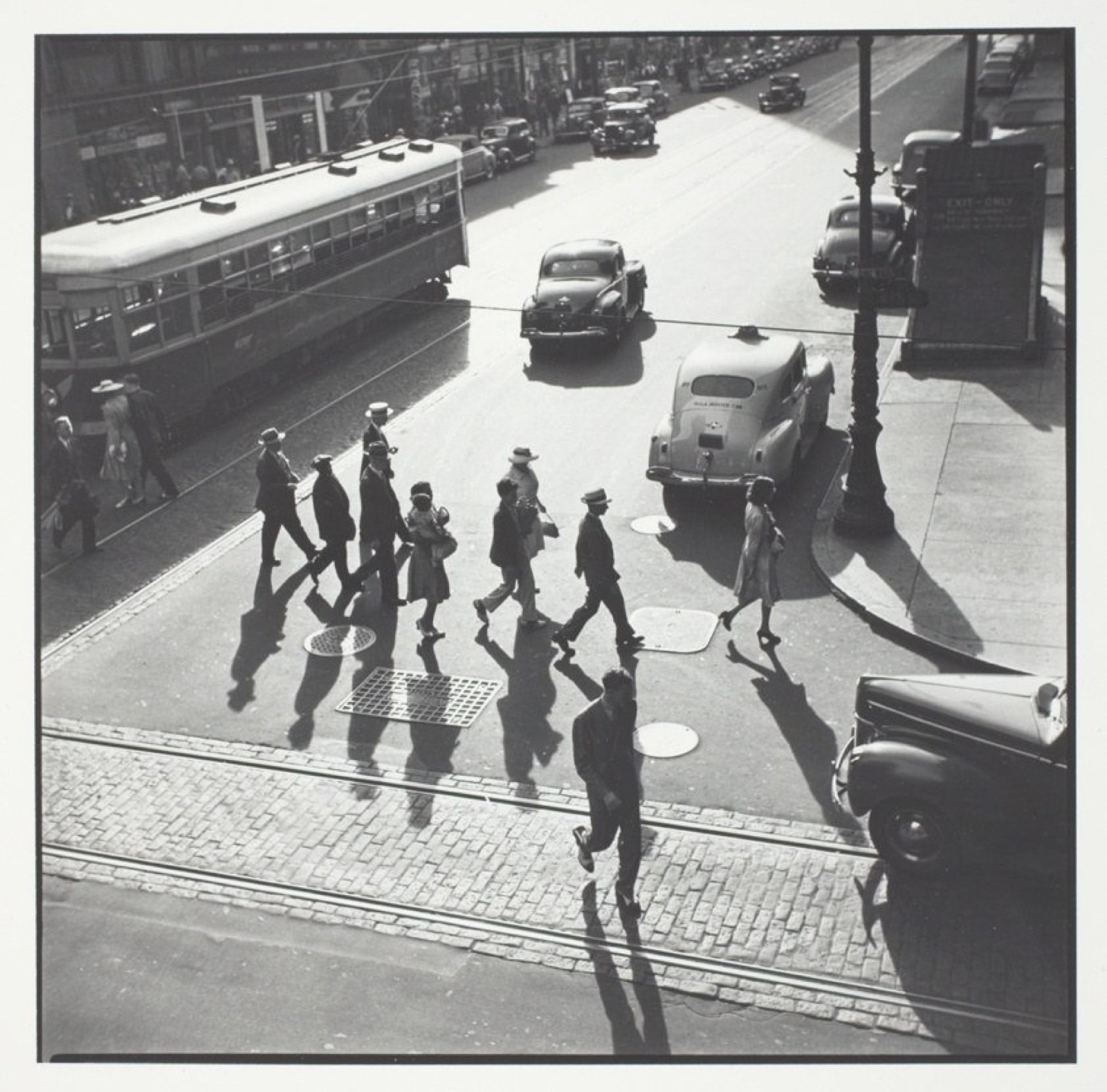
Faurer made this picture from above, and the elevation changes everything. From the window or fire escape that gave him this vantage, a Philadelphia intersection in 1937 becomes a diagram of itself: the trolley and the automobiles laid out like counters on a board, the cobblestones and tram rails ruling the lower third into staves, the pedestrians strung across the crossing in a loose, unrepeatable line. At street level this would be noise. From here it is something close to music.

What the raking sun supplies is a second population. Every figure trails a shadow longer than itself, and these dark elongations do as much compositional work as the people who cast them, knitting the walkers to the cars and the cars to the curb. Faurer, then about twenty-one and years from the New York pictures that made his name, already knew that the camera does not record a moment so much as confirm one — that the worth of an instant lies in how completely it resolves. A half-second earlier or later and the line of crossers would not have cohered.

He keeps one figure apart: the lone man in the foreground, walking toward us against the lateral flow, his own shadow thrown forward like a path. He is the small disturbance the picture needs, the irregular note that keeps the order from hardening into mere pattern. The street is full, the light is exact, and a single person is going the wrong way. That is the whole of it, and it is enough.