Look at where the real glamour and the printed glamour land in the same frame. Low in the picture, a man absorbed in his copy of Il Giorno holds the paper open so its fashion page — a drawn beauty in pearls, "favorite all'Oscar" — floats just beneath the live mannequin standing on the Spanish Steps above him. Horvat sets two seductions one over the other and lets you feel the joke: the woman in ink sells the same dream the woman in the cape-jacket is, at that instant, performing.
And she performs it beautifully. Deborah Dixon, the Texan known in the studios as the Snow Queen, wears a sculptural turban-hat and three loops of pearls, the pale capelet cut sharp against a dark column of skirt, her gloved cool absolute among the weathered stone. The two boys in miniature suits and knotted ties flank her like a borrowed family, one watching us, one drifting off — children pulled into a sitting they don't quite understand, which is exactly what gives the shot its charge. This is fashion smuggled out of the studio and dropped into Roman traffic.
That smuggling is the whole story of Horvat at Harper's Bazaar in these years: a photojournalist's eye turned on couture, the Leica close and quick, the clothes alive because the street is alive around them. Printed later as a gelatin silver print, this 1962 frame remains one of his sharpest arguments that elegance is best caught off guard — a picture about looking, by a man who knew precisely how images breed more images.
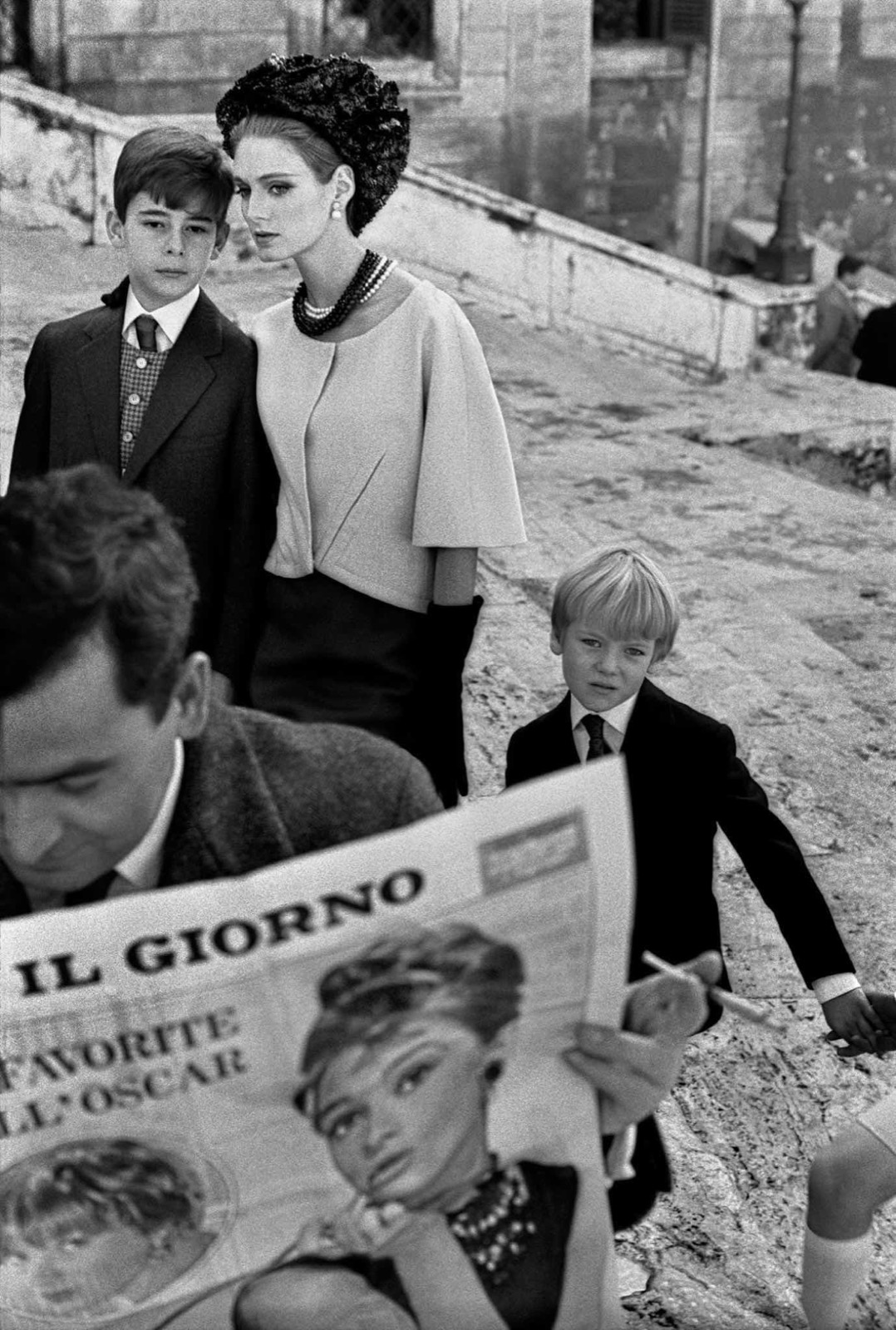
Look at where the real glamour and the printed glamour land in the same frame. Low in the picture, a man absorbed in his copy of Il Giorno holds the paper open so its fashion page — a drawn beauty in pearls, "favorite all'Oscar" — floats just beneath the live mannequin standing on the Spanish Steps above him. Horvat sets two seductions one over the other and lets you feel the joke: the woman in ink sells the same dream the woman in the cape-jacket is, at that instant, performing.
And she performs it beautifully. Deborah Dixon, the Texan known in the studios as the Snow Queen, wears a sculptural turban-hat and three loops of pearls, the pale capelet cut sharp against a dark column of skirt, her gloved cool absolute among the weathered stone. The two boys in miniature suits and knotted ties flank her like a borrowed family, one watching us, one drifting off — children pulled into a sitting they don't quite understand, which is exactly what gives the shot its charge. This is fashion smuggled out of the studio and dropped into Roman traffic.
That smuggling is the whole story of Horvat at Harper's Bazaar in these years: a photojournalist's eye turned on couture, the Leica close and quick, the clothes alive because the street is alive around them. Printed later as a gelatin silver print, this 1962 frame remains one of his sharpest arguments that elegance is best caught off guard — a picture about looking, by a man who knew precisely how images breed more images.