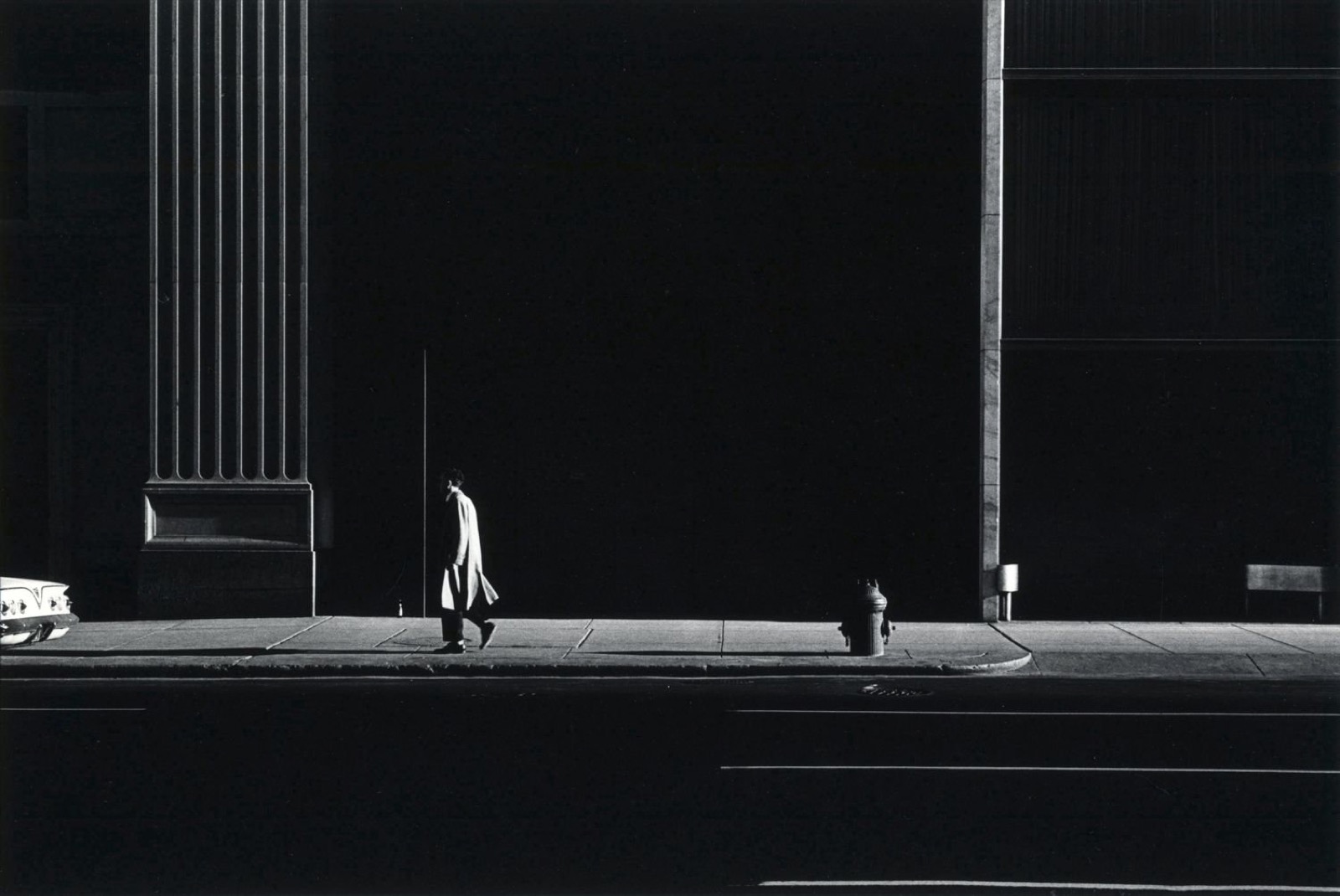
A single pedestrian crosses a vast field of black, and the city seems to hold its breath. A young man in a pale raincoat, caught mid-stride on the sunlit lip of a sidewalk, his trousers and shoes dissolving into shadow while the coat catches the low, raking light like a struck match. Behind him a colossal wall of darkness rises—the flank of a downtown building reduced to an almost total void, broken only by a thin vertical pole and, at its edges, the fluted base of a classical column at left and a paler marble pier at right. Light falls only where allowed: along the curb, across a few slabs, on the man's back and crown. Everything else is withheld.
At lower left, the unmistakable tailfin and bullet taillight of a 1959 Chevrolet—the Impala of the title—edge into the frame, chrome gleaming like a relic of postwar abundance, parked and going nowhere. To the right, a squat fire hydrant stands sentinel. Man, machine, and hydrant: three lonely punctuation marks strung along a bright ledge above the asphalt's faint, ruled lane lines. This is the photographer at full command of his native city, returned from his studies to make his defining work—pressing the blacks until the street reads less as record than as a stark calligraphy of presence and erasure.
The picture belongs to a moment when American photographers were learning to treat the city as syntax, yet few pushed emptiness this far without losing the tender particular: the slight forward lean of a walker who does not know he is watched. That tension is why the image hangs in major museums, and why a print made in its own year carries a charge no later impression can match—the specific weight of 1963 held in the silver itself.
A single pedestrian crosses a vast field of black, and the city seems to hold its breath. A young man in a pale raincoat, caught mid-stride on the sunlit lip of a sidewalk, his trousers and shoes dissolving into shadow while the coat catches the low, raking light like a struck match. Behind him a colossal wall of darkness rises—the flank of a downtown building reduced to an almost total void, broken only by a thin vertical pole and, at its edges, the fluted base of a classical column at left and a paler marble pier at right. Light falls only where allowed: along the curb, across a few slabs, on the man's back and crown. Everything else is withheld.
At lower left, the unmistakable tailfin and bullet taillight of a 1959 Chevrolet—the Impala of the title—edge into the frame, chrome gleaming like a relic of postwar abundance, parked and going nowhere. To the right, a squat fire hydrant stands sentinel. Man, machine, and hydrant: three lonely punctuation marks strung along a bright ledge above the asphalt's faint, ruled lane lines. This is the photographer at full command of his native city, returned from his studies to make his defining work—pressing the blacks until the street reads less as record than as a stark calligraphy of presence and erasure.
The picture belongs to a moment when American photographers were learning to treat the city as syntax, yet few pushed emptiness this far without losing the tender particular: the slight forward lean of a walker who does not know he is watched. That tension is why the image hangs in major museums, and why a print made in its own year carries a charge no later impression can match—the specific weight of 1963 held in the silver itself.