Bruce Weber American, b. 1946

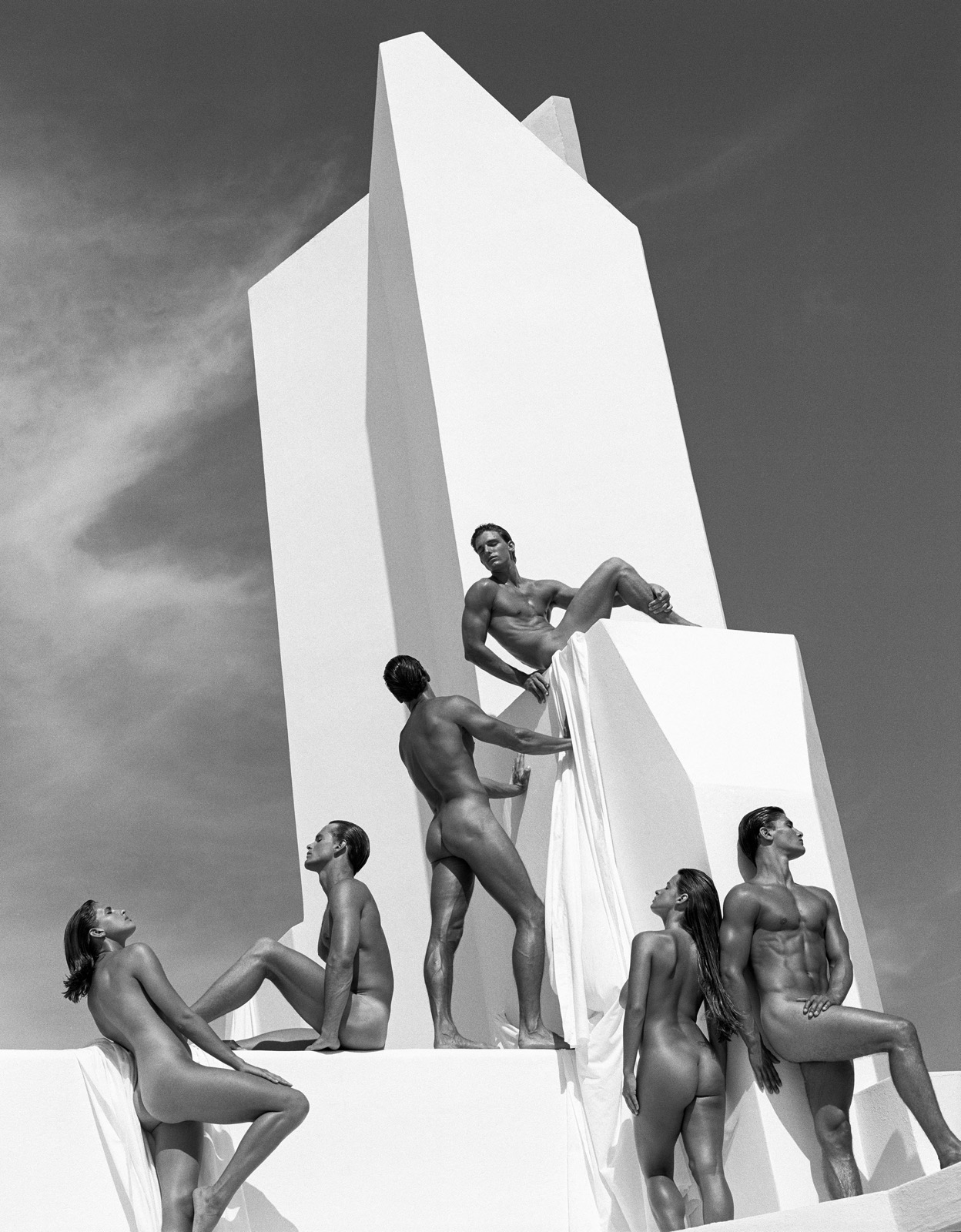
On the set for “Obsession for the Body” by Calvin Klein, Miami, FL, 1986.
Gelatin Silver Print.
Edition of 15
17 x 14 in / 43 x 35 cm

Edition of 5
24 x 20 in / 60 × 50 cm
Hand-signed by artist, titled, numbered and dated on print verso

Look at the man perched at the apex, one knee drawn up, a length of white cloth slipping from his fingers like a flag of surrender to the Miami sky. He's the keystone of the whole arrangement, and everything below him — the seated woman arching back on her hands, the standing nude turned to bronze, the long-haired pair pressed against the far pier — radiates out from that loose drapery as if the fabric were the only thing holding the composition in tension. Weber has built a pyramid of bodies against a real pyramid of poured concrete, and the wit of it is that the architecture is the only thing wearing white.

This is the "Obsession for the Body" shoot of 1986, the campaign that taught a generation what a perfume ad could be — not a bottle but a tableau, sun-struck and faintly pagan, sex sold as sculpture. By then Weber's Calvin Klein work had already colonized the Times Square billboards and the back pages of every glossy; he and Klein had been remaking American desire since '82. What's striking here is how he stages a fashion picture with no fashion in it at all, only oiled skin, raked light, and that monumental geometry borrowed from de Chirico by way of South Beach.

The cropped-square negative tightens the cluster, deep blacks anchoring the figures while the sky goes nearly white above the obelisk. Vintage gelatin silver prints of this image are scarce; Weber's nudes from the era sit in the Getty and the Whitney's holdings, and the campaign work is canonical now. Glamour seen clearly enough becomes something colder and grander — a frieze, a cult, an advertisement for the body as its own religion.