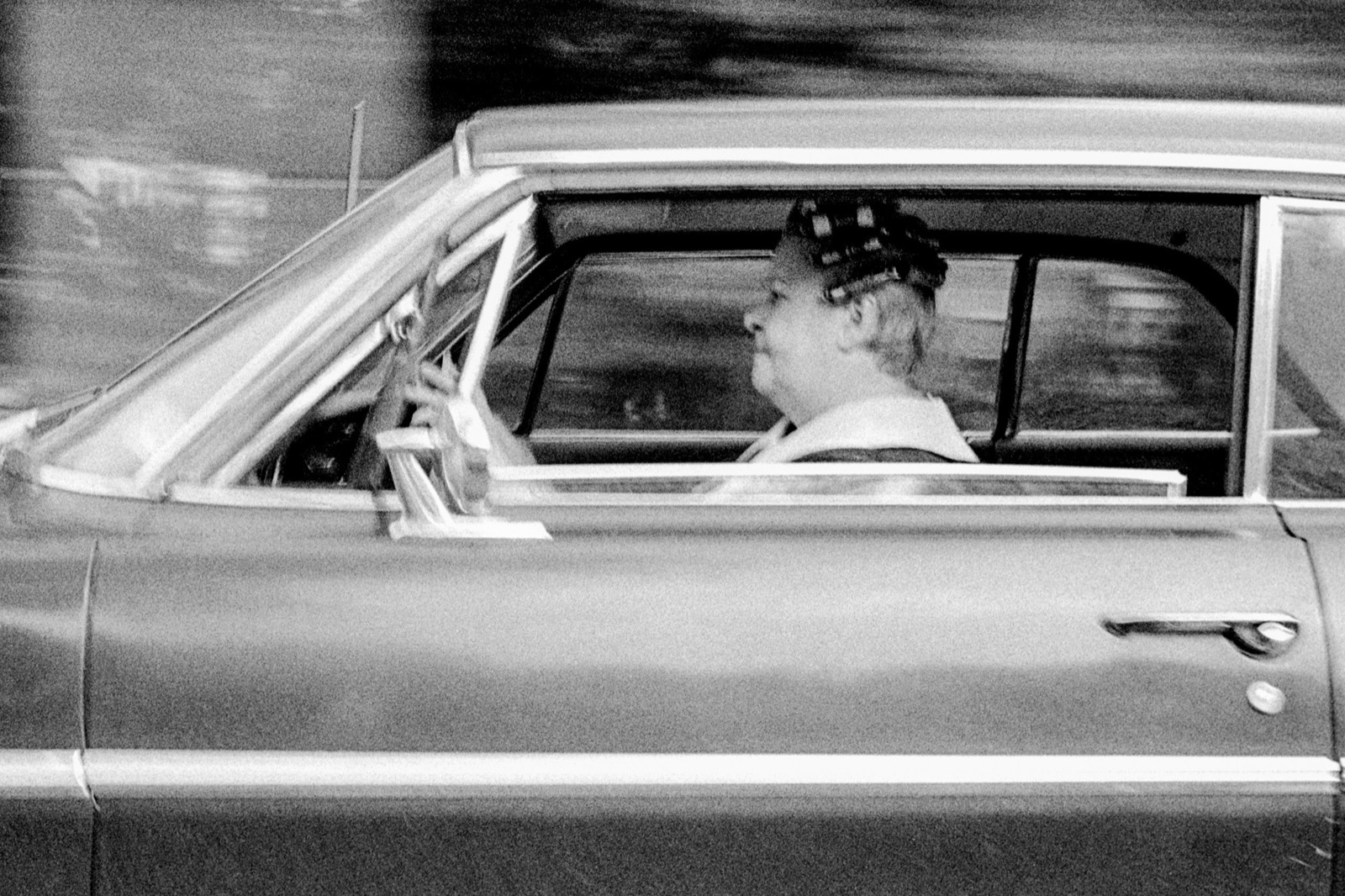
A car passes, and the camera holds still long enough to let it smear: the flanks of the sedan dissolve into a gray wash of reflected trees, while the woman inside stays sharp. That is the whole trick of the picture, and it is a real one. Everything that moves is allowed to blur; the one thing that matters is pinned. She sits in clean profile behind the wheel, chin lifted, and the curlers ride her head in a tidy grid she plainly forgot she was wearing in public. The window frames her like a second viewfinder. On the dashboard a little figurine throws up its arms, the only other gesture in a picture otherwise made of stillness inside speed.
Winter has set the problem cleanly. The side of an automobile is a difficult subject—long, low, mostly empty sheet metal—and he solves it by treating the glass as the picture's true window and the painted door below as so much dead, gleaming surface. The horizontal of the body, the band of dark interior, the bright reflections sliding the other way: it is built, not stumbled upon, though it reads as if seen in a single glance from a sidewalk.
What the photograph describes, finally, is a private moment carried through a public street at twenty miles an hour. The curlers belong to a kitchen; the car belongs to the open road; the frame puts them in the same instant without comment. Winter, an American photographer of the early 1970s working this seam between the domestic and the mobile, trusts description to do the arguing. He does not editorialize the woman. He simply waits for the car to arrive, lets the world streak, and keeps her exactly where the eye wants her.
A car passes, and the camera holds still long enough to let it smear: the flanks of the sedan dissolve into a gray wash of reflected trees, while the woman inside stays sharp. That is the whole trick of the picture, and it is a real one. Everything that moves is allowed to blur; the one thing that matters is pinned. She sits in clean profile behind the wheel, chin lifted, and the curlers ride her head in a tidy grid she plainly forgot she was wearing in public. The window frames her like a second viewfinder. On the dashboard a little figurine throws up its arms, the only other gesture in a picture otherwise made of stillness inside speed.
Winter has set the problem cleanly. The side of an automobile is a difficult subject—long, low, mostly empty sheet metal—and he solves it by treating the glass as the picture's true window and the painted door below as so much dead, gleaming surface. The horizontal of the body, the band of dark interior, the bright reflections sliding the other way: it is built, not stumbled upon, though it reads as if seen in a single glance from a sidewalk.
What the photograph describes, finally, is a private moment carried through a public street at twenty miles an hour. The curlers belong to a kitchen; the car belongs to the open road; the frame puts them in the same instant without comment. Winter, an American photographer of the early 1970s working this seam between the domestic and the mobile, trusts description to do the arguing. He does not editorialize the woman. He simply waits for the car to arrive, lets the world streak, and keeps her exactly where the eye wants her.