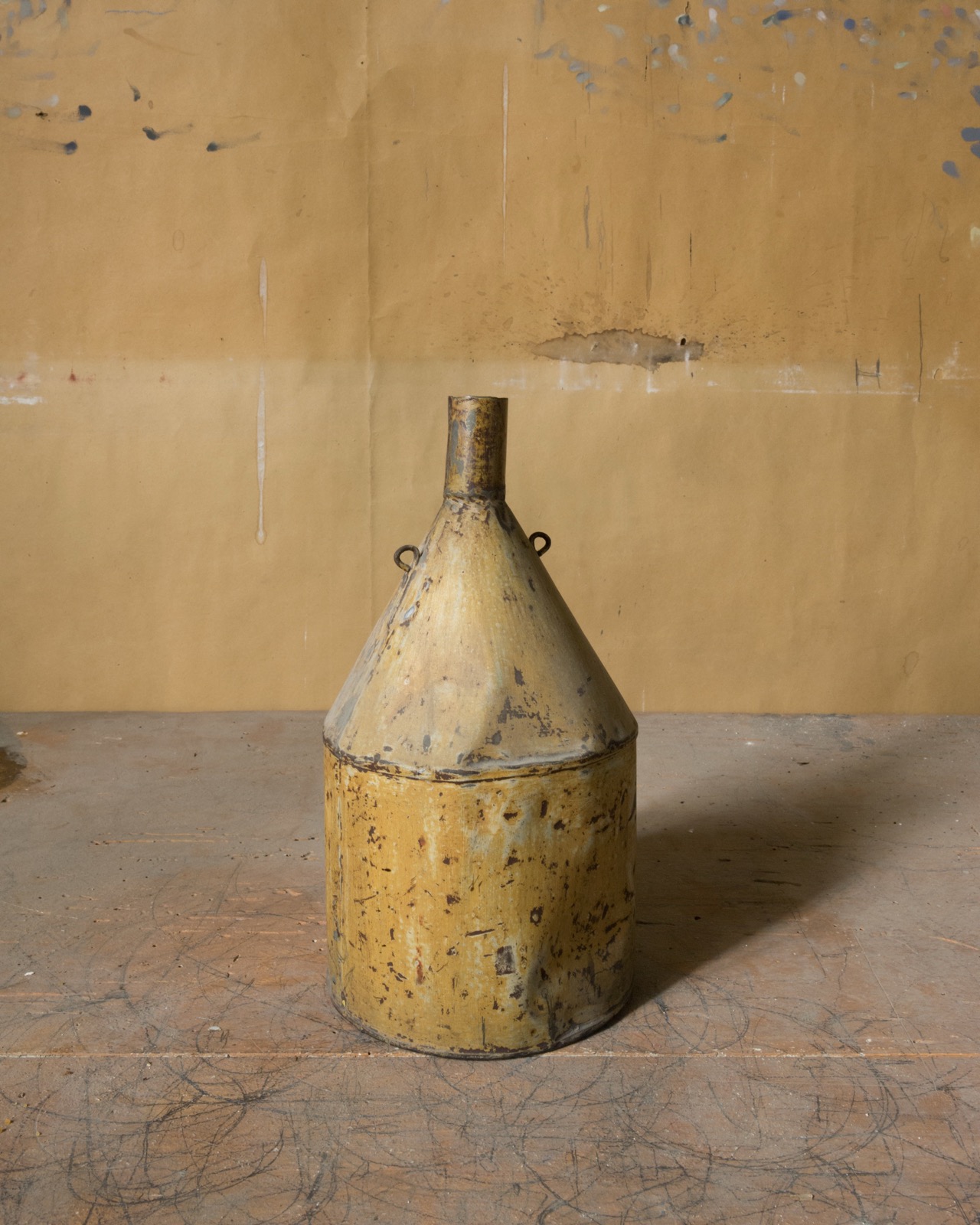
What does it mean to call an object the last one? Meyerowitz titles this picture The Last Object, and sets a single vessel at the center of a bare ground, alone where Morandi would have crowded a small congregation. It is a funnel-topped canister of tin or pressed metal, ochre and dun, its conical shoulder narrowing to a stub of a neck, two loop handles at the join. The surface is bruised — flaked, scratched, spotted with corrosion — the way humble things grow a face after decades of being handled.
Behind it rises a wall of soft tan plaster, stained and patched, a faint pencil mark near the top right like a measurement no one finished. The thing stands on a worktable scored with a fine web of scratches, and from its base a long shadow leans to the left, the only diagonal in a composition otherwise built of patient verticals. Light comes evenly, without drama, the studio light of Bologna that Morandi taught a century to love. The color holds to a narrow band — ochre object, ochre wall, grey floor — so the eye, denied incident, begins to read the small geography of dents and to attend the quiet.
I keep returning to the word last, and to the loneliness it lends this battered cone. These are the actual things from Morandi's studio, kept and dusted and inherited by another pair of eyes. To photograph one of them alone is to confess that the maker is gone and the company dispersed. The vessel was built to pour, to pass something from one container to another. Now it pours nothing, holds nothing, and is asked only to stand and be looked at — which it does, with the dignity of a thing that has outlived its use and gained, in exchange, a portrait.
What does it mean to call an object the last one? Meyerowitz titles this picture The Last Object, and sets a single vessel at the center of a bare ground, alone where Morandi would have crowded a small congregation. It is a funnel-topped canister of tin or pressed metal, ochre and dun, its conical shoulder narrowing to a stub of a neck, two loop handles at the join. The surface is bruised — flaked, scratched, spotted with corrosion — the way humble things grow a face after decades of being handled.
Behind it rises a wall of soft tan plaster, stained and patched, a faint pencil mark near the top right like a measurement no one finished. The thing stands on a worktable scored with a fine web of scratches, and from its base a long shadow leans to the left, the only diagonal in a composition otherwise built of patient verticals. Light comes evenly, without drama, the studio light of Bologna that Morandi taught a century to love. The color holds to a narrow band — ochre object, ochre wall, grey floor — so the eye, denied incident, begins to read the small geography of dents and to attend the quiet.
I keep returning to the word last, and to the loneliness it lends this battered cone. These are the actual things from Morandi's studio, kept and dusted and inherited by another pair of eyes. To photograph one of them alone is to confess that the maker is gone and the company dispersed. The vessel was built to pour, to pass something from one container to another. Now it pours nothing, holds nothing, and is asked only to stand and be looked at — which it does, with the dignity of a thing that has outlived its use and gained, in exchange, a portrait.