Four ropes run from the lower right corner up to a point we never see, and the whole picture hangs from them. They are the photograph's spine. The girl has been carried forward to the top of her arc, her body folded almost flat over the seat, hair flung loose into the white sky, and the camera has caught her at the one instant when she weighs nothing. A fraction earlier or later and she would simply be a child on a swing. Here she is a shape with no ground under it.
That is the wit of the frame. Horvat has set the swing not over a playground but over a pit of broken masonry and rubble, the rooftops of Cairo dissolving into haze behind. The light comes from behind her too, so she reads as a near-silhouette, the patterned dress and the bent arm legible but the face given over to shadow. The camera describes the diagonal of the ropes with great precision and lets nearly everything else go soft. What is sharp is the tension; what is vague is the world she swings above.
The picture comes from the long photo-essay Horvat made on assignment for the German magazine Revue in 1962, a circuit of the world that returned him from the fashion studios to the street. It is the kind of frame that justifies the whole detour: nothing posed, nothing explained, a girl and four ropes and an empty sky, held in balance by a photographer who understood that the strongest pictures are often the ones with the least in them.
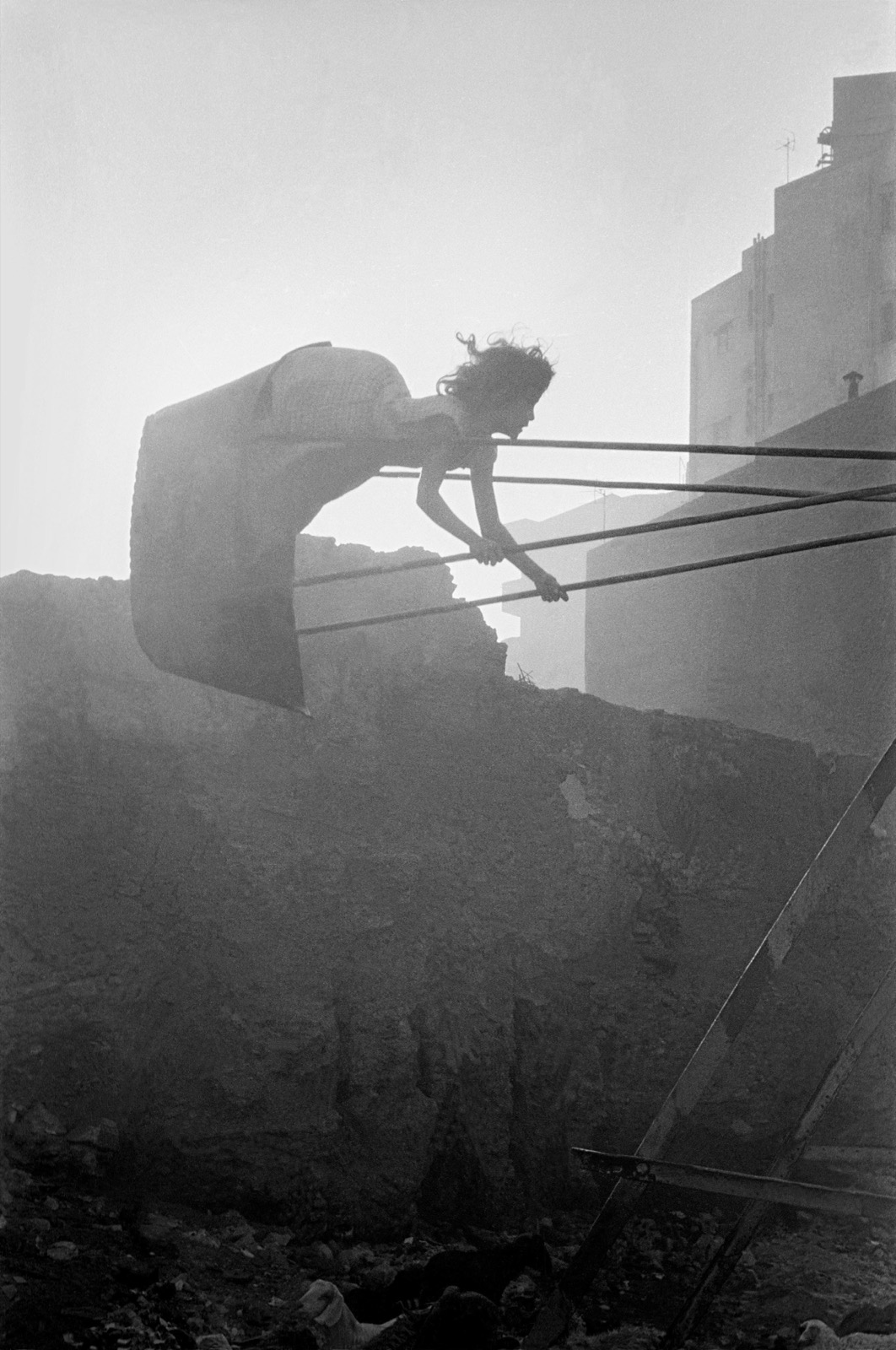
Four ropes run from the lower right corner up to a point we never see, and the whole picture hangs from them. They are the photograph's spine. The girl has been carried forward to the top of her arc, her body folded almost flat over the seat, hair flung loose into the white sky, and the camera has caught her at the one instant when she weighs nothing. A fraction earlier or later and she would simply be a child on a swing. Here she is a shape with no ground under it.
That is the wit of the frame. Horvat has set the swing not over a playground but over a pit of broken masonry and rubble, the rooftops of Cairo dissolving into haze behind. The light comes from behind her too, so she reads as a near-silhouette, the patterned dress and the bent arm legible but the face given over to shadow. The camera describes the diagonal of the ropes with great precision and lets nearly everything else go soft. What is sharp is the tension; what is vague is the world she swings above.
The picture comes from the long photo-essay Horvat made on assignment for the German magazine Revue in 1962, a circuit of the world that returned him from the fashion studios to the street. It is the kind of frame that justifies the whole detour: nothing posed, nothing explained, a girl and four ropes and an empty sky, held in balance by a photographer who understood that the strongest pictures are often the ones with the least in them.