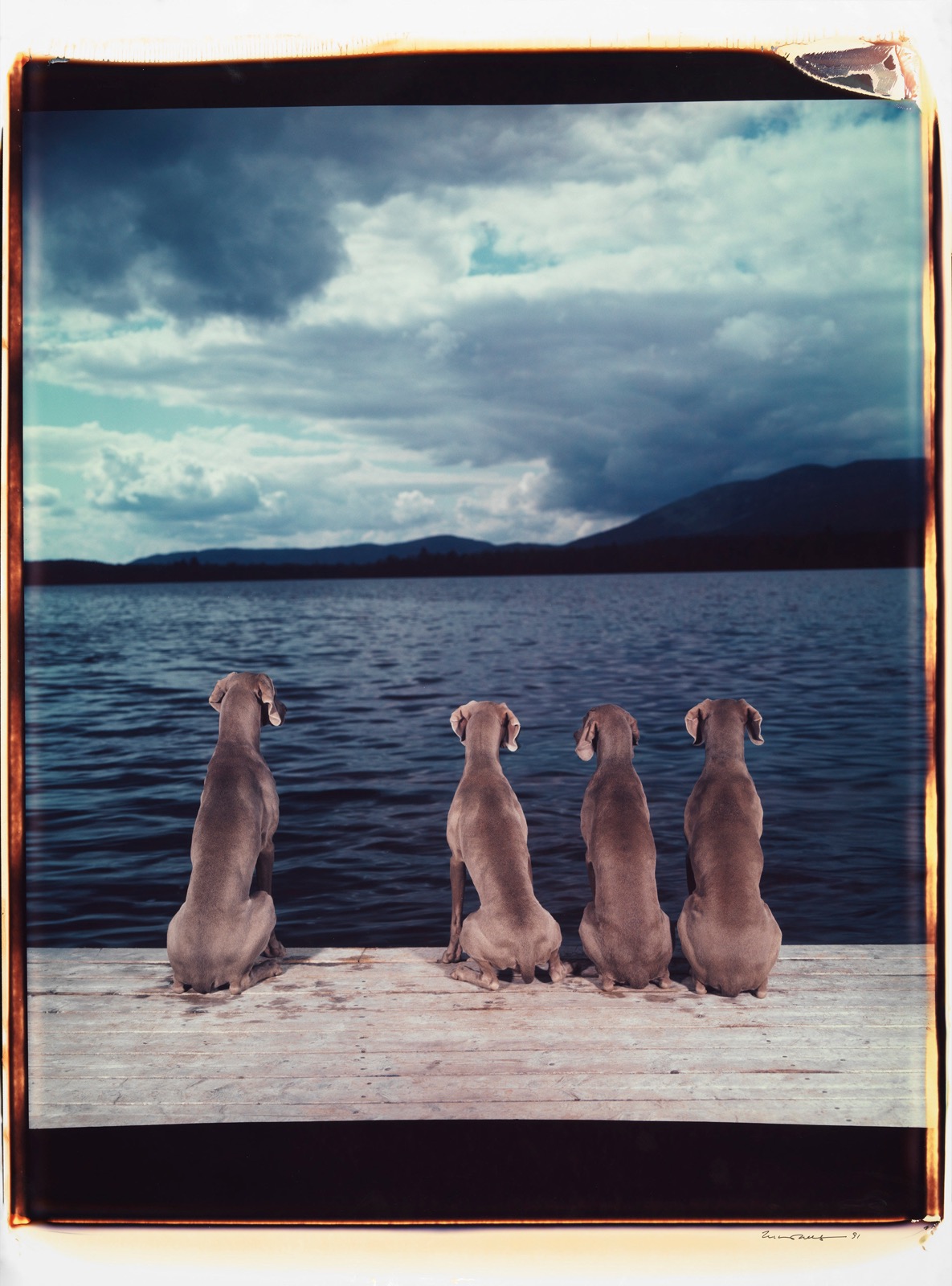
Start at the ragged edge, where the emulsion lifted as the print was peeled. This is a single sheet of Polaroid stock, roughly 20 by 24 inches, exposed once inside a camera so large it occupies a room, then processed by hand. There is no negative behind it, no edition to follow, no second chance — only this one print, its dye couplers fixed forever in the instant they were pulled. You can read that making all along the margins: the warm chemical bleed staining the borders, the artist's signature riding the lower edge of the sheet itself. The image does not float above its support; it is the support, chemistry and paper bound into a single irreplaceable thing.
What the process records is itself a kind of patience. Four Weimaraners sit in a row at the end of weathered planks, backs to us, the camera sharing their vantage rather than meeting their eyes. The dyes hold the bruised slate of a storm still deciding whether to arrive, and they hold, with that Polaroid fidelity to subtle color, the silvered fur that rhymes exactly with the metallic lake and the grain of the dock. Such tonal precision is not incidental; it is what this apparatus was built to do, and why Wegman walked into the Polaroid studio in the late 1970s and stayed for decades.
The result belongs to the lineage of his Weimaraner portraits, from Man Ray onward, now held by the Whitney, the Metropolitan Museum of Art, and the Centre Pompidou. Beneath the wit sits the oldest Romantic device — the figure with its back turned, contemplating the sublime — performed here by four wry familiars and pressed, once and unrepeatably, into a single sheet of light-sensitive paper.
Start at the ragged edge, where the emulsion lifted as the print was peeled. This is a single sheet of Polaroid stock, roughly 20 by 24 inches, exposed once inside a camera so large it occupies a room, then processed by hand. There is no negative behind it, no edition to follow, no second chance — only this one print, its dye couplers fixed forever in the instant they were pulled. You can read that making all along the margins: the warm chemical bleed staining the borders, the artist's signature riding the lower edge of the sheet itself. The image does not float above its support; it is the support, chemistry and paper bound into a single irreplaceable thing.
What the process records is itself a kind of patience. Four Weimaraners sit in a row at the end of weathered planks, backs to us, the camera sharing their vantage rather than meeting their eyes. The dyes hold the bruised slate of a storm still deciding whether to arrive, and they hold, with that Polaroid fidelity to subtle color, the silvered fur that rhymes exactly with the metallic lake and the grain of the dock. Such tonal precision is not incidental; it is what this apparatus was built to do, and why Wegman walked into the Polaroid studio in the late 1970s and stayed for decades.
The result belongs to the lineage of his Weimaraner portraits, from Man Ray onward, now held by the Whitney, the Metropolitan Museum of Art, and the Centre Pompidou. Beneath the wit sits the oldest Romantic device — the figure with its back turned, contemplating the sublime — performed here by four wry familiars and pressed, once and unrepeatably, into a single sheet of light-sensitive paper.