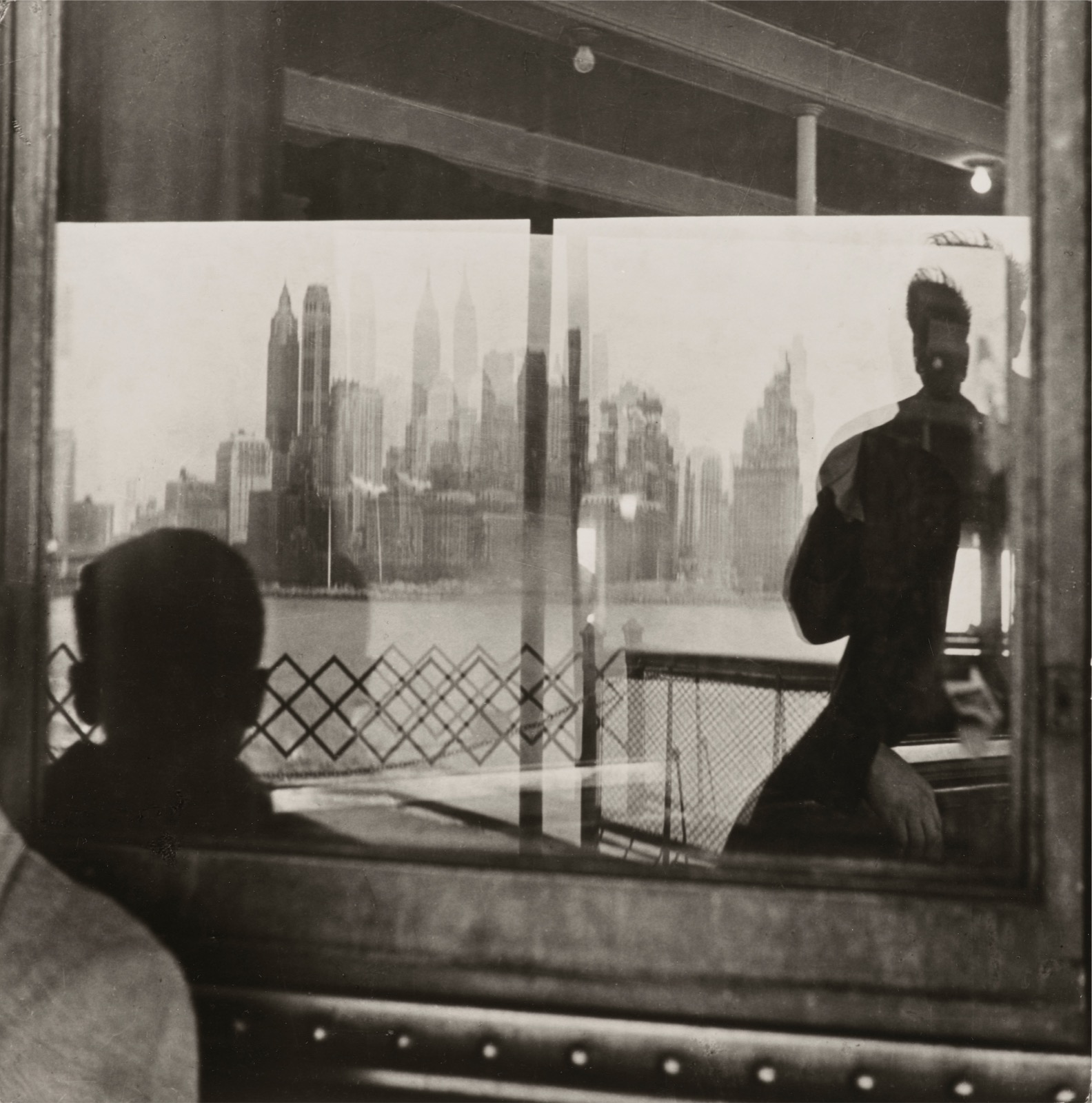
How many pictures are folded into this one? At least three. There is the dark interior of the Staten Island ferry, framed by a heavy wooden window with its row of brass studs along the sill. There is the skyline of lower Manhattan beyond the water, soft and silvered through the glass. And there is the man on the right, standing in shirtsleeves with one arm braced on the rail, whose figure is in fact a reflection laid over the city like a second exposure. Faurer made the window do the work that a darkroom does.
The arrangement is governed by that pane. A vertical mullion divides the view, and the diamond grillwork of the deck rail runs as a band across the lower third, holding the river in place. On the left, a passenger's head is a black silhouette, faceless, turned toward the towers. The eye is asked to sort what is in front of the glass from what is behind it, and the sorting never quite resolves, which is the point Faurer is content to leave unsettled.
What keeps it from being a mere trick is the temperature of feeling. The reflected man seems to occupy the skyline, to stand among the buildings as though the city were his own apparition. New York here is not a destination but a haze, present and unreachable in the same instant. Faurer, who loved the accidental theater of glass, found in this 1946 crossing a way to picture the modern condition of being inside and outside a place at once.
How many pictures are folded into this one? At least three. There is the dark interior of the Staten Island ferry, framed by a heavy wooden window with its row of brass studs along the sill. There is the skyline of lower Manhattan beyond the water, soft and silvered through the glass. And there is the man on the right, standing in shirtsleeves with one arm braced on the rail, whose figure is in fact a reflection laid over the city like a second exposure. Faurer made the window do the work that a darkroom does.
The arrangement is governed by that pane. A vertical mullion divides the view, and the diamond grillwork of the deck rail runs as a band across the lower third, holding the river in place. On the left, a passenger's head is a black silhouette, faceless, turned toward the towers. The eye is asked to sort what is in front of the glass from what is behind it, and the sorting never quite resolves, which is the point Faurer is content to leave unsettled.
What keeps it from being a mere trick is the temperature of feeling. The reflected man seems to occupy the skyline, to stand among the buildings as though the city were his own apparition. New York here is not a destination but a haze, present and unreachable in the same instant. Faurer, who loved the accidental theater of glass, found in this 1946 crossing a way to picture the modern condition of being inside and outside a place at once.