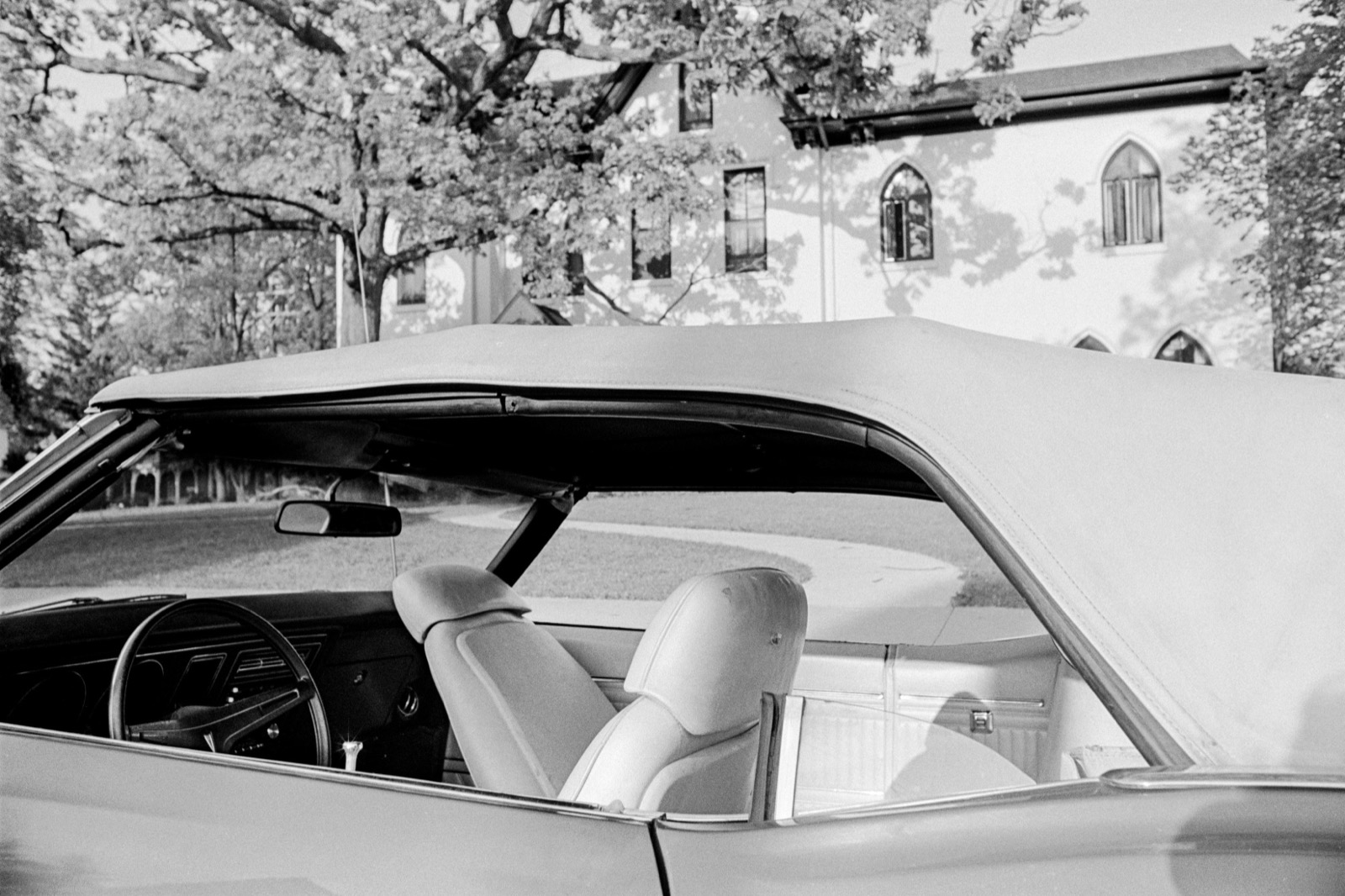
The whole picture turns on a single rhyme: the taut white vinyl of the convertible's raised top and, behind it, the pale plastered wall of a church whose lancet windows lift into pointed arches. Winter lets the two whites answer each other across the frame, the manufactured curve of the roof set against the older, ecclesiastical geometry, so that an ordinary parked car becomes a small argument about what endures. Nothing moves. The steering wheel, the cool bucket seats, the chrome door-pull catching one hard point of sun—all of it waits, framed by the open window like a second picture inside the first.
This is the descriptive intelligence that runs through Winter's Ohio work of the early 1970s, made in the same years that Shore, Sternfeld, and the New Topographics circle were teaching American photography to look plainly at the built vernacular of the country. Winter belongs to that lineage of patient, formally exact observation, though he keeps his attention close and unpolemical: a single car, a single façade, the dappled spring foliage laid in soft grays across the upper register. He understood that the camera describes best when it refrains from comment.
What holds the eye is the photographer's command of tone. The print carries a full, unhurried scale of grays—shaded upholstery to bright roof to the luminous wall beyond—so the boundary between automobile and architecture softens into a continuous surface of light. The result is quietly monumental: a machine of motion stilled before a house of permanence, the two reconciled by nothing more than a sympathetic eye and the right afternoon.
The whole picture turns on a single rhyme: the taut white vinyl of the convertible's raised top and, behind it, the pale plastered wall of a church whose lancet windows lift into pointed arches. Winter lets the two whites answer each other across the frame, the manufactured curve of the roof set against the older, ecclesiastical geometry, so that an ordinary parked car becomes a small argument about what endures. Nothing moves. The steering wheel, the cool bucket seats, the chrome door-pull catching one hard point of sun—all of it waits, framed by the open window like a second picture inside the first.
This is the descriptive intelligence that runs through Winter's Ohio work of the early 1970s, made in the same years that Shore, Sternfeld, and the New Topographics circle were teaching American photography to look plainly at the built vernacular of the country. Winter belongs to that lineage of patient, formally exact observation, though he keeps his attention close and unpolemical: a single car, a single façade, the dappled spring foliage laid in soft grays across the upper register. He understood that the camera describes best when it refrains from comment.
What holds the eye is the photographer's command of tone. The print carries a full, unhurried scale of grays—shaded upholstery to bright roof to the luminous wall beyond—so the boundary between automobile and architecture softens into a continuous surface of light. The result is quietly monumental: a machine of motion stilled before a house of permanence, the two reconciled by nothing more than a sympathetic eye and the right afternoon.