Series: Fashion
Archival Pigment Print.
Edition of 5
20 x 24 in / 50 × 60 cm
Edition of 5
30 x 40 in / 76 × 101 cm
Edition of 3
46 3/4 x 60 1/2 in / 118.7 x 153.7 cm
Edition of 1
59 x 76 3/4 in / 150 x 195 cm
20 x 24 in / 50 × 60 cm
Edition of 5
30 x 40 in / 76 × 101 cm
Edition of 3
46 3/4 x 60 1/2 in / 118.7 x 153.7 cm
Edition of 1
59 x 76 3/4 in / 150 x 195 cm
Hand-signed by artist, mounted, titled, editioned and print date in ink label affixed to mount verso
© The Artist

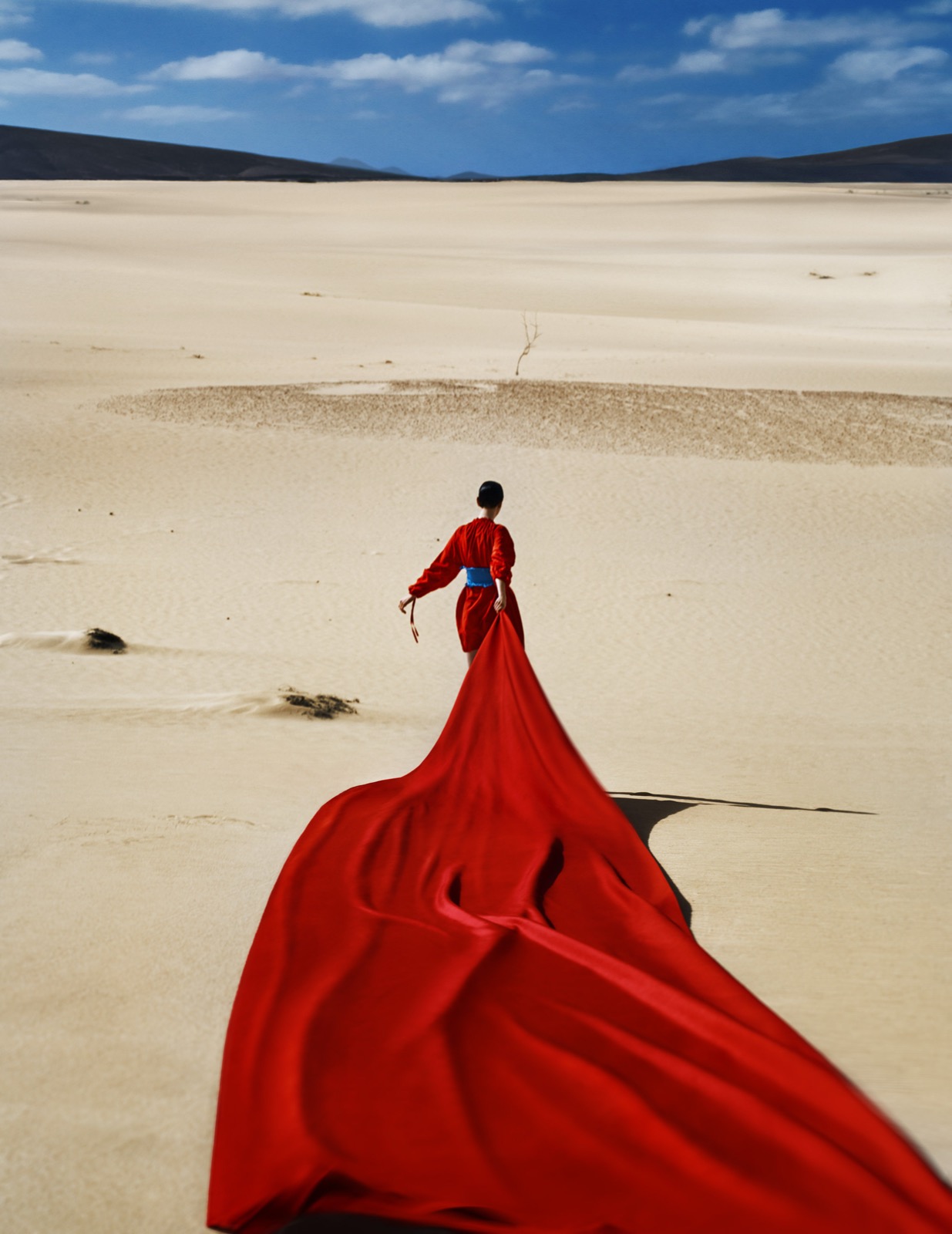
The dress does not end. It pours from the woman's waist and runs for yards across the sand, a single river of red that is the only saturated thing in a bleached world. Everything else has been drained toward neutrality—the pale plain of Fuerteventura, the volcanic hills smudged at the horizon, the cool indifferent blue overhead. Against that emptiness the fabric reads as pure assertion: look here, and nowhere else. To photograph a figure this way is to stage desire itself, to make a body into a wound of color the eye cannot refuse.
She walks away from us. The face is withheld, the back turned, so there is no person to meet, only a destination she alone can see. This is the photograph's quiet severity. The red garment promises a heroine and then denies us the heroine, leaving the gorgeous trailing tail to do the work a face would do—to carry the feeling, to perform the solitude. We are seduced and informed at once: that what fashion photography sells is not the dress but the longing to be the one wearing it, vanishing into landscape.
Txema Yeste, who came to fashion by way of photojournalism, knows that a picture persuades through the friction of opposites. Here the friction is total—organic flesh against geometric waste, abundance against scarcity, the staged against the found. The trade winds that flattened these dunes have not touched the silk; it lies arranged, deliberate, an artifact dropped into wilderness. The result is less a record of a place than an argument about looking: that beauty, isolated and made absolute, becomes a kind of austerity. The image keeps its spectacle and its melancholy in the same frame, and refuses to choose.