Joel Meyerowitz American, b. 1938

Fallen Man, Paris, 1967.
Series: 35 mm - Color
Archival pigment print. Printed later.
Edition of 15
20 x 24 in / 50 × 60 cm

Edition of 10
30 x 40 in / 76 × 101 cm

Edition of 5
48 x 60 in / 121 × 152 cm

Edition of 3
60 x 75 in / 152.4 x 190.5 cm
Hand-signed by artist, mounted, titled, editioned and print date in ink label affixed to mount verso
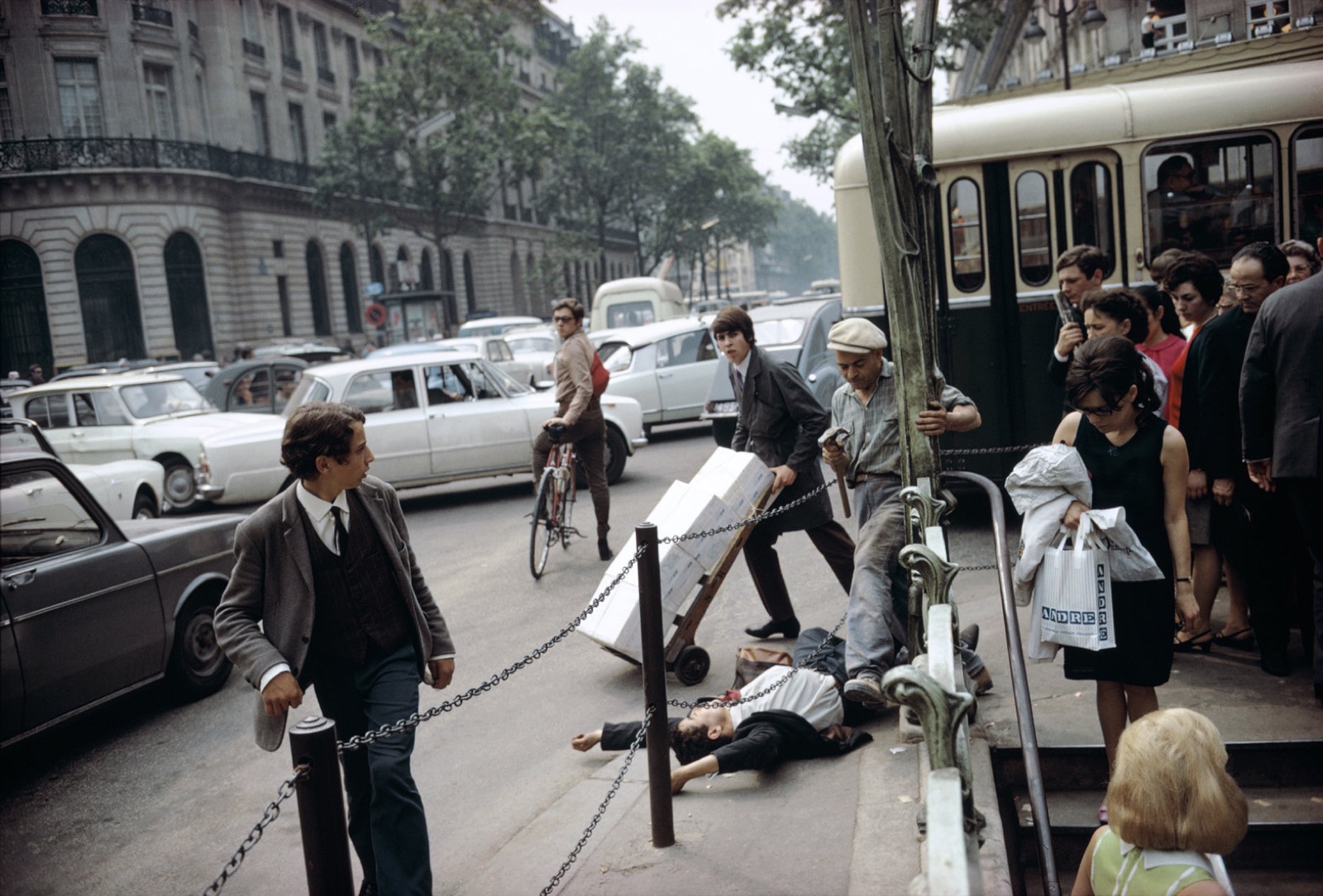
A man lies on the Paris pavement behind a chain railing while the crowd at the bus stop looks elsewhere, and a single young man in a grey suit turns back with an expression poised between concern and disbelief. Joel Meyerowitz made this picture in 1967, in the heat of his early years on the street, and it remains one of his most quietly unsettling. Nothing is explained. Has the man fainted, fallen, died? The photograph holds the question open and lets the indifference of the city answer it.

Meyerowitz was then among the first serious photographers to commit to color, at a time when the art world still dismissed it as merely commercial. Having taken to the street in 1962 in the wake of Robert Frank, he worked in defiant Kodachrome and proved that color could carry the full weight of human drama. The summer greens, the cream of a Paris bus, the scattered reds of the traffic all heighten rather than soften the scene, while the low chain slices the frame like a stage rail, casting us as just another bystander unsure whether to step forward.

His pioneering vision would later flower in the celebrated Cape Light series of 1978, a landmark in the acceptance of color photography as art, and place him in the permanent collections of the Museum of Modern Art, the Metropolitan, and beyond. A generous teacher and writer, he has shaped how we understand the medium itself. This early Paris street frame is the work of a young master discovering that the decisive moment could be rendered in full color, and that the most ordinary corner could become a theater for the mystery of strangers.