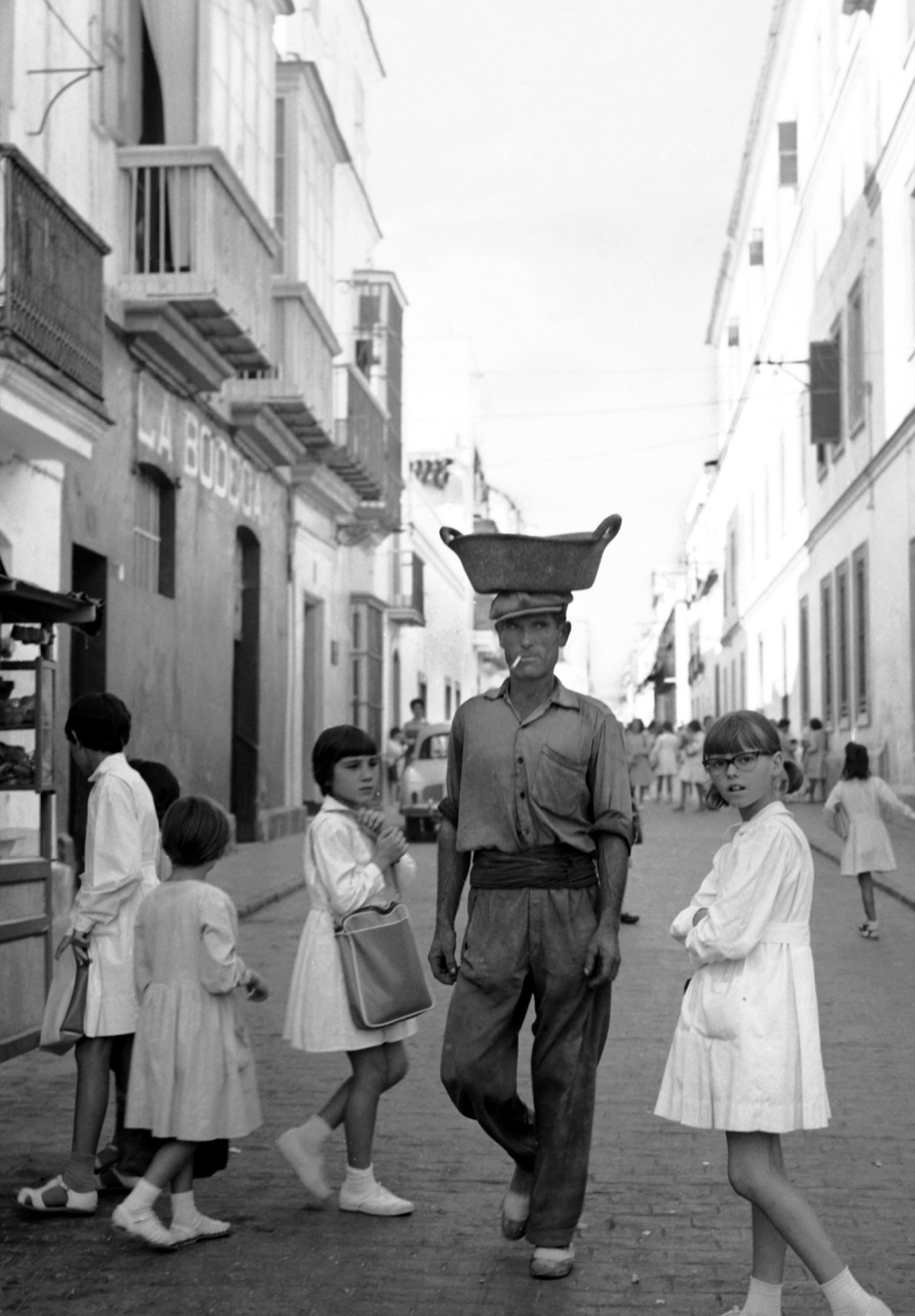
What is in the tub? That is what you want to know, and it is exactly what you are never going to be told. The man comes straight down the middle of the street toward you with a battered metal basin balanced flat on his head, and the thing is empty — or empty enough that he carries it the way other men carry a hat, casually, with a cigarette going at the corner of his mouth and both hands free. He has either delivered whatever it held or is on his way to fetch it, and you arrive, as photographs always make you arrive, at precisely the wrong moment to find out. The basin is a question with the answer scooped out of it.
Everything else conspires to make him a kind of accidental king. The narrow street of Puerto de Santa María funnels back behind him, balconies and shuttered windows, the painted word BODEGA half-swallowed by shadow on the wall to the left, a little parked car wedged in the distance like a beetle. And ranged on either side of him, in white smocks that the selenium has toned to a soft pewter, the children — a girl clutching a bright satchel, two more in profile, and on the right one bespectacled girl with her arms folded who has turned her whole attention not on the man but on the camera, on us. She is the one who has noticed there is something to notice.
Masats was in his twenties when he made this, one of the young Spaniards remaking the country's image away from official solemnity into something with a wink in it. You feel the wink here. The man processes; the town ignores him; the girl in glasses keeps her counsel; and the empty vessel rides above it all, perfectly level, refusing to say what it is for. Printed later in rich selenium-toned silver, it holds its small, dry comedy without ever quite letting you laugh.
What is in the tub? That is what you want to know, and it is exactly what you are never going to be told. The man comes straight down the middle of the street toward you with a battered metal basin balanced flat on his head, and the thing is empty — or empty enough that he carries it the way other men carry a hat, casually, with a cigarette going at the corner of his mouth and both hands free. He has either delivered whatever it held or is on his way to fetch it, and you arrive, as photographs always make you arrive, at precisely the wrong moment to find out. The basin is a question with the answer scooped out of it.
Everything else conspires to make him a kind of accidental king. The narrow street of Puerto de Santa María funnels back behind him, balconies and shuttered windows, the painted word BODEGA half-swallowed by shadow on the wall to the left, a little parked car wedged in the distance like a beetle. And ranged on either side of him, in white smocks that the selenium has toned to a soft pewter, the children — a girl clutching a bright satchel, two more in profile, and on the right one bespectacled girl with her arms folded who has turned her whole attention not on the man but on the camera, on us. She is the one who has noticed there is something to notice.
Masats was in his twenties when he made this, one of the young Spaniards remaking the country's image away from official solemnity into something with a wink in it. You feel the wink here. The man processes; the town ignores him; the girl in glasses keeps her counsel; and the empty vessel rides above it all, perfectly level, refusing to say what it is for. Printed later in rich selenium-toned silver, it holds its small, dry comedy without ever quite letting you laugh.