Series: 1 - House Hunting
Archival pigment print mounted on aluminium Dibond.
Edition of 10 + 3 AP
61 x 50.8 cm / 24 x 20 in
Edition of 5 + 1AP
96.5 x 76.2 cm / 38 x 30 in
Edition of 3 + 1AP
121.9 x 96.5 cm / 48 x 38 in
Edition of 1 + 1 AP NFS
187.3 x 149.9 cm / 73 3/4 x 59 in
61 x 50.8 cm / 24 x 20 in
Edition of 5 + 1AP
96.5 x 76.2 cm / 38 x 30 in
Edition of 3 + 1AP
121.9 x 96.5 cm / 48 x 38 in
Edition of 1 + 1 AP NFS
187.3 x 149.9 cm / 73 3/4 x 59 in
Signed, titled, numbered, and dated on a label affixed to the verso of the mount
© The Artist
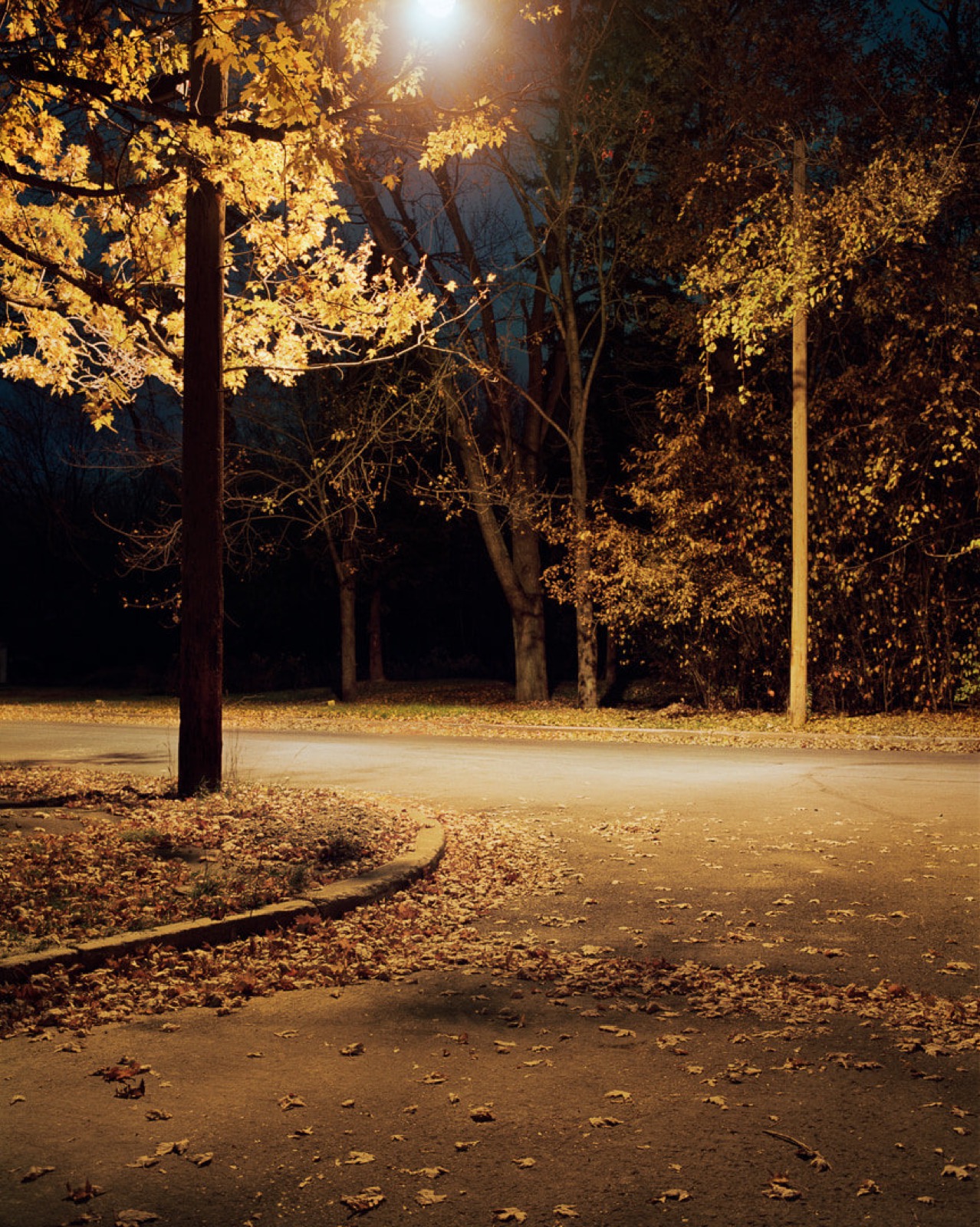
The lamp is pouring itself down the corner, blooming into a white corona at the top of the frame and gilding one tree into amber before the asphalt below cools to velvet. It keeps doing this — flooding, settling, holding — for as long as the shutter stays open, which is the whole argument. Where a film would let the streetlamp flicker and a figure cross the corner, Hido holds the night still until it settles. Stillness here is not the absence of an event but the medium's own condition, made visible.
What kind of image is this, exactly. Not a document — there is nobody to document, no car, no lit window, only a bending residential corner and a curb strewn with leaves the lamp turns to rust. Not quite a fiction either, though it borrows the grammar of the establishing shot, the frame that in a film would precede an arrival. Hido built his reputation on precisely this suspension: the American suburb photographed from the street with a large-format camera, the night assembling itself slowly onto the negative. The pictures behave like film stills cut loose from any film, waiting for a narrative that the photograph has no obligation to supply.
That withholding is the work's intelligence. The autumnal register — golds against deep shadow, the branches thinning into blue-black — is among the most sought registers of his nocturnes, and the scale, mounted on aluminium, lets the corner hold a room. These images entered the Whitney, SFMOMA, the Guggenheim, not as records of a place but as a study of how photography keeps time: by stopping it, and asking us to notice what stopping does.