Todd Hido American, b. 1968

2256-a, 1999.
Series: 2 - Outskirts
Archival pigment print mounted on aluminium Dibond.
Edition of 10 + 3 AP
61 x 50.8 cm / 24 x 20 in
Sold Out

Edition of 5 + 1AP
96.5 x 76.2 cm / 38 x 30 in
Sold Out

Edition of 3 + 1AP
121.9 x 96.5 cm / 48 x 38 in
Sold Out

Edition of 1 + 1 AP NFS
187.3 x 149.9 cm / 73 3/4 x 59 in
Signed, titled, numbered, and dated on a label affixed to the verso of the mount
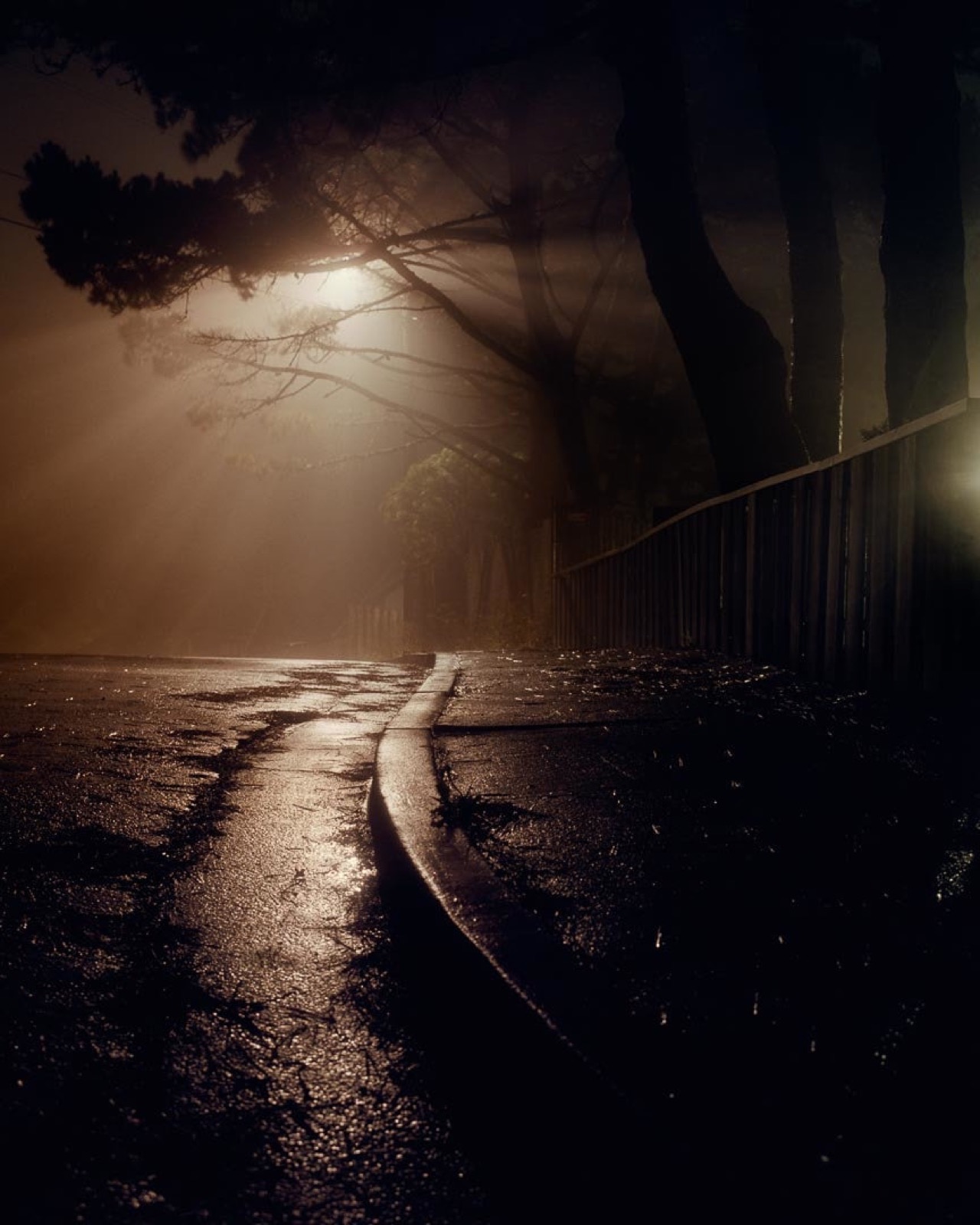
Some pictures want to be the still frame a film forgot to keep moving past. This is one of them, and what fixes it is a single thread of amber light, pooled along the ridge of a low concrete divider that runs straight down the wet lane toward us, like a seam of poured metal cooling in the dark. Everything else in 2256-a is organized around that line. The tar-black asphalt is crazed into rain-beaded mosaic; the fence fails into shadow at right; the streetlamp flares behind winter pines into long diagonal rays. The divider is a spine and also a vector — the one element insisting that this nowhere leads somewhere.

That is the condition Todd Hido works inside. The long exposure that gives the image its sodium-and-sepia haze is not an effect but an admission: time has passed across this frame, yet nothing has moved. The street is emptied of event and made to stand for one. It wants the duration of cinema — the slow tracking shot down a road at night, headlights, the promise of an arrival — and is denied all of it, left with a single instant held open far longer than an instant should be.

Made on film from the House Hunting and Houses at Night series — Hido often shooting from an idling car — these are pictures about the American suburb after midnight, no window lit, no figure to absorb the gaze. The afterlife of such an image is domestic: archival pigment on Dibond, collected by SFMOMA, the Whitney, the Guggenheim. But what it describes is stranger than its provenance. A road left alone to do the haunting that people usually do.