Bruce Weber American, b. 1946

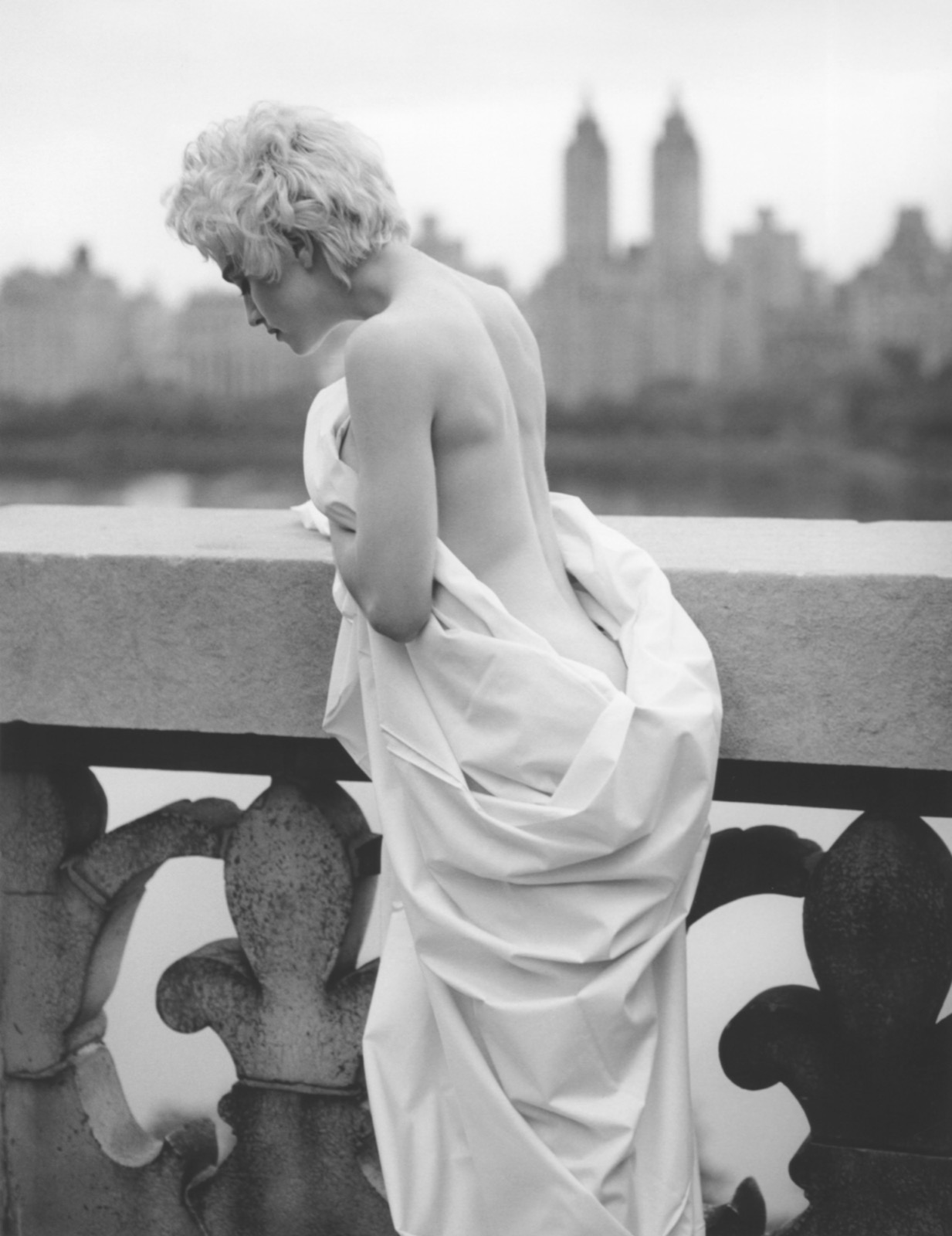
Madonna, New York City, 1986.
Gelatin Silver Print.
Edition of 15
11 x 14 in / 27 x 35 cm

Edition of 5
20 x 24 in / 50 x 60 cm
Hand-signed by artist, titled, numbered and dated on print verso

Fame turns the body into a place others believe they already know. Here the most photographed woman of her decade gives the camera her back. The bleached crop of platinum hair, the bare shoulder blade, the white sheet slipping toward the terrace floor — all of it offered, and yet the face is withheld, bowed and turned to profile, looking down at something we are not permitted to see.

The picture works by reversal. Across the reservoir the towers of the San Remo rise into a flat pearl sky; the skyline is the public fact, the postcard anyone can own. The skin is meant to be the private fact. But the photograph trades their values. The city is soft, dissolved, almost weatherless behind her, while the back is rendered with clinical exactness — the vertebra, the tension along the spine, the drapery let go rather than arranged. To photograph a star this way is to insist that the real intimacy is not nudity but inattention: the moment she stops performing for us.

What snags is lower in the frame, where nothing was staged. The ornamental cast-iron railing, fleur-de-lis worn to a leprous gray, eats the foreground and rhymes with the stone balustrade she leans on. It is municipal, anonymous, indifferent to celebrity, holding the bottom third like ballast. The body floats above this corroded grille as if the city's hardware were the only thing keeping the apparition in place.

This is among the studies made when the era's reigning image-maker and its reigning image met in 1986, and the gelatin silver surface keeps that meeting in a long gray scale that refuses both gloss and judgment. The print describes a famous body and declines to deliver it. That refusal is the subject.