Series: 35 mm - Color
Archival pigment print. Printed later.
Edition of 20
20 x 24 in / 50 × 60 cm
Edition of 10
30 x 40 in / 76 × 101 cm
Edition of 5
48 x 60 in / 121 × 152 cm
Edition of 3
60 x 75 in / 152.4 x 190.5 cm
20 x 24 in / 50 × 60 cm
Edition of 10
30 x 40 in / 76 × 101 cm
Edition of 5
48 x 60 in / 121 × 152 cm
Edition of 3
60 x 75 in / 152.4 x 190.5 cm
Hand-signed by artist, mounted, titled, editioned and print date in ink label affixed to mount verso
© The Artist

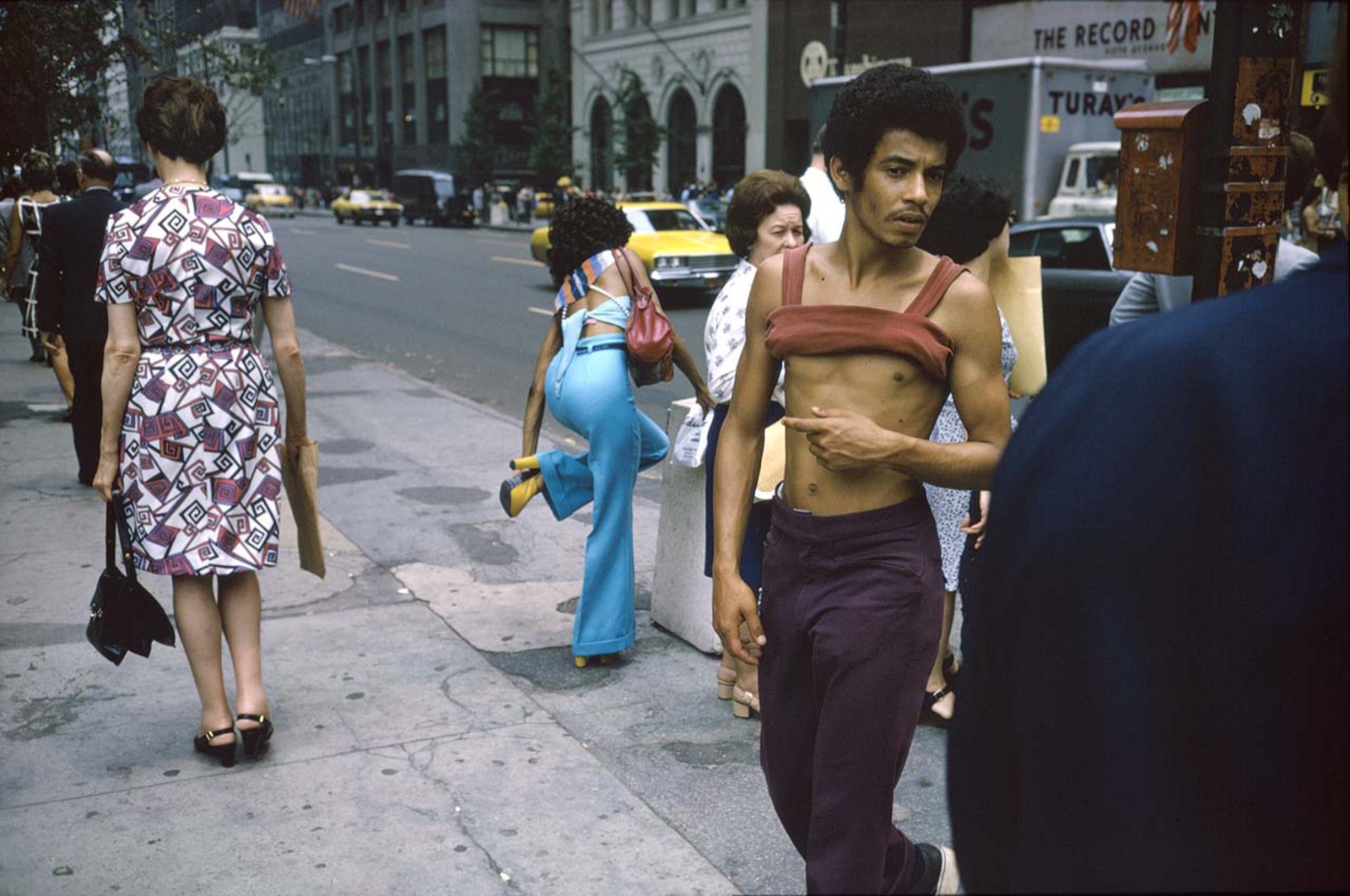
A street photographer of the older, black-and-white persuasion would have made this a study in posture and gesture, a question of who leans where. Meyerowitz, working in color in 1974, lets the picture be organized by something a monochrome frame could never admit as a subject: the rust-terracotta wrap slung across a young man's bare chest, and the wine-dark trousers below it, two registers of nearly the same red holding the center the way a single chord holds a passage of music. Take the color away and the man is merely shirtless. Leave it in and he becomes the warm axis the whole sidewalk turns on.
What the camera describes here it describes all at once, with no hierarchy of attention. The man strides toward us, his right hand pointing down across his body at nothing in particular; a woman in a dress of purple-and-white diamonds walks away with a paper bag; another, in cobalt bell-bottoms with a red shoulder bag, crosses the middle distance on platform soles. A yellow cab idles, a truck lettered TURAY'S sits at the far curb, and a vendor's cabinet of inlaid wood glows at the right like furniture left in the sun. Each is given the same even daylight, the same plain due. The picture does not choose for us; it lays the block out and trusts us to sort it.
That trust is the discipline. The blurred blue shoulder cropping the right edge reminds us the frame was cut from a moving world, that the photographer stood in the crowd rather than above it. This sheet belongs to the New York street pictures Meyerowitz made through the seventies, the decade in which he argued, by example, that color was not a decoration laid over the document but the document itself. Here the argument is won quietly, on one warm note carried across a man's chest.