To photograph the overlooked is to confer a value the world withheld. These four young men — extras, the uncast, bodies hired to stand at the edge of someone else's story — were waiting out a shoot at Coppola's Zoetrope when Bruce Weber, who across the 1980s taught American advertising to want exactly such bodies, photographed them as if they were the event. The camera does not flatter the situation; it elevates it. That is the older, more troubling power of the medium: to make the incidental look chosen.
The picture is built on an incongruity it refuses to resolve. One extra has hauled himself onto the bench seat of a stranger's convertible and thrown a leg straight up, hand clamped to the ankle, a white athletic wrap still on his foot — a ballet barre exercise performed with no barre, in flip-flop daylight, before an audience of no one. A body disciplined to the proportions of classical sculpture is set down among steering wheels, denim, and asphalt, under a flat California sun that grants no shadow its mercy. To look is to feel the seam between the heroic and the merely available.
What Weber understood is that glamour is not a property of the famous but a decision made by the photographer. The mohawked figure leaning away with a guitar, the two sprawled on hoods in boredom — none of them were chosen for the film, and all of them have been chosen here. The gelatin silver print keeps every gradient of that bleaching light, which is to say it keeps the argument: that the camera's gift and its danger are the same gift, the conversion of waiting into permanence.
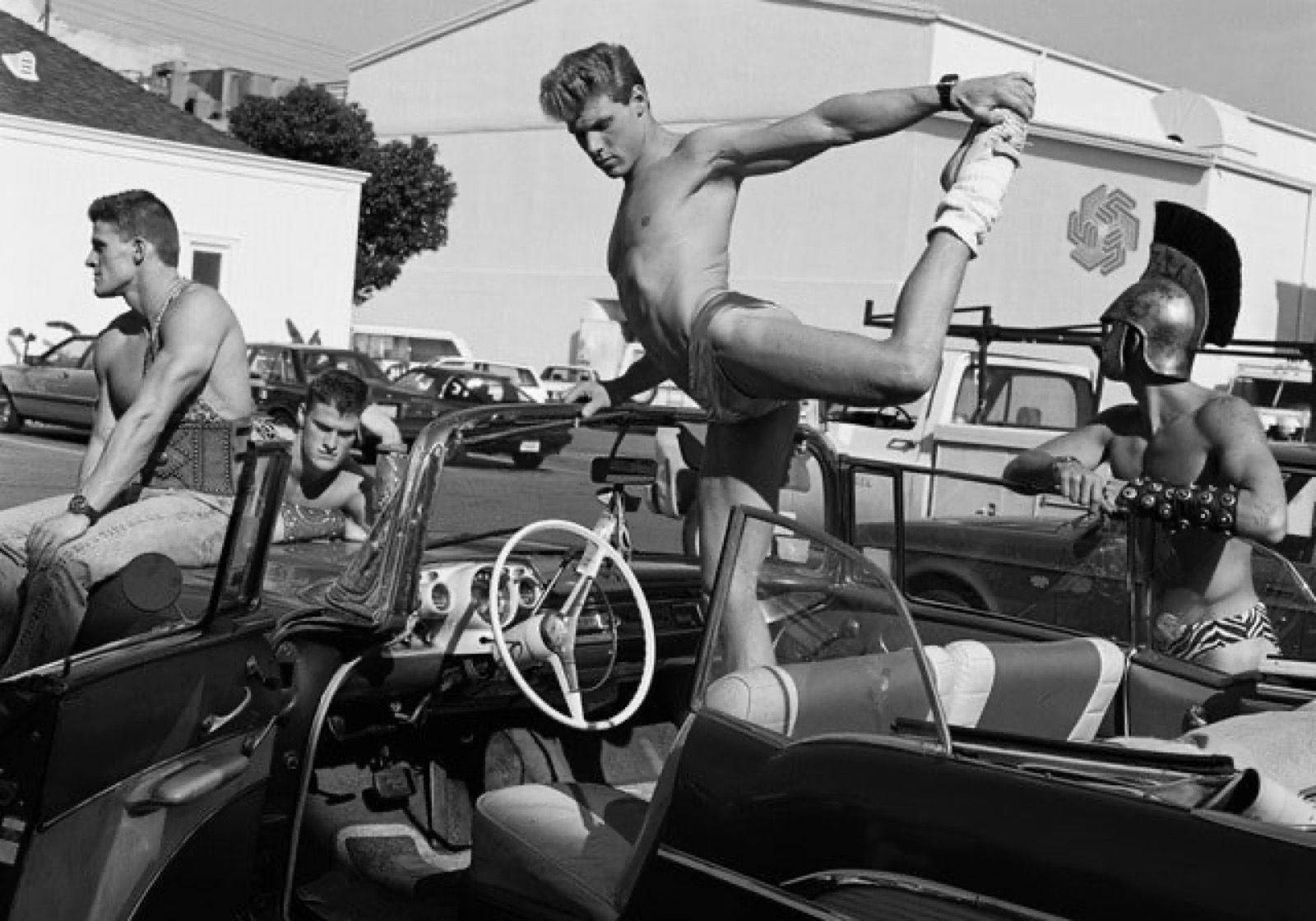
To photograph the overlooked is to confer a value the world withheld. These four young men — extras, the uncast, bodies hired to stand at the edge of someone else's story — were waiting out a shoot at Coppola's Zoetrope when Bruce Weber, who across the 1980s taught American advertising to want exactly such bodies, photographed them as if they were the event. The camera does not flatter the situation; it elevates it. That is the older, more troubling power of the medium: to make the incidental look chosen.
The picture is built on an incongruity it refuses to resolve. One extra has hauled himself onto the bench seat of a stranger's convertible and thrown a leg straight up, hand clamped to the ankle, a white athletic wrap still on his foot — a ballet barre exercise performed with no barre, in flip-flop daylight, before an audience of no one. A body disciplined to the proportions of classical sculpture is set down among steering wheels, denim, and asphalt, under a flat California sun that grants no shadow its mercy. To look is to feel the seam between the heroic and the merely available.
What Weber understood is that glamour is not a property of the famous but a decision made by the photographer. The mohawked figure leaning away with a guitar, the two sprawled on hoods in boredom — none of them were chosen for the film, and all of them have been chosen here. The gelatin silver print keeps every gradient of that bleaching light, which is to say it keeps the argument: that the camera's gift and its danger are the same gift, the conversion of waiting into permanence.