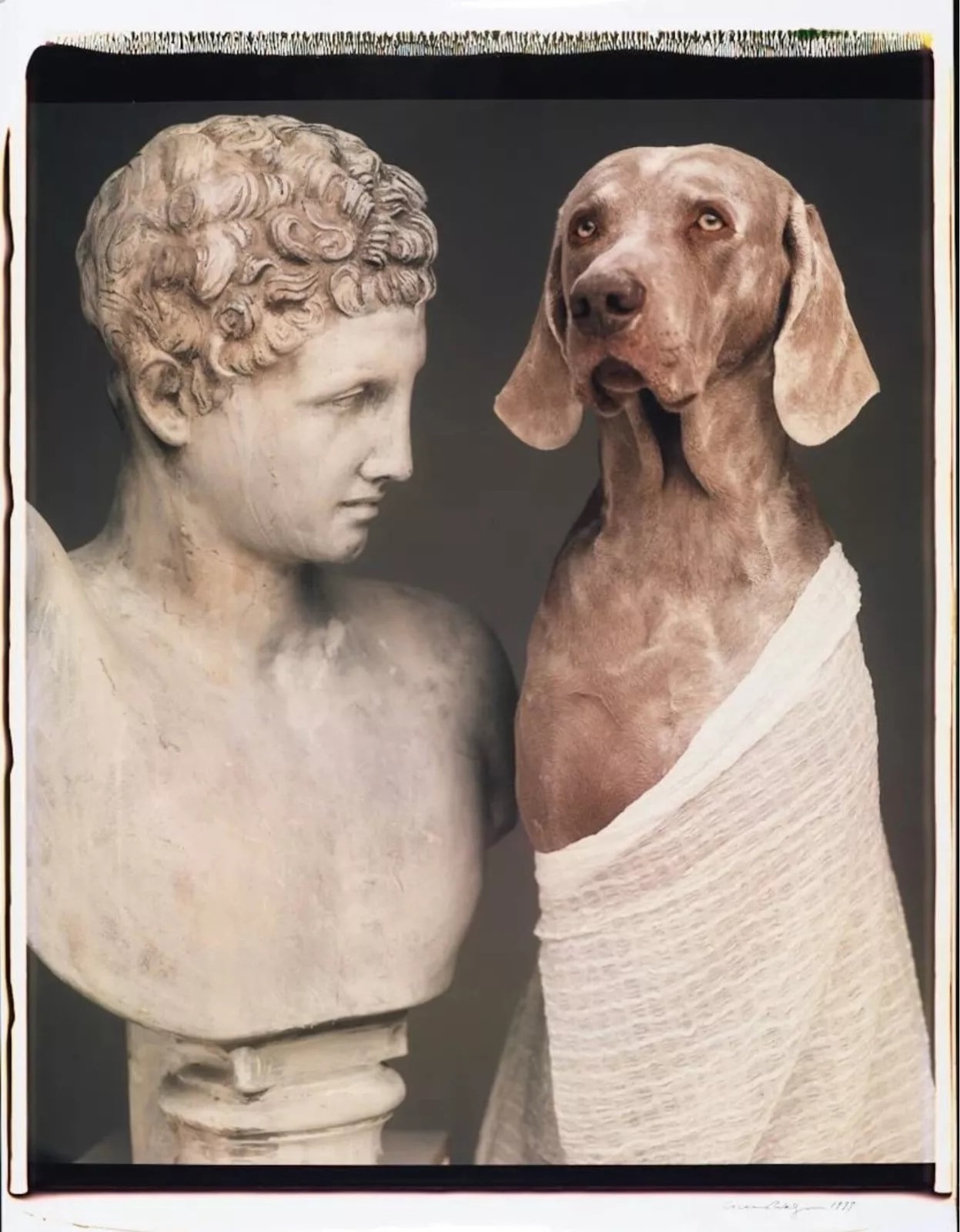
Look first not at the dog but at the ragged top edge of the picture, where the emulsion has bled into a torn fringe and the dye has run thin. That serration is the signature of the machine that made this: the room-sized Polaroid 20×24 camera, which spits its sheet through steel rollers and develops it on the spot, in the open, with no negative behind it. There is no other print. What you are looking at is the unique physical event of dye-coupler diffusion, fixed once, in 1999, and never repeatable.
Wegman understood that this apparatus does not merely enlarge — it touches. The Weimaraner's coat and the gauze toga and the chalky pores of the marble are all rendered in the same dense, slightly sweated color, because all three were caught by one shallow sheet of chemistry under the same hot lights. The bust is cool stone, profiled in pale plaster-white; the living animal beside it is warmed flesh-grey, its eye holding a wet amber the marble can never have. The drapery slung over the dog's shoulder repeats, in soft cloth, the carved fall of antique cloth on the broken torso opposite. The camera flattens this conceit until you must concede the joke is also a problem in tone and surface: how does instant dye describe stone, fur, and woven linen as one continuous skin?
This is the deep pleasure of the object. The dog impersonates a classical head and the Polaroid impersonates the permanence of sculpture, yet the print remains the most fragile thing in the room — light-sensitive, singular, mortal. Wegman, who made the 20×24 his own instrument across decades, lets the apparatus stage its own vanity: antiquity and instantaneity, marble and emulsion, facing each other across the seam of the frame.
Look first not at the dog but at the ragged top edge of the picture, where the emulsion has bled into a torn fringe and the dye has run thin. That serration is the signature of the machine that made this: the room-sized Polaroid 20×24 camera, which spits its sheet through steel rollers and develops it on the spot, in the open, with no negative behind it. There is no other print. What you are looking at is the unique physical event of dye-coupler diffusion, fixed once, in 1999, and never repeatable.
Wegman understood that this apparatus does not merely enlarge — it touches. The Weimaraner's coat and the gauze toga and the chalky pores of the marble are all rendered in the same dense, slightly sweated color, because all three were caught by one shallow sheet of chemistry under the same hot lights. The bust is cool stone, profiled in pale plaster-white; the living animal beside it is warmed flesh-grey, its eye holding a wet amber the marble can never have. The drapery slung over the dog's shoulder repeats, in soft cloth, the carved fall of antique cloth on the broken torso opposite. The camera flattens this conceit until you must concede the joke is also a problem in tone and surface: how does instant dye describe stone, fur, and woven linen as one continuous skin?
This is the deep pleasure of the object. The dog impersonates a classical head and the Polaroid impersonates the permanence of sculpture, yet the print remains the most fragile thing in the room — light-sensitive, singular, mortal. Wegman, who made the 20×24 his own instrument across decades, lets the apparatus stage its own vanity: antiquity and instantaneity, marble and emulsion, facing each other across the seam of the frame.