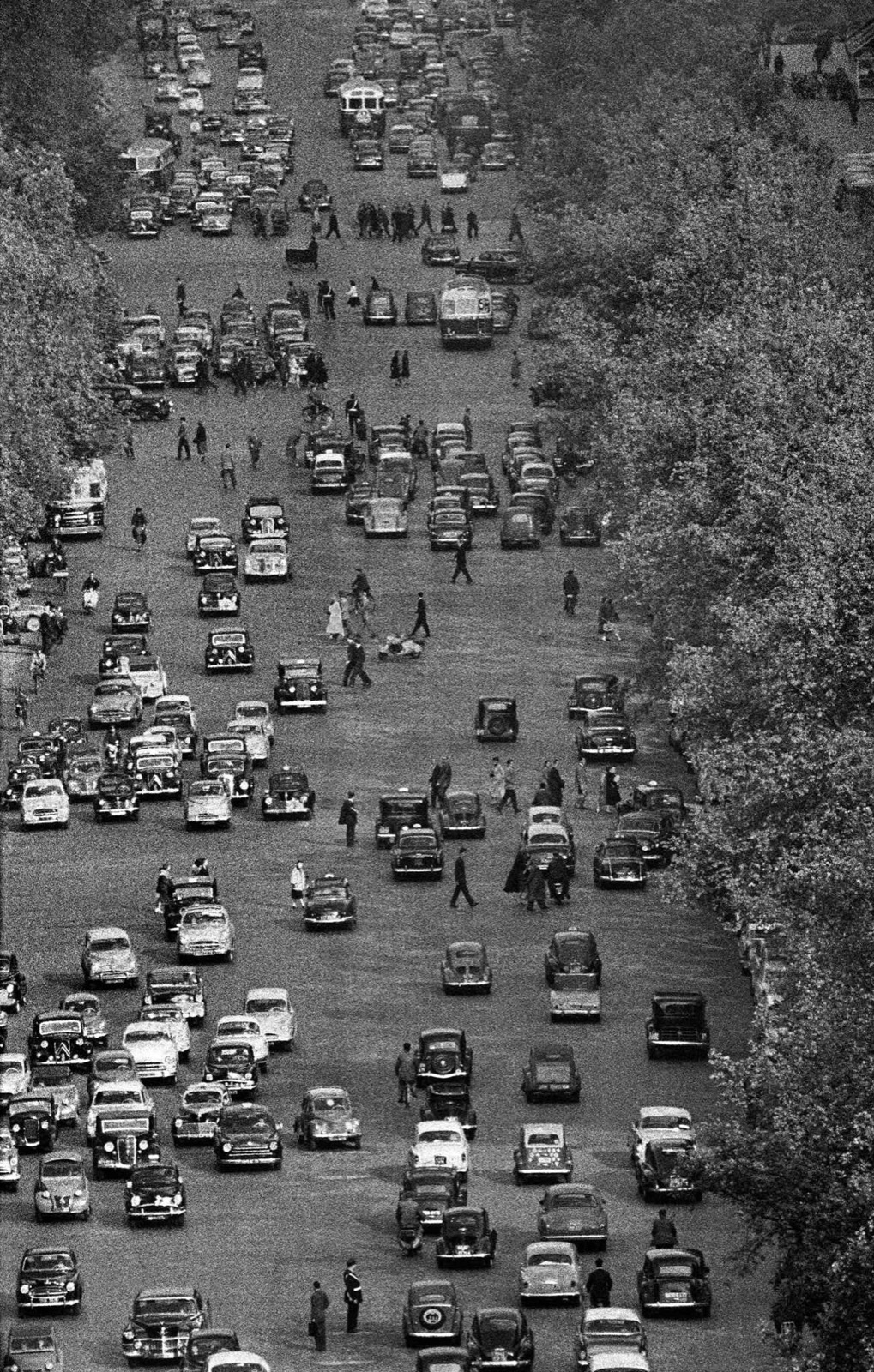
Look how small the man in the white coat is, down at the bottom of the frame, planted in the road with his arms out like a conductor nobody can hear. He's the traffic cop, and around him the Champs-Élysées has dissolved into a glittering jam of bug-backed Citroëns and Peugeots, hundreds of them, packed nose to tail and shining like beetles after rain. Horvat shot it from up high with a long lens, and the telephoto does the thing telephoto loves to do: it flattens the famous slope into a single dense pelt of chrome and roof, the two ranks of trees pressing in like dark green walls. The boulevard of luxe and strolling has become a metal river that has stopped flowing.
What I keep returning to is the scatter of pedestrians, ant-sized, picking their way across the median and between bumpers with a Parisian nonchalance that reads, at this distance, as pure choreography. One small figure seems to be sitting or sprawled on the grass strip mid-frame, an accident of the eye that the picture refuses to explain. That refusal is the charge of it. Nothing is staged, yet everything composes.
Horvat made his name in fashion through the late fifties, slipping the model out of the studio and into exactly this kind of unruly street, and you can feel the same appetite here, the same instinct for the live city as backdrop. This is his great Paris off-duty, the reportage that fed the glamour. Prints from the boulevard period are scarce and quietly coveted; his estate has been tightly managed, his vintage Paris work long collected by the major museums. A picture that turns gridlock into something you'd happily stare at for an hour.
Look how small the man in the white coat is, down at the bottom of the frame, planted in the road with his arms out like a conductor nobody can hear. He's the traffic cop, and around him the Champs-Élysées has dissolved into a glittering jam of bug-backed Citroëns and Peugeots, hundreds of them, packed nose to tail and shining like beetles after rain. Horvat shot it from up high with a long lens, and the telephoto does the thing telephoto loves to do: it flattens the famous slope into a single dense pelt of chrome and roof, the two ranks of trees pressing in like dark green walls. The boulevard of luxe and strolling has become a metal river that has stopped flowing.
What I keep returning to is the scatter of pedestrians, ant-sized, picking their way across the median and between bumpers with a Parisian nonchalance that reads, at this distance, as pure choreography. One small figure seems to be sitting or sprawled on the grass strip mid-frame, an accident of the eye that the picture refuses to explain. That refusal is the charge of it. Nothing is staged, yet everything composes.
Horvat made his name in fashion through the late fifties, slipping the model out of the studio and into exactly this kind of unruly street, and you can feel the same appetite here, the same instinct for the live city as backdrop. This is his great Paris off-duty, the reportage that fed the glamour. Prints from the boulevard period are scarce and quietly coveted; his estate has been tightly managed, his vintage Paris work long collected by the major museums. A picture that turns gridlock into something you'd happily stare at for an hour.