Gelatin Silver Print. Printed 1989.
Image: 15.2 x 22.5 cm / 6 x 8 7/8 in / Paper: 20.3 x 25.4 cm / 8 x 10 in
Annotated by the artist in pencil, and RKM Archive authentication stamp with initials of Vicki Harris, Director, print date, and edition number in pencil on print verso
© The Artist

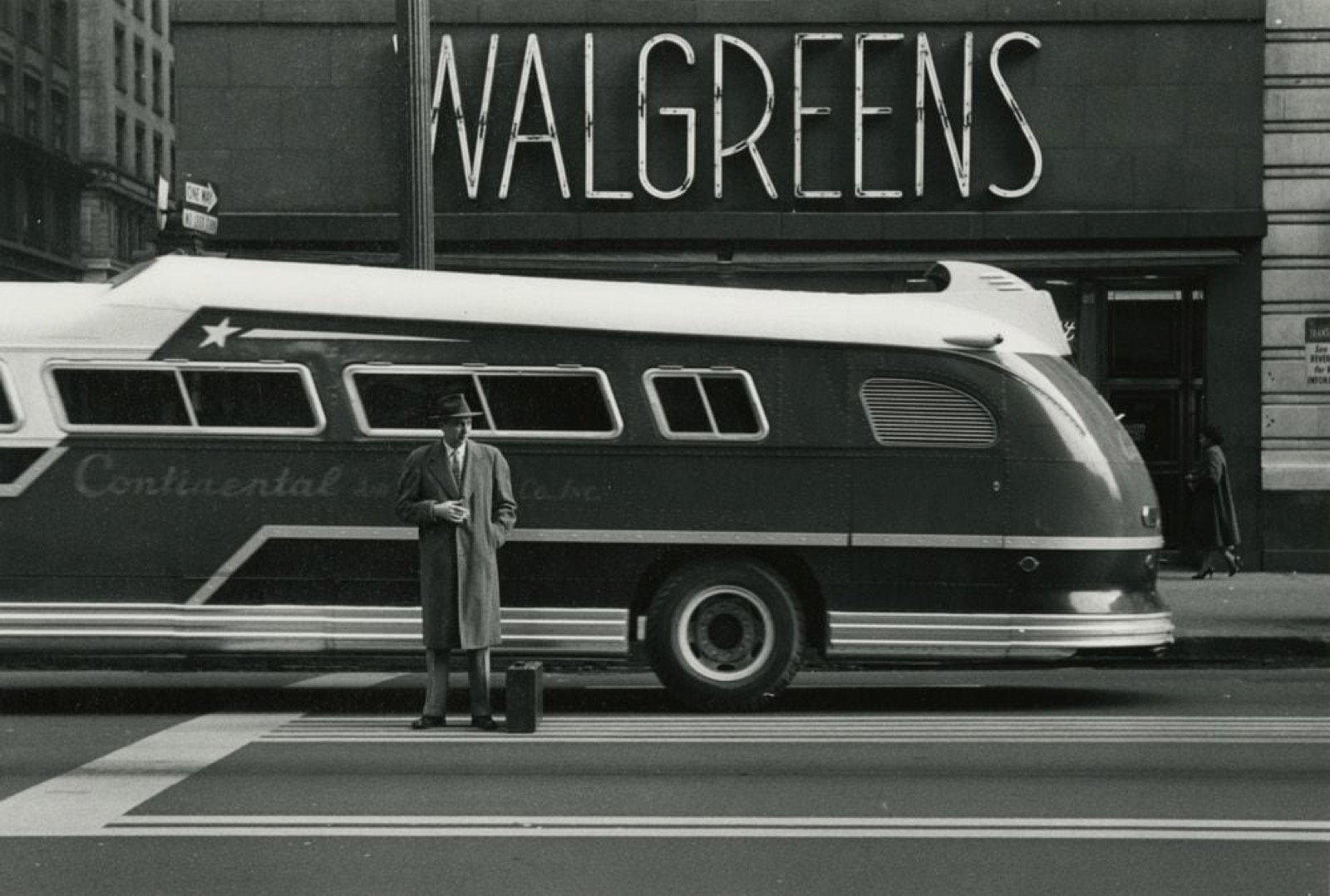
Look first at how the picture is divided. A great chrome-and-steel coach fills the middle band of the frame, parked broadside across its whole width, its prow nosing toward a dark doorway that swallows the last light. The neon WALGREENS sign rides the top edge in clean capitals, the only bright note in a register of flat stone and shadow. Below, dead center, stands one man in a belted overcoat and snap-brim hat, a small suitcase by his foot. He is dwarfed—deliberately—by the bus, a single vertical dropped into a strong horizontal world, and the eye keeps returning to him because every line of the composition quietly agrees to meet there.
The image is built of bands stacked one on another: the masonry facade, the curtained coach windows like a strip of film frames, the dark flank lettered Continental, the wheel low against all those straights, the crosswalk stripes spreading toward us. Every value is described with care—cool street grays, the highlight rolling along the roofline, the velvet black of the open entrance. This is the rigor of a particular Chicago classroom, where a generation learned to make the camera answer to its own frame and treat the street as a problem in light and geometry.
What holds the picture is the tension between that patient figure and the machine of departure idling at his back—stillness against the promise of motion, a person small inside the architecture of a modern city. An early work, made as he began testing how much order a single negative could carry, it already shows the hand later gathered into the great museum collections. A vintage print like this—made near the moment of exposure, its blacks dense, its whites unhurried—is the form in which that seeing survives intact.