Series: Bay / Sky
Archival pigment print. Printed later.
Edition of 20
20 x 24 in / 50 × 60 cm
Edition of 10
30 x 40 in / 76 × 101 cm
Edition of 5
48 x 60 in / 121 × 152 cm
Edition of 3
60 x 75 in / 152.4 x 190.5 cm
20 x 24 in / 50 × 60 cm
Edition of 10
30 x 40 in / 76 × 101 cm
Edition of 5
48 x 60 in / 121 × 152 cm
Edition of 3
60 x 75 in / 152.4 x 190.5 cm
Hand-signed by artist, mounted, titled, editioned and print date in ink label affixed to mount verso
© The Artist

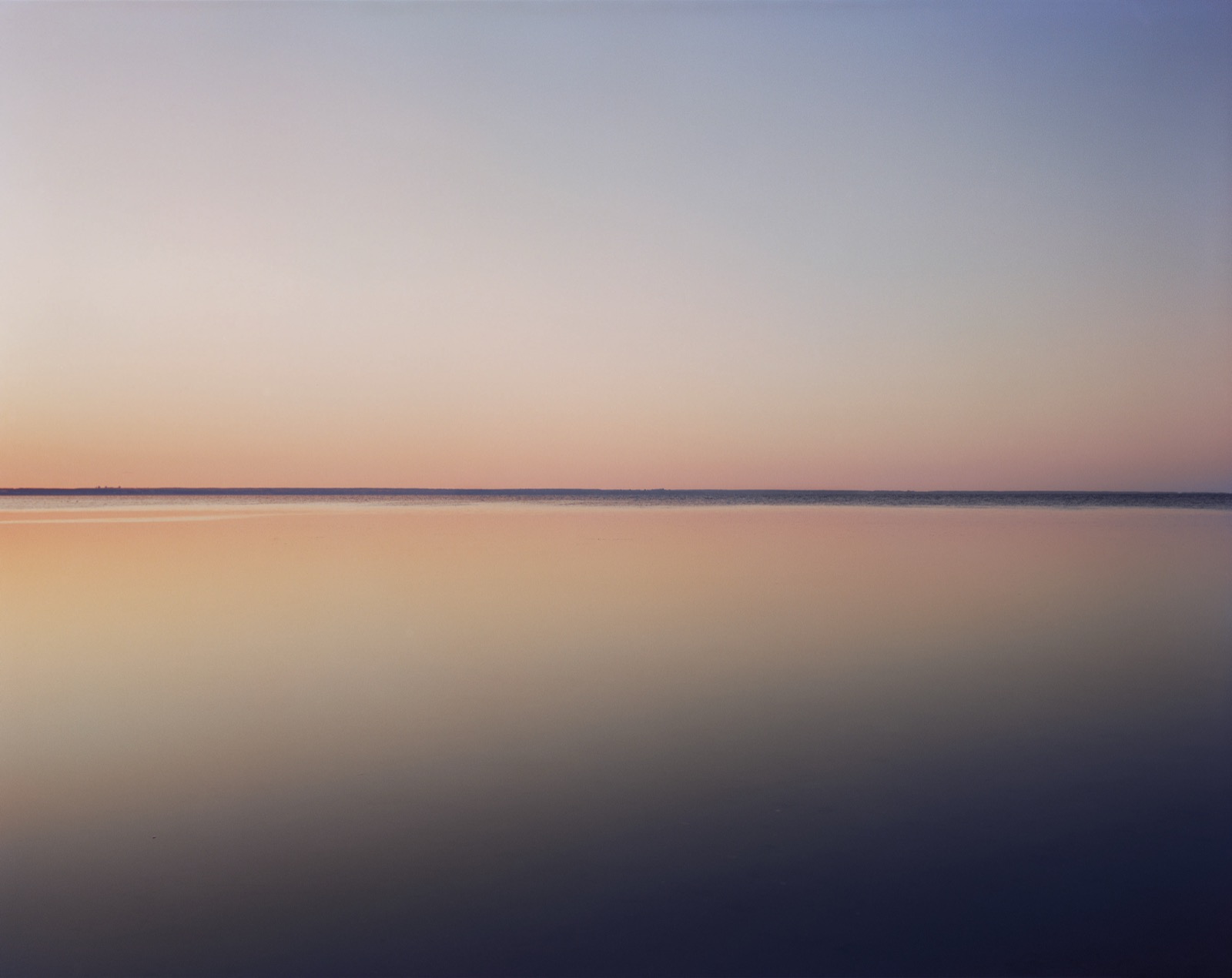
Colour does all the structural work here, and it does so with no edge to lean on. The sky descends through register after register — a cool, powdered lilac at the top, bluer at the upper corners, then warming as the eye falls until it pools into a band of peach and faded rose above the waterline. Nothing is brushed; the gradients are so even they read as a surface dyed rather than lit. Across the centre runs the single hard fact in the frame: a low, dark seam of distant Provincetown shore, barely thicker than a pencil line, one faint cluster of lights pricking it at the left.
Below that seam the bay answers the sky almost note for note, but slowed and dimmed, the way a memory returns a colour without its heat. The water is glass. It lays the coral horizon back as a softer coral, the lilac as a heavier, more violet version, so the picture folds along its own midline into a near-symmetry that is not quite symmetrical — the lower half denser, more saturated, weighted toward the deep blue-grey that gathers at the foot of the print. This is the hour after the sun has gone, when there is no source to point to, only an even afterglow that bay and air share equally.
Made in 1984 within Meyerowitz's long Bay/Sky project, the image proposes the horizon as a readymade — a found minimalism the world delivers ready to be framed. He stations the camera where the only event is a tonal one, then trusts a single transit of colour to hold the whole rectangle. The result reads less as a record of a place than as a deliberate object: a flat field tuned to the moment when warmth and coolness change rank, and the bay stops being scenery and becomes pure, lapidary colour.