Ramón Masats Spanish, 1931–2024

Museo Del Prado, 1965.
Series: 65 - Madrid
Gelatin Silver Print. Printed Later.
Edition of 15
30 x 40 cm / 11 3/4 x 15 3/4 in

Edition of 5
50 x 60 cm / 19 3/4 x 23 5/8 in
Ramón Masats Estate dry stamp, signed and authenticated by Sonia Masats with title and edition number in pencil on label affixed to print verso
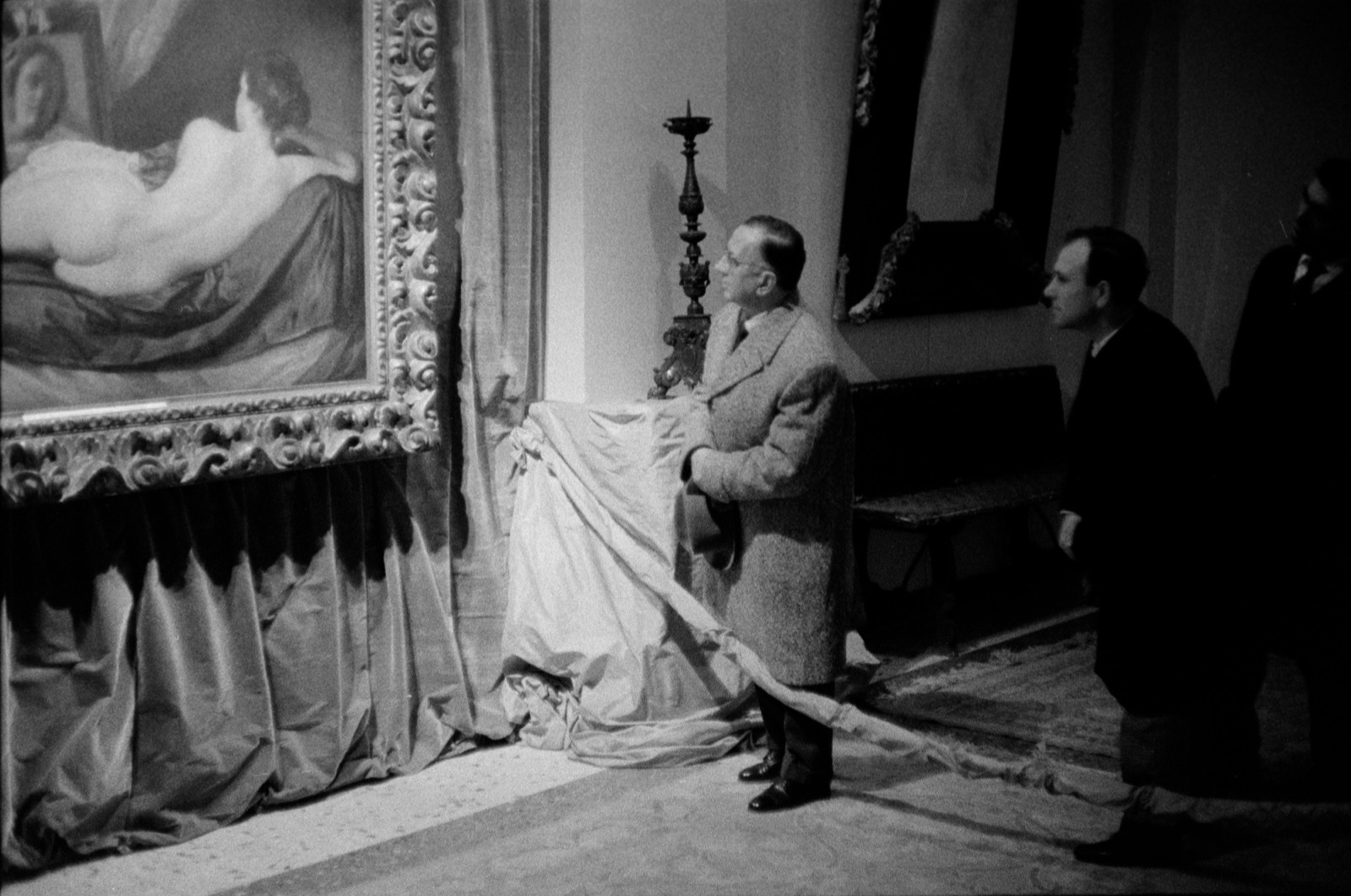
A man in a heavy tweed coat stands at the center of the Prado, and a pale cloth pools at his feet and spills toward us across the floor, as if he had only this moment let it fall. He could be a sitter who has shed a robe, or an attendant caught mid-gesture, or simply a visitor whom the gallery's hush has turned into furniture. Beside him a candlestick rises like a second, thinner body. And to his left, framed in gilt scrollwork that curls and breaks like surf, lies the painted woman: Velázquez's Venus, her back to the room, regarding herself in a mirror she will not share with us.

So there are two nudes the man might attend to and he attends, it seems, to neither. He looks up and away, past the frame, while the painted body offers its long uninterrupted line to anyone who enters. This is what a museum does, Masats notices in 1965: it grants permission. It lets the clothed and the careful stand for as long as they like before what would, elsewhere, be forbidden them. The two men to the right, one stepping into the light, one swallowed by the dark, complete the small choreography of the educated gaze.

Masats was among those who taught Spain to see itself past the brittle pieties of its official image, and his eye here is patient rather than ironic. He keeps the velvet, the worn carpet, the heavy drapery whole, and lets the picture breathe in its grays. What he gives us, finally, is not the Venus but the room around her: the long apprenticeship of looking, and how much of ourselves we leave behind in it, like a dropped cloth.