Louis Faurer American, 1916–2001

14th Street, Horn & Hardart, New York City, 1947.
Series: The Light Suite
Gelatin Silver Print. Printed by Chuck Kelton, 1980-81.
Image: 21 x 30.3 cm / 8 1/4 x 11 7/8 in / Paper: 28 x 35.5 cm / 11 x 14 in
Signed, titled, and dated in pencil on the reverse
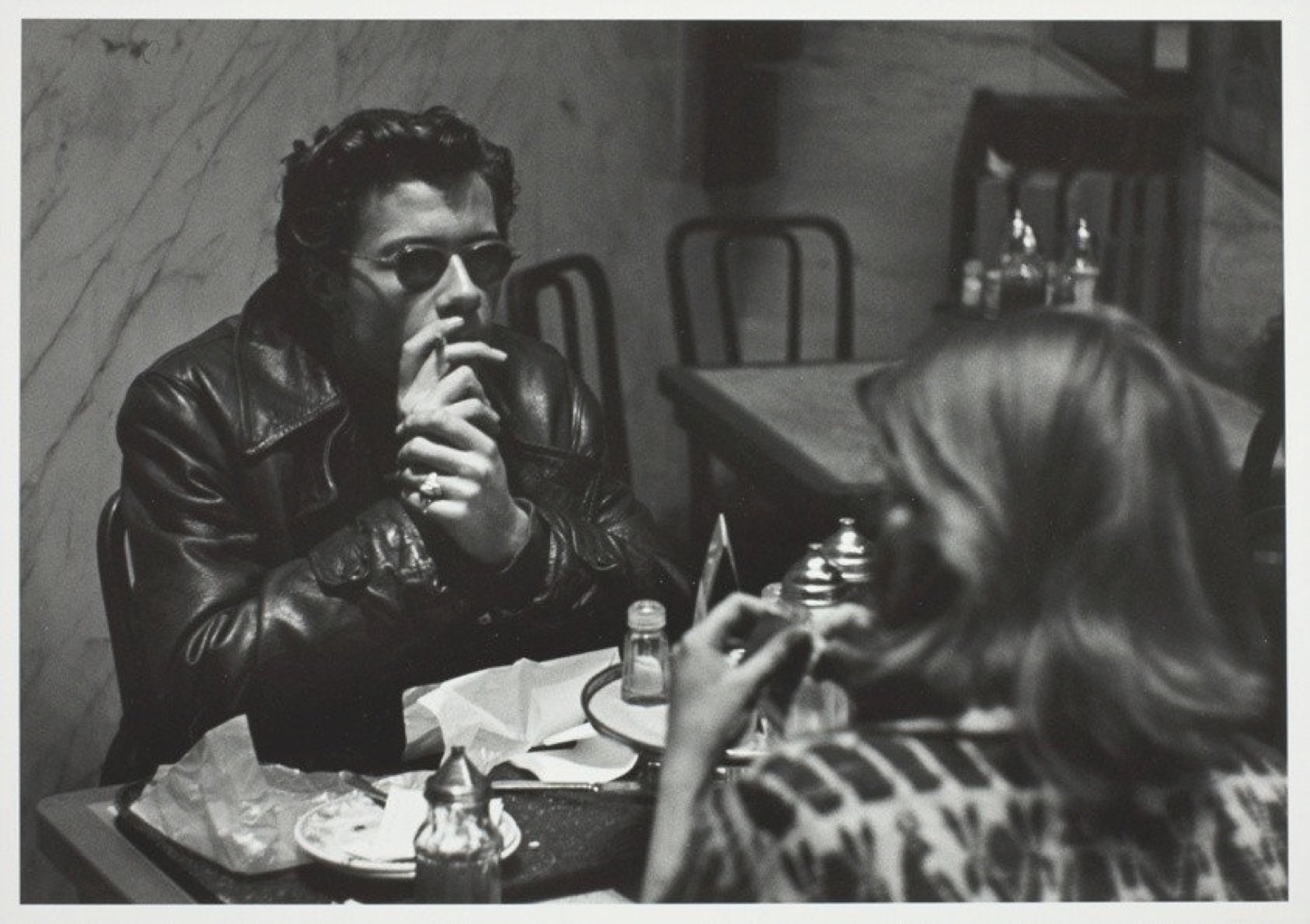
What is the young man in the leather jacket protecting himself from? He sits at a marble-walled Horn & Hardart on Fourteenth Street, hands clasped against his mouth as if to seal it, his eyes hidden behind dark glasses worn indoors, at night. A ring catches what little light there is. Across the table, turned away from us and dissolved into blur, is the blonde whose company he keeps and whom, in this instant, he is not looking at. Faurer has photographed not a conversation but its suspension.

The automat was democracy's dining room, a place where anyone with coins could sit among strangers, and Faurer returned to such interiors because they let private states surface in public. Here the privacy is total despite the proximity. Sunglasses at a supper table are a small scandal of withholding; they convert a face into a façade. We are made to feel that something has just been said, or is being refused, and that the camera arrived at the precise width of that silence.

This is the melancholy peculiar to photographs of the postwar city: two people at one table, each enclosed. Faurer trusted the available darkness, the salt shakers and the litter of the meal, to do the moral work. The image does not explain the man; it preserves his refusal to be explained. Looking long enough, one understands that the photograph's subject is less the couple than the impossibility of knowing, from outside, what passes between any two faces.