Series: Photojournalism
Gelatin Silver Print.
Printed in 2025.
Image: 20 x 30 cm / 7 7/8 x 11 3/4 in / Paper: 30 x 40 cm / 11 3/4 x 15 3/4 in
Frank Horvat Estate dry stamp, signed and authenticated by Fiammeta Horvat with title and edition number in pencil on verso
© The Artist
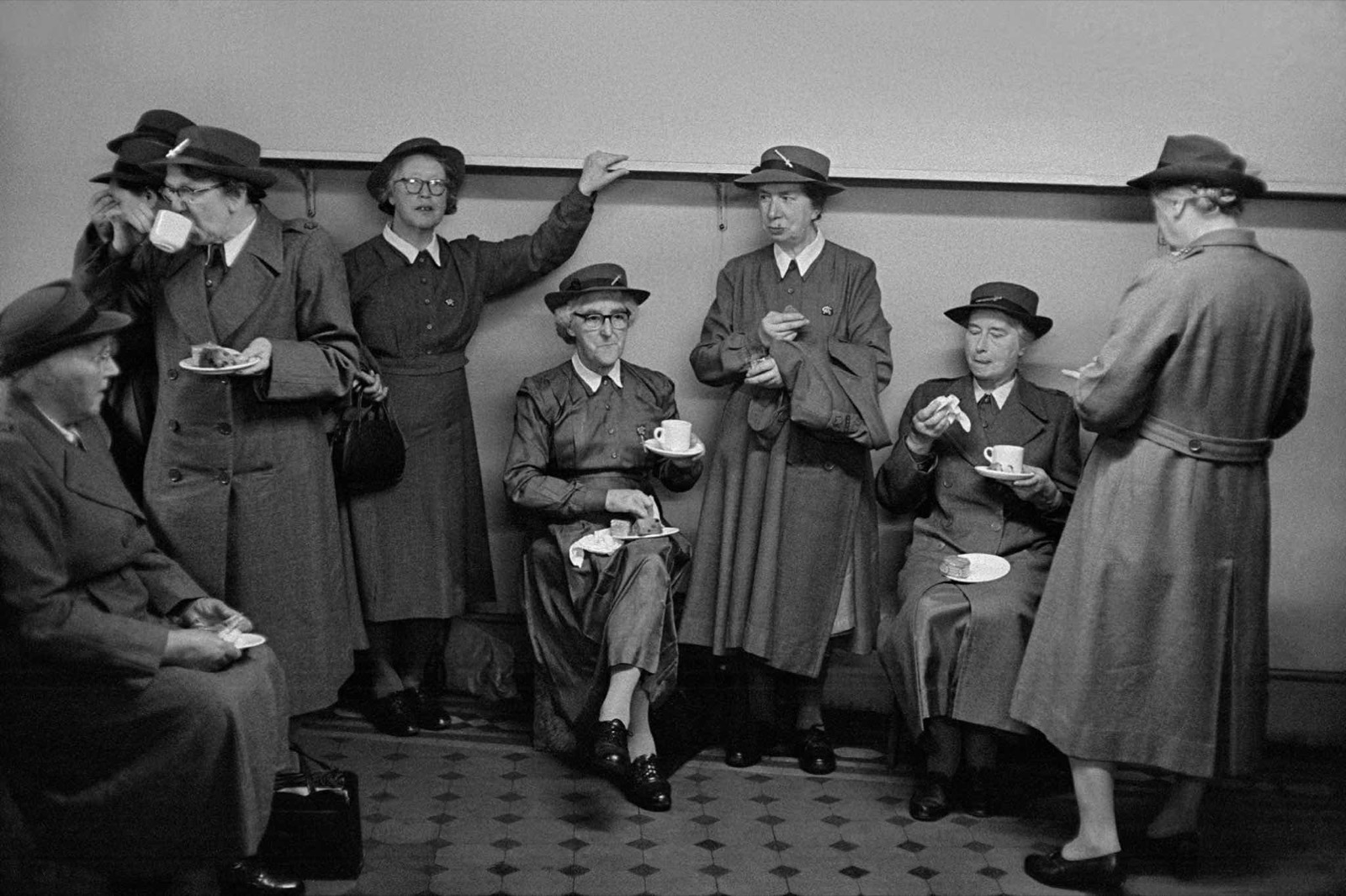
Look at the arm. One of the Salvation Army ladies has reached up and hooked her hand over the picture rail, casual as a girl at a bar, and the gesture electrifies an otherwise sober row of dark coats and serious hats. That single insolent reach is the whole picture's charge: it tells you these women, cups and saucers balanced with cafeteria expertise, are not posing for anyone. Horvat caught them off-duty, on a break, and the off-duty is exactly where the glamour hides.
Because there is glamour here, of an unexpected order. The brimmed hats sit at seven different angles down the wall, each one cocked to its wearer's temperament — one severe, one rakish, one resigned. A plate of biscuits has just made its rounds. Spectacles flash. A man in a belted mackintosh turns his back to us at the right edge, sealing the group into its private canteen world. It reads like a fashion sitting that forgot it was being photographed, which is the rarest kind, and the kind Horvat — who could make couture breathe on the steps of the Piazza di Spagna — prized above the staged.
That double life is the point. This is the photographer of Paris fashion and the Sphynx brothel turning the same hungry, tender eye on uniformed women in a London hall, finding in their wool and tea the same human theater. The composition is a frieze, deliberate; the gestures are pure accident. Horvat's reportage from these years anchors the major monographs and retrospectives of his work, and frames as alive as this one rarely surface. A modern print of a 1959 negative, it keeps the off-the-cuff voltage of the original look — that arm flung up, still holding the room.